
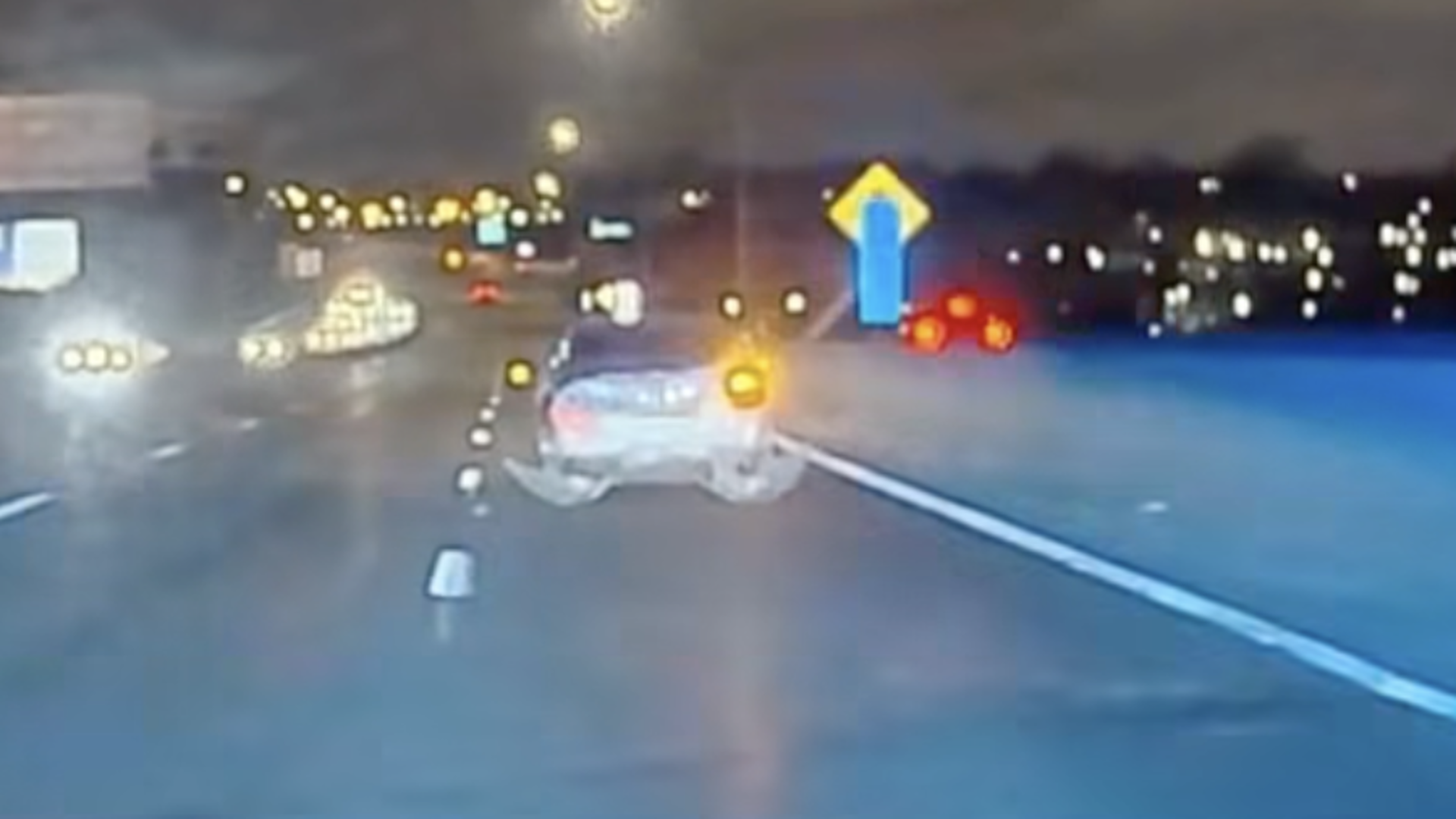
Bryan Noyola-Delacruz ran from a Missouri trooper at 110 mph on I-35 in January. It ended with his car spun out and a trooper’s gun on him, and now he’s headed to state prison for three years, the first 12 months of it with no shot at parole. The Kansas City man admitted one count of aggravated fleeing a stop, the felony Missouri calls Valentine’s Law, according to the Clay County Prosecuting Attorney’s Office, whose announcement KCTV5 reported on Sept. 16.
Two years ago the same drive would have ended differently, and almost certainly not on the far side of the Bond Bridge with a patrol car’s fender in his rear quarter panel. Since then Missouri has done two things. The legislature turned running from a traffic stop into a felony with a locked year in it, and the Highway Patrol, which for years did not let troopers spin fleeing cars out, began training every one of them to do exactly that. Clay County is where those two changes meet most often.
From Parvin Road to the far side of the Bond Bridge
The prosecutor’s account of Jan. 2, 2026, is short. A trooper clocked a tan Honda Accord at 80 mph in a 55 mph zone on southbound I-35 near Parvin Road, in the Northland, and tried to stop it. The driver didn’t stop. Prosecutors say the Accord reached 110 mph heading south toward East Front Street, which meant crossing the Christopher S. Bond Bridge, the cable-stayed span that carries I-29, I-35 and U.S. 71 over the Missouri River toward downtown. On the south side, the trooper spun the car out and took the driver into custody at gunpoint. KCTV5’s report includes dashcam video of the pursuit.
Related Articles
- Your EV Accidentally Jams AM Radio. The House Just Voted to Make Automakers Keep It Anyway.
- Stellantis Lined Up an Armored-Vehicle Builder for Brampton. Now It Needs the Union to Sign.
By the interstate’s mile markers, Parvin Road to the Front Street exit is a little over three miles, which at 110 mph takes less than two minutes. The county line runs down the middle of the river, so the flight began in Clay County and the spin-out happened in Jackson County. Clay County prosecuted anyway, which Missouri’s venue statute permits when an offense crosses county lines: any county where an element of the crime occurred can bring the case. That matters here, because the office that got the case is the one that has made this statute its signature.
What the felony did to a speeding ticket
On paper, 25 over on a Missouri interstate is a class B misdemeanor under RSMo 304.010: up to six months in jail and a $1,000 fine, though in practice it means a fine, court costs and points on the license.
Once the trooper’s lights came on and the Accord didn’t slow, the case moved into a different chapter of the code. Before Aug. 28, 2024, fleeing a stop in a car was charged as resisting under RSMo 575.150: a class A misdemeanor, bumped to a class E felony worth up to four years if the flight created a substantial risk of serious injury or death, with probation on the table.
Valentine’s Law, RSMo 575.151, created a separate offense. Fleeing an officer “at a high speed or in any manner which creates a substantial risk” of serious injury or death is a class D felony, which under RSMo 558.011 carries up to seven years. Then the section does something the old law never did: it forbids probation, parole or conditional release until the defendant has served at least one year. If the flight injures someone, the charge becomes a class B felony, five to 15 years. If it kills someone, class A, 10 to 30 years or life.
Two other lines in the statute do most of the work in a case like this one. A driver is presumed to be fleeing once he keeps going after he saw, or should have seen, the emergency lights, or heard the siren. And it is no defense that the officer was acting unlawfully; the statute says a person need not know why he is being stopped, only that he is. The legislature moved the argument over whether the stop was legal off the highway and into the courtroom, after the fact.
The law arrived in SB 754, a public-safety bill sponsored by Sen. Tony Luetkemeyer, R-Parkville, and signed by Gov. Mike Parson on July 9, 2024. It is named for St. Louis County Detective Antonio Valentine, who died Dec. 1, 2021. The state’s own award citation for him records that the detectives who tried to stop the stolen car were not chasing it; they had let it go because of its speed. The driver crossed the centerline into Valentine’s unmarked vehicle anyway. The people who wrote the statute point to that crash as proof the danger is the flight, whether or not a police car is behind it.
The Patrol started spinning cars out in 2025
The spin-out is the newer change. The Patrol calls it tactical vehicle intervention, TVI; most people call it a PIT. The pursuing car lines its front fender up with the fleeing car’s rear quarter panel and steers into it. Push the rear tires past their grip and the car rotates, and the driver goes from 110 mph to sitting sideways on the shoulder with a trooper’s pistol pointed at him.
Missouri troopers did not do this until last year. In April 2025, the Department of Public Safety said the Patrol’s academy had begun training in TVI with instructors from the Oklahoma Highway Patrol, which has used the technique since 1998, KY3 reported. DPS Director Mark James, appointed by Gov. Mike Kehoe that January, described the goal as ending chases before they run across two or three counties. “We are gonna start putting people in ditches,” he said, according to KOAM, which reported that the Patrol had not previously allowed its troopers to use the maneuver. Nine months later a trooper used it on the Accord. We couldn’t find a published speed threshold for TVI from the Patrol.
Agencies draw that line in very different places. The Los Angeles County Sheriff’s Department’s manual allows a PIT only when both cars are doing 35 mph or less and a watch commander approves. The Kansas City Police Department’s pursuit directive, in the version posted on its website and dated June 2019, tells officers not to start a pursuit for a serious traffic violation unless the occupants were involved in a dangerous felony or present a clear and immediate danger, and reserves TVI for violent felony offenders. Had a KCPD cruiser been behind that Accord instead of a trooper, department policy pointed toward letting it go and filing a warrant later. Which badge is in the mirror decides what happens next.
The Auto Wire has watched enough trooper dashcam to know the tactic carries risk for the person performing it. An Arkansas trooper flipped his own cruiser attempting a PIT at roughly 130 mph, and another Arkansas spin-out sent both vehicles airborne. The physics that stop the runner can stop the trooper too.
The Supreme Court settled the constitutional question in 2007
If the driver wanted to sue over the bumper, the Supreme Court closed most of that road in a case that began the way his did. In Scott v. Harris, a Georgia deputy clocked a 19-year-old at 73 in a 55 in March 2001. The driver ran. Six minutes and nearly 10 miles later, a second deputy got permission to PIT him, judged the speeds too high to do it safely, and rammed him from behind instead. The car left the road and rolled, and the driver was left a quadriplegic.
The Court ruled 8–1 in April 2007 that the deputy had not violated the Fourth Amendment. Justice Scalia’s opinion set the rule still in force: an officer’s attempt to end a dangerous high-speed chase that threatens bystanders is constitutional even when it puts the fleeing driver at risk of serious injury or death. The Court refused to require police to break off and hope, reasoning that such a rule would tell every runner that escape was his if he drove recklessly enough; the Constitution, Scalia wrote, does not extend “this invitation to impunity-earned-by-recklessness.”
The Constitution therefore leaves the spin-out to agency policy and the officer’s judgment in the moment, and Missouri just moved the policy.
Clay County leads Missouri in chases, and in these cases
Prosecutor Zachary Thompson told reporters in May that Highway Patrol data show Clay County logged more pursuits than any other Missouri county from 2020 through 2025, WDAF reported. His office has “the dubious distinction of being number one in the state,” he told KCTV5. Thompson said the office filed 76 Valentine’s Law cases in the statute’s first 11 months, about one every four days, and had charged 35 people under it in 2026 by mid-May, three of them in one 72-hour stretch. One of those three is accused of hitting about 130 mph after a trooper clocked him at 90 in a 55 on I-35 while street racing, according to police reports cited by WDAF. Those are charges, not convictions.
Related Articles
- Diesel Just Hit a Record $6.53. Before You Panic-Buy an EV, Read the Window Sticker.
- Lucid Promised Bolt 25,000 Robotaxis. Europe Only Lets It Register 1,500 a Year.
The sentences are landing. Andres Galvan-Zuniga got four years in May for a February 2025 run from Clay County deputies that reached 103 mph in a 35 zone. Kara Crow got five years last week for a chase on the same day as the Accord run, Jan. 2, that also passed 100 mph, plus two consecutive years in a separate drug case. Three years for Noyola-Delacruz sits at the low end of what the office has been getting.
What it means for the next driver who sees blue lights
Noyola-Delacruz goes to the Missouri Department of Corrections on a three-year term, and the parole board cannot consider him before the one-year mark. He pleaded guilty rather than test the statute at trial, and KCTV5’s report of the announcement includes no statement from his attorney.
For everyone else, here’s the law in one sentence: keep going after the lights come on, fast enough to put anyone at risk, and you’ve bought a felony with a locked year attached, even if nobody’s hurt and even if the stop was unlawful. The tactic that ends the run is now in every trooper’s training file. Other states draw these lines elsewhere; several treat a first eluding offense as a misdemeanor, and some big agencies still forbid PITs at highway speed, so the rules change with the badge and the border.
Missouri has decided that a driver who won’t stop for a speeding ticket should be spun out by the trooper and then serve a mandatory year. Is that the right answer to the flight itself, or should the spin-out and the locked year be saved for drivers who have already hurt someone?
Images Via: Zachary Thompson Clay County Prosecutor on Facebook