
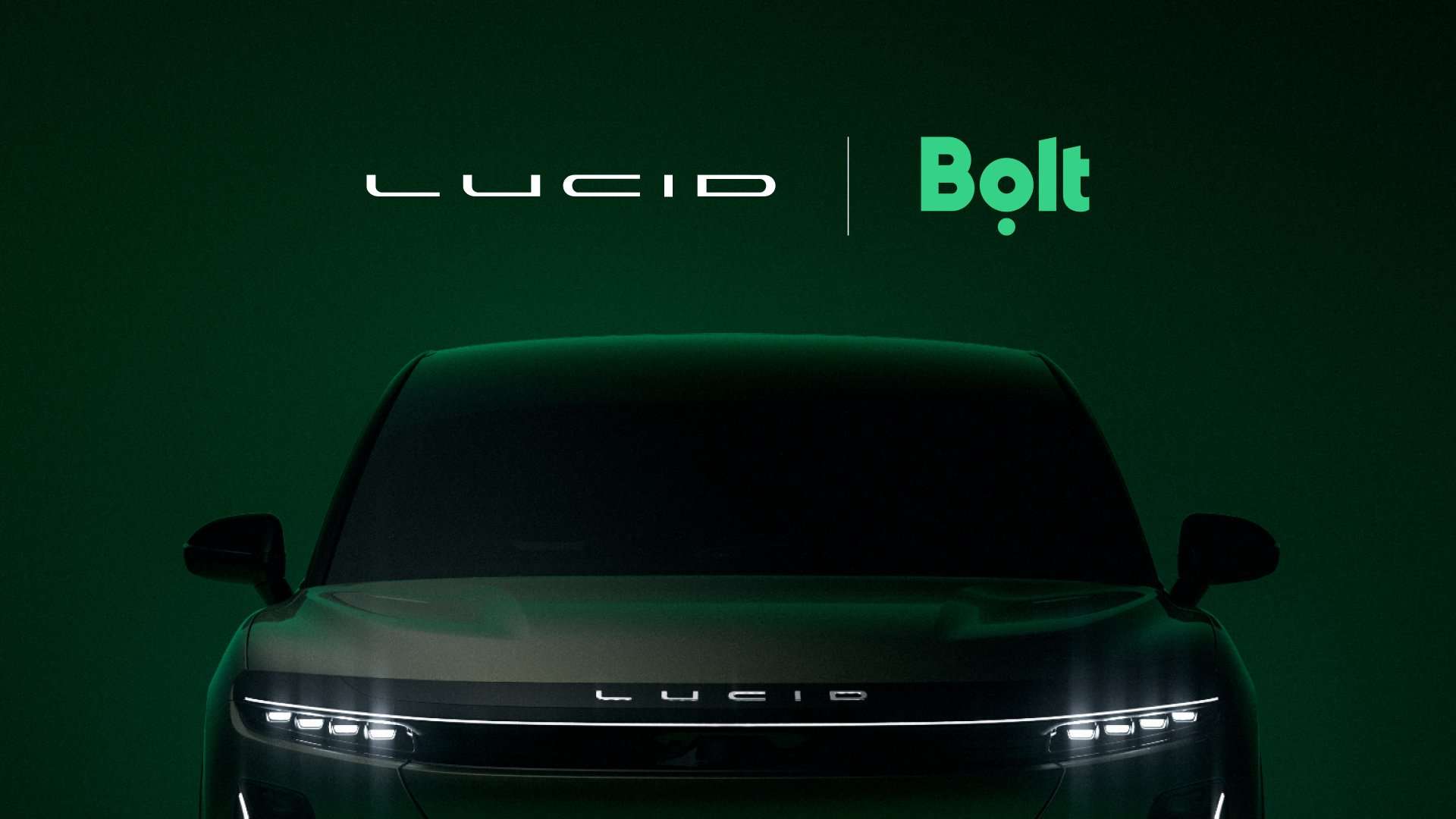
Lucid has spent five years learning how hard it is to sell a lot of expensive electric cars one buyer at a time. Its new partnership with Bolt is the clearest sign yet that the company is done waiting for those buyers to arrive on their own.
On September 17, Lucid and Bolt, the Tallinn-based ride-hailing company, announced that Bolt intends to put at least 25,000 fully driverless Lucid vehicles into service across Europe. The cars will come from Lucid’s Midsize platform, the sub-$50,000 architecture that hasn’t reached production yet. Bolt plans to own and run the fleet.
Twenty-five thousand is a big, round, headline-friendly number. It is also, for now, more of a destination than a delivery schedule. The release names no launch year, no cities, and no financial terms. And it lands in a region whose own type-approval rules currently let a driverless vehicle model register only 1,500 units a year.
The gap between the promise and the paperwork matters, and so does what the promise says about Lucid.
What was actually agreed
Strip out the adjectives and the announcement contains a handful of concrete commitments. The two companies will co-develop what they call an “ADS-ready” vehicle, meaning one designed from the start to host an automated driving system, targeting SAE Level 4 operation. That’s the level where the car drives itself within a defined area with no human expected to take over. The platform is expected to use NVIDIA’s Hyperion reference architecture, a packaged combination of computing hardware and a standardized sensor set.
Bolt’s new autonomous unit will define vehicle requirements, software, safety and rider experience, then build the depots, operating systems and city relationships. On Lucid’s side, a division called Lucid Technologies, which gathers the company’s AI, driver-assistance, autonomy and digital work, will lead.
Everything else is aspiration. The word the release leans on is “aims,” which is corporate for “we’d really like to.” Bolt frames the 25,000 cars as a step toward its broader goal of 100,000 autonomous vehicles on its platform by 2035.
That’s not a criticism. Early partnership announcements are rarely purchase orders. But readers should know the difference, and so should anyone valuing Lucid on it.
Lucid’s most important new customer doesn’t need a test drive
Add this deal to Lucid’s existing robotaxi agreement with Uber and Nuro, which the companies expanded in April to at least 35,000 vehicles, and Lucid now has public ambitions for roughly 60,000 driverless cars across two fleet partners.
Compare that with what Lucid builds today. In the second quarter of 2026, the company produced 4,774 vehicles and delivered 3,953, deliberately slowing output to work down inventory. At that pace, 60,000 cars is more than three years of Lucid’s entire production.
The same quarter shows why fleets are so appealing. Lucid reported $405 million in revenue against a $1.03 billion net loss, announced a workforce reduction in June, and laid out an “operational reset” aimed at $1.4 billion in cash improvements this year. It told investors its $3.0 billion in liquidity lasts “well into 2027.” Of the four strategic priorities it listed, the robotaxi program was one; the Midsize platform was another.
The logic is plain. A new vehicle platform is a bet that enough buyers will show up to fill the factory. Private buyers show up a few at a time and have to be persuaded, financed and serviced one by one. A fleet operator that has publicly committed to tens of thousands of units is a volume forecast suppliers and investors can see. Lucid has spent five years selling cars one buyer at a time. It is now trying to sell them by the tens of thousands, one fleet at a time.
Lucid said as much in March, when it listed robotaxi partnerships and platform licensing among the recurring revenue streams it wants the Midsize program to support, and showed Lunar, a two-seat robotaxi concept built on the same architecture. The company’s own numbers explain why efficiency matters so much in that pitch: Lucid says the battery pack makes up 30 to 40 percent of an EV’s cost, so a car that needs a smaller pack to cover the same miles is cheaper to buy and cheaper to charge. A private owner might notice that at the dealership. A fleet operator notices it on every shift.
The 1,500-car ceiling
Now for the part neither company got around to mentioning.
The European Union does have a legal path to put driverless passenger cars on the road. Implementing Regulation (EU) 2022/1426 sets out how the automated driving system of a fully automated vehicle is type-approved. It covers three use cases: vehicles operating within a predefined area, vehicles running hub-to-hub on fixed routes, and automated valet parking. A robotaxi serving a city zone fits the first.
The catch is volume. Those approvals were written as a small-series scheme. In an amendment adopted this March, the Commission restated the condition plainly: the scheme’s derogations apply only as long as registrations of a vehicle type in the EU do not exceed 1,500 per year. The same amendment lifted that cap for exactly one use case, automated valet parking. Robotaxis remain under it.
Do the arithmetic. At 1,500 registrations a year, a single vehicle type would take nearly 17 years to reach 25,000 on EU roads. That’s not a rollout. That’s a career. Bolt’s 2035 target of 100,000 vehicles across all its partners would require the rules to change, or for the fleet to be spread across many separately approved types.
The rules probably will change. The March amendment explicitly treats lifting the small-series limit as a step-by-step process, starting with parking. But it is a political and technical process that neither Lucid nor Bolt controls, and it helps explain why the announcement carries no dates. Europe did not build a highway for driverless cars. It built an on-ramp with a gate across it, and it opens that gate one use case at a time.
That’s also why Bolt keeps stressing “European terms.” On its autonomous solutions page, the company argues that driving models trained elsewhere don’t transfer cleanly to Europe’s signage, lane markings, weather and regulation, and it is gathering partners accordingly: Stellantis and NVIDIA earlier this month, and Pony.ai for testing in Luxembourg. Lucid is one supplier in a portfolio, not an exclusive.
Why “ADS-ready” is the phrase that matters
If you build cars, the most interesting line in the release is the one about working together “from the product-development stage.”
Retrofitting autonomy onto a car designed for a human driver is possible. It is also a compromise. A Level 4 vehicle has no person to fall back on, so the systems that keep it safe when something fails, including power supply, steering and braking, have to be planned into the architecture, along with space, cooling and wiring for the compute and sensors. Doing that after the platform is frozen means redesign, added cost and delay. Doing it up front is cheaper, but only if you know what the customer’s autonomy stack will need.
That’s what makes Lucid’s arrangement significant. In the United States, Lucid’s Gravity is being fitted with Nuro’s driving system for Uber. In Europe, Bolt is building its own autonomy business on NVIDIA’s platform. If Lucid can design one Midsize vehicle that hosts both, it becomes something closer to a platform supplier than a luxury brand, and it collects on engineering it would have done anyway.
There is a practical side for anyone who repairs or insures these vehicles, too. Fleet robotaxis don’t go to the corner body shop. Uber, for example, has secured a 50,000-square-foot depot in Houston for maintenance, repairs and cleaning of the Lucid–Nuro fleet. Collision repair on a sensor-covered car means recalibration, and downtime is lost revenue. Expect the fleet operators, not the automaker, to own that business, and the insurance risk that comes with it.
Who wins, and who waits
Bolt gets a purpose-built vehicle it helped specify, and a credible hardware partner for pitching regulators and cities. It also takes on the capital cost of owning the fleet, which is where the real money and risk in ride-hailing autonomy sit.
Lucid gets a second large fleet customer at the moment it most needs to show volume for a platform that isn’t in production. That’s worth something even before a single car is built. But the deal also ties Lucid’s growth story to two things it doesn’t control: autonomy software that still has to prove itself on European streets, and a regulator that has so far lifted its volume limit only for parking garages.
The people who wait are Lucid’s traditional customers. The Midsize platform was pitched as the affordable Lucid for private buyers. It still is. But the company’s most concrete volume commitments for it now come from companies planning to remove the driver entirely. For a brand that has had a rough year on quality and saw its shares take an outsized hit on tariff news, that’s a revealing shift in who it’s building for.
It also fits a broader pattern. Ride-hailing companies are reorganizing around autonomy, and even the purpose-built robotaxi developers still train their software on conventional vehicles before the real product reaches the street. Everyone wants the fleet. The vehicles, the software and the permissions are arriving on different schedules.
The number that matters
Forget the 25,000 for a moment. The number that matters is 1,500.
Until Brussels lifts its small-series ceiling for vehicles like these, no European robotaxi plan, from Bolt or anyone else, can scale the way its press release implies. What Lucid and Bolt have really announced is a bet on how quickly that ceiling rises, and a bet by Lucid that its future customer is a fleet operator rather than a driver.
The cars may be ready before the rulebook is. For Lucid, that might be the easier part.
So which side are you on: should Europe lift the 1,500-car cap and let robotaxi fleets scale, or is that cap the only thing keeping a big-number press release from turning into 25,000 unproven driverless cars on city streets?
Image via Lucid Motors.