
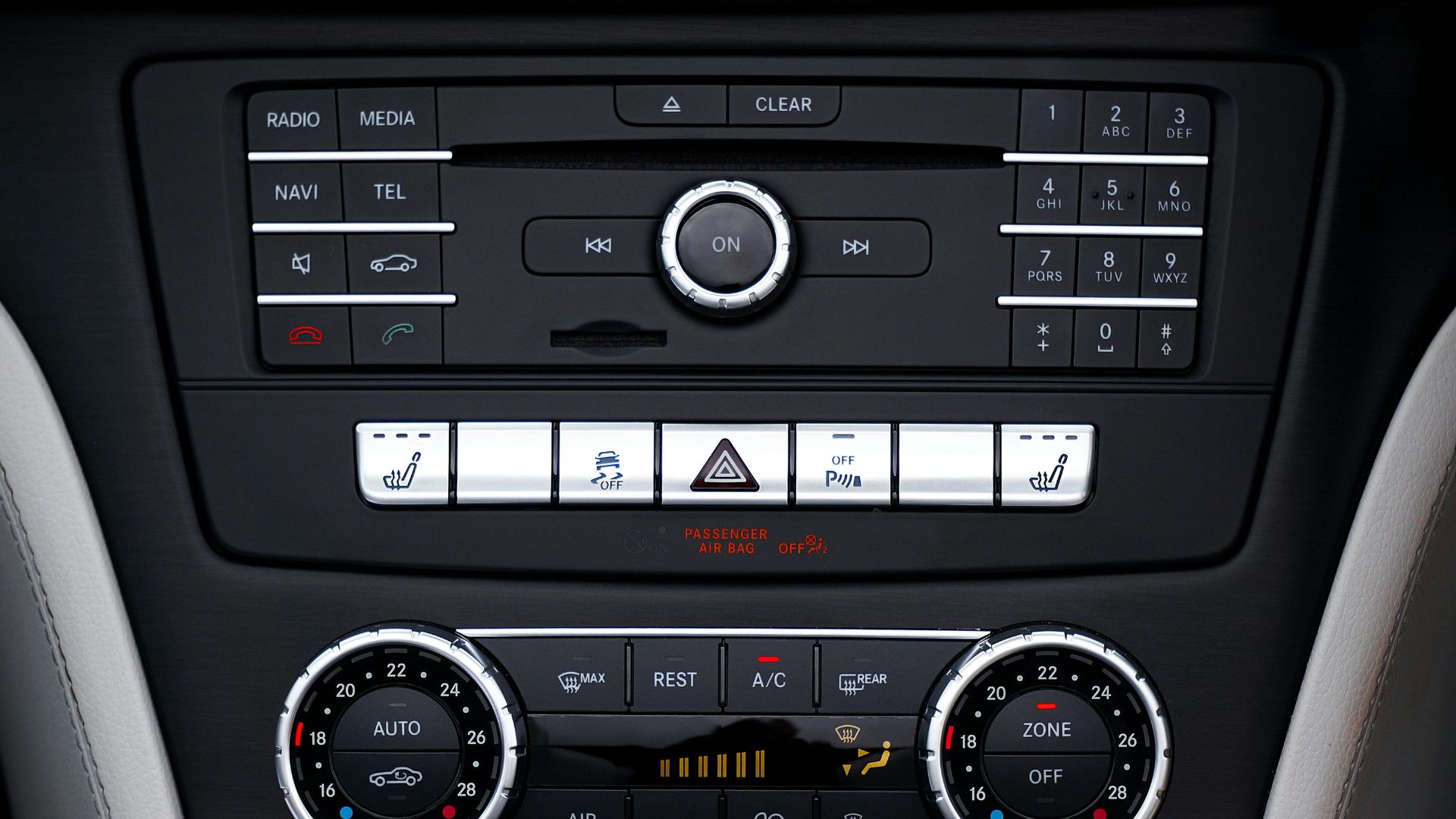
Every electric car on the road is, in a small and entirely accidental way, a radio transmitter.
Its inverter slices direct current from the battery into the alternating current the motor wants, switching on and off thousands of times a second. The electrical noise left behind by all that switching, by the automakers’ own admission, spills into the same stretch of spectrum that AM stations have occupied since before the interstate highway system existed. Tesla told a U.S. senator in 2023 that EV drivetrains produce electromagnetic waves that interfere with AM signals. Volvo said that keeping AM would likely have meant “EMC disturbances” in its battery-electric and plug-in hybrid models.
Set aside the speeches about nostalgia, and that noise is what the U.S. House of Representatives voted on this month.
The bill is called the AM Radio for Every Vehicle Act, and most of the talk around it has been about emergency alerts, rural listeners, and Friday-night football on a 50,000-watt signal. All of that is real. For anyone who builds, buys or fixes cars, though, the bill says something else: Congress is about to tell automakers that “the motor is too loud” is no longer an acceptable reason to delete a feature.
What the House actually passed
H.R. 979 passed the House on September 15 and was placed on the Senate calendar the next day. It directs the Secretary of Transportation to write a rule, within one year of the bill becoming law, requiring AM reception as standard equipment in new passenger vehicles built for or imported into the U.S. market.
The details:
- “Standard” means free. The bill defines standard equipment as something installed at the factory for no additional or separate fee. AM cannot become a subscription or a paid software unlock. Sorry, product planners.
- Two clocks, not one. Large automakers must comply no more than two years after the rule is issued. Manufacturers that built 40,000 or fewer passenger vehicles for the U.S. market in 2022 get at least four years.
- Disclosure in the meantime. Until the rule takes effect, any new vehicle without AM must carry clear and conspicuous labeling saying so, and automakers may not charge extra for AM access.
- Digital counts, sort of. Automakers can comply with receivers that play hybrid digital AM (the in-band, on-channel system most listeners know as HD Radio). Stations broadcasting in all-digital AM are expressly excluded from that definition.
- A built-in expiration date. The entire act, including DOT’s authority to enforce the rule, sunsets eight years after enactment.
- A homework assignment. The Government Accountability Office must study how emergency alerts reach the public, including the role of FEMA’s alert system and how effective AM broadcasts actually are.
The Senate version is not a long shot on paper. Sens. Ted Cruz and Ed Markey say their companion bill cleared the Senate Commerce Committee in February 2025 and reached 60 cosponsors that April. What it needs now is floor time. The Auto Wire covered the House committee vote last September, and the idea itself dates back to 2023.
How AM became an EV problem
In December 2022, Markey wrote to 20 automakers asking whether they planned to keep AM radio. Eight said they had dropped it or were dropping it, largely from electric models: BMW, Ford, Mazda, Polestar, Rivian, Tesla, Volkswagen, and Volvo. Ford reversed course in May 2023.
The automakers’ written responses are worth reading, because they are unusually candid about why. BMW cited poor analog AM reception caused by electromagnetic interference. Rivian said the electromagnetism of its EVs overlaps the spectrum AM uses. Several companies pointed customers toward internet radio, streaming apps, and phone-based emergency alerts as substitutes.
The same stack of letters shows the problem can be engineered around. Stellantis said it already used shielded high-voltage cables and connectors and planned to move AM and FM receiver components farther from EV hardware in its next-generation infotainment systems. Lucid, a company that builds nothing but electric cars, told Markey it kept AM.
Nobody seriously doubted that an EV could pick up AM. The argument was over whether it was worth paying to make an EV quiet enough to hear it.
Two price tags for the same job
The Alliance for Automotive Innovation, the industry’s main trade group, has leaned on a Center for Automotive Research study that lists the tools for fighting interference: shielding, filtering, active noise cancellation, and careful placement of components. The Alliance puts the cost of those fixes at $3.8 billion over seven years, and notes that the money buys a reduction in interference, not its elimination. Shielding and filters also add weight, and weight costs range.
The Congressional Budget Office looked at the same mandate and reached a very different number. CBO estimates the rule would touch roughly 2 million to 2.5 million vehicles a year, mostly from EV makers that have removed or planned to remove AM, and that the total cost to industry would be “several millions of dollars each year.” CBO describes the work as a small increase in production costs to update media-system software and modify radio components.
Billions versus millions is not a rounding error. The gap comes down to what each side thinks the job is. CBO describes software and radio hardware changes. The industry-cited study describes the far harder task of quieting an entire high-voltage electrical system well enough that analog AM is actually pleasant to listen to. The bill itself requires vehicles to receive and play AM content; how clean that reception has to be is a question the statute leaves to DOT’s rulemakers.
That makes the rulemaking, not the vote, the moment to watch. A standard that accepts a crackly signal is cheap. A standard that demands broadcast-quality reception in a vehicle with a 400-volt or 800-volt inverter a few feet from the dash is not.
The eight-year law and the twelve-year car
Then there’s the sunset.
Run the bill’s own timeline. DOT gets up to a year to write the rule. Large automakers then get up to two more years to comply. If both clocks run long, the requirement does not bite until roughly three years after the bill becomes law, and it expires at year eight. For large manufacturers, that could mean as little as five years of enforceable mandate. For small ones, whose deadline sits at least four years after the rule, the window could be shorter still.
Five years is a short life for a regulation. It is an even shorter life compared with the cars themselves. The Alliance’s own position paper notes that the average vehicle on U.S. roads is more than 12 years old and that 99 percent of them already have AM, a point it uses to argue that AM will be around for decades with or without a mandate.
Turn that argument around and it cuts the other way. Electromagnetic compatibility is not something engineers bolt on at the end; the CAR study itself stresses that it works best as system-level planning rather than a late fix. Once an automaker has routed shielded cables, moved a receiver, and tuned its filters for a platform, that work is baked into the vehicle for the platform’s entire production run and for every year that car spends on the road afterward. No one is going to rip it back out the day the statute expires. The law can lapse; the wiring stays until the car is scrapped.
That is why the eight-year clock is less of a concession than it looks. Congress does not need the mandate to last forever. It only needs to last long enough to force a generation of EV architecture to be designed quiet.
The emergency case, and its limits
Supporters’ strongest argument is public safety, and it rests on real infrastructure. FEMA’s National Public Warning System is built around a network of radio stations equipped with backup communications gear and generators so they can stay on the air during and after a disaster. FEMA says the system can directly reach more than 90 percent of the U.S. population. Most of the stations on FEMA’s list broadcast on AM.
AM’s physics help. Its long waves travel farther than FM, and a car radio needs no cell tower, no data plan, and no working internet connection. When the power grid and the phone network go down together, a battery-powered receiver in a parked car is still a working alert terminal.
Automakers answer that FEMA’s alert system reaches drivers through other paths too, and they have offered to deliver those alerts across their platforms at no cost. Congress apparently isn’t fully convinced either way, which is why the bill orders the GAO study. So lawmakers are mandating the hardware first and commissioning the research on whether it is the best tool second.
Who wins, who pays, and one irony
Broadcasters are the obvious winners. Drivers who rely on local AM news, farm reports, or play-by-play win too. The companies with the most engineering work ahead are the ones that removed AM from their EVs, and their costs will eventually show up somewhere, whether in price, weight, or development time.
The quietest winner may be the buyer. The ban on charging a separate fee for AM access is a small clause, but it establishes a line: a basic function tied to public safety cannot be moved behind a paywall. Watch whether that principle surfaces in future fights over which features automakers may sell back to owners as software.
There’s also an irony in the fine print. In 2020, the Federal Communications Commission allowed AM stations to switch to all-digital broadcasting on a voluntary basis, part of a long effort to modernize the band. This bill, written to save AM, carves those all-digital stations out of the digital option it offers automakers. Congress is protecting AM radio as it exists today, not necessarily the version regulators have been trying to build for tomorrow.
The bill also fits a larger trend. Washington is increasingly writing hardware requirements into cars, from the connected-vehicle rules now being argued over in the Senate to the fights over which safety systems become mandatory. The AM bill is unusual because it specifies a technology rather than a performance outcome, which is exactly what the Alliance calls a troubling precedent. That criticism deserves a hearing. So does the fact that the industry created this problem by deciding that interference was easier to delete than to engineer out.
Electrical discipline
If the Senate passes this bill, the headlines will say Congress saved AM radio. True enough, but that skips the engineering story.
What Congress is really mandating is electrical discipline. The AM Radio for Every Vehicle Act tells EV engineers that the noise their drivetrains make is their problem to solve, not the listener’s problem to live with. Whether that costs millions or billions will be settled in a DOT rulemaking most drivers will never read. But the design choices it forces will ride along in millions of cars long after the law itself has expired.
Where do you come down? Should every new car be required to carry AM, or is it time to retire a 1920s technology and let phones handle the storm warnings?