
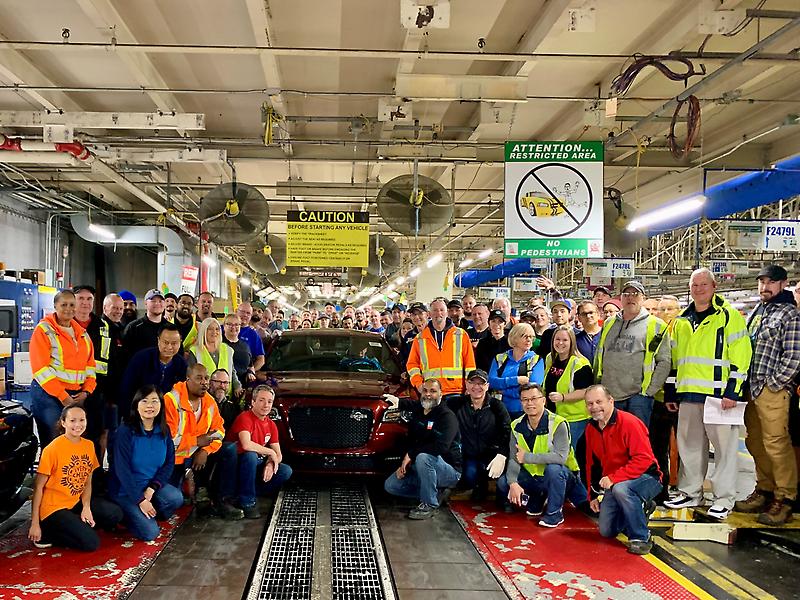
For most of its life, the sprawling assembly plant in Brampton, Ontario, had one job: turn out rear-wheel-drive Chryslers and Dodges. Today its most valuable output might be a signature.
Stellantis wants to close Brampton Assembly and has signed a memorandum of understanding with Roshel, the armoured-vehicle builder, about a possible sale. We covered that proposed deal last week. The more revealing detail is in the bargaining room. According to Unifor, Stellantis has offered “only conditional agreement with the economic pattern settlement tied to the closing of Brampton.”
A wage deal for thousands of people who still build things is being linked to the union’s consent to shut a plant that hasn’t built a car since 2023.
That tells you where the real obstacle is. Selling the building isn’t the hard part. Anyone can sell a building, and Stellantis already has an interested buyer. What it can’t do on its own is make the promises attached to the building go away, and those promises are what this fight is about.
A plant that was supposed to be the future
Brampton has always been an odd fit for the company that owns it. American Motors built it in 1986, and Chrysler picked it up a year later when it bought AMC. From 1992 on, it became the home of Chrysler’s big sedans: first the LH cars, then the Chrysler 300, Dodge Charger and Dodge Challenger. The last of those Hemi-era sedans and coupes rolled out of Brampton in December 2023. By Stellantis’s own count, the site covers 2.95 million square feet on 269 acres, with a stamping plant next door.
The end of the muscle cars was supposed to be an intermission. In May 2022, Stellantis announced a C$3.6 billion investment in Windsor and Brampton. Brampton would get a complete modernization starting in 2024, a new flexible vehicle architecture and at least one all-new electrified model. Taxpayers helped pay for that plan. Ottawa committed up to C$529 million, and Ontario provided money too. The chosen product was the next-generation Jeep Compass.
Then the ground moved. Retooling started in 2024 and was paused in February 2025, when, in Stellantis’s words, the company “reassessed its North American product strategy.” In October 2025, Stellantis announced a US$13 billion U.S. investment plan. That plan included more than $600 million to reopen Belvidere Assembly in Illinois for the Jeep Cherokee and Jeep Compass starting in 2027. The release doesn’t mention Canada anywhere. Federal briefing documents later noted that those two Jeeps were the vehicles “initially planned to start being manufactured in 2026 at the Brampton, ON facility.”
So Brampton didn’t lose a product because Canadians stopped buying Jeeps. It lost the product because the product moved south, where tariffs no longer penalize it. Follow the tariffs and you’ll usually find the Jeep.
The penalty most drivers never heard about
Ottawa didn’t just complain. It went after a mechanism most car buyers have never heard of.
When Canada put counter-tariffs on U.S.-built vehicles in 2025, it also set up a remission framework. Automakers that keep building cars in Canada get a quota of U.S.-built vehicles they can import without paying those tariffs. It works like a loyalty discount for local production, and it’s reviewed every quarter against what each company actually builds. On October 23, 2025, Ottawa cut Stellantis’s annual quota by 50 percent and said the Brampton cancellation broke the company’s commitments. General Motors got a 24.2 percent cut over production changes at Oshawa and Ingersoll.
That is the leverage in this story. Stellantis sells plenty of U.S.-built vehicles in Canada, and a smaller tariff-free quota raises the cost of bringing them north. As Toyota’s tariff bill shows, automakers can only absorb so much before it reaches the showroom. Stellantis hasn’t said how much of this it will absorb and how much will show up on window stickers. But anyone shopping for a U.S.-built Stellantis product in Canada now has a stake in what happens to an empty plant in Peel Region, whether they know it or not.
Ottawa also brought out the contract language. In a letter to CEO Antonio Filosa made public October 15, 2025, Industry Minister Mélanie Joly wrote that Stellantis had agreed “to maintain its full Canadian footprint” in exchange for public money, and that “anything short of fulfilling that commitment will be considered as default under our agreements.” Ottawa opened a formal dispute process in November 2025, and Joly announced a notice of default in December.
Why the union’s signature matters more than Roshel’s
Under the Unifor contract, Stellantis has to give “no less than one-year’s notice” of any closure or sale. That clause changes what the company actually needs.
Unifor says Stellantis told it on August 12, 2026, that it was considering closing and selling Brampton. Bargaining for more than 9,000 Stellantis workers in Canada began September 1. By September 11 the talks had reached an impasse, and Unifor said there would be “no tentative settlement without a suitable resolution” for Brampton’s Local 1285. The contract expired September 20. The parties are now in Ontario’s mandatory conciliation process, so there is no legal strike deadline yet, and Unifor says the company’s position hasn’t moved. In the meantime, the two sides agreed to extend income security for laid-off Brampton members until a new contract or a legal strike or lockout position arrives.
Why tie a pattern agreement to a closure deal? If the union signs off on Brampton, Stellantis gets something a sale alone can’t give it: evidence that the affected workers accepted the outcome. That matters when a federal government says you’re in default and has already cut your import quota in half. A closure the union agreed to looks very different from a promise the company broke, both in a negotiation with Ottawa and possibly before a judge.
That’s why Brampton is the sticking point, even though the rest of this year’s Detroit Three pattern is already settled. Ford set this year’s pattern first, and GM’s workers ratified on August 30 with commitments for new products and investment. Stellantis is last in line, and it’s the only one of the three asking the union to sign away a plant this round.
The buyer is already a neighbour, and already a partner
Roshel isn’t some distant stranger. It is headquartered in Brampton and builds armoured vehicles, including its Senator family, for customers it lists as the U.S. Department of Homeland Security, U.S. Customs and Border Protection, GardaWorld and Brink’s. It also already works with Stellantis. In October 2025, the two companies showed an armoured Jeep Wagoneer and a Senator MRAP on a Ram 5500 chassis cab.
Roshel CEO Roman Shimonov said at the time that final assembly for that program is “completed at our facilities in the United States.” It’s a small detail, but it runs straight into the problem Ottawa is trying to solve. The pull of the U.S. market works on defence suppliers too.
Roshel’s appetite also fits Ottawa’s other big industrial project. Canada’s Defence Industrial Strategy, launched in February 2026, aims to raise the share of defence purchases awarded to Canadian firms to 70 percent and to raise defence exports by 50 percent by 2035. In 2025, Roshel announced a partnership with Sweden’s Swebor to set up Canada’s first ballistic-grade steel production, and Joly praised it. A company that wants to control everything from armour plate to final assembly could use a huge, already-built factory near home. Brampton isn’t the only place where automotive capacity is drifting toward defence work, either.
That’s awkward for Ottawa. The government is effectively on both sides of this deal: it’s pursuing Stellantis for default while promoting the kind of domestic defence manufacturing Roshel represents. Unifor has publicly asked Joly whether Roshel’s lobbyists discussed the plant with her department in August and whether the government is aware of the MOU’s contents. According to the union, the government replied that it “neither instigated nor endorsed” the proposed sale.
What a car plant actually is
People outside the industry tend to picture an assembly plant as a building. Insiders know the building is the least valuable part. A car plant is a paint shop, a body shop and a trim line tuned to a specific vehicle. It’s also a supplier network that has grown up around it: seat plants, stampers and logistics yards whose schedules depend on its production rate. Unifor says hundreds of supplier firms and thousands of their workers depend on Brampton. An armoured-vehicle maker, however successful, builds in a different rhythm and at a different scale.
So a sale to Roshel could put people back to work under that roof. That would be better than an empty lot, and it would be unfair to dismiss it. But it wouldn’t bring back what Canada paid for in 2022: a high-volume car plant anchoring a supply chain, fitted for the next generation of vehicles.
Neither Stellantis nor Roshel has disclosed financial terms, and Stellantis hasn’t published a detailed case for closing the plant on its corporate or media sites. Until the company says more, its intentions have to be read from what it’s doing, and what it’s doing is asking for a signature.
What did the public buy?
Brampton is a test case for a question every government that subsidizes an automaker will eventually face. When a company takes public money in exchange for a production footprint and then moves the product, what exactly did the public buy?
Ottawa and Queen’s Park paid for a promise. Stellantis is offering them a building. That’s a bit like ordering a car and getting the parking space.
How the gap between those two things gets settled, whether at the bargaining table, through the remission quota or in court, will shape how every future plant deal in Canada gets written. The next automaker that asks for help to retool a Canadian factory should expect clawbacks, quotas and default clauses with real teeth. If that happens, the last Hemi Charger and Challenger won’t be the most important thing Brampton ever produced. The precedent will be.
Pick a side: when an automaker takes public money and then sends the product south, should Canada claw back every dollar, or is a buyer who puts people back to work under that roof a fair way out?