
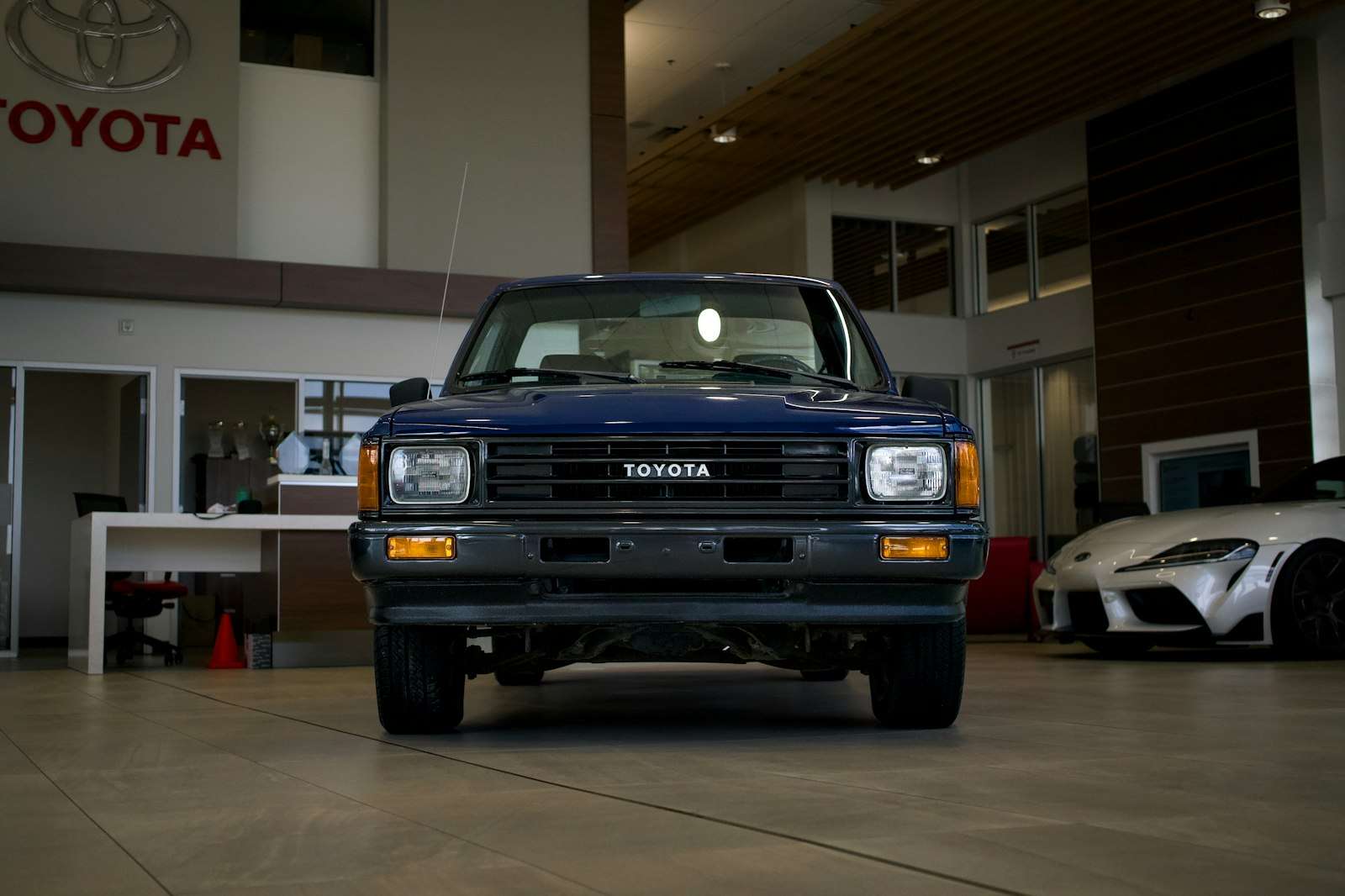
Every member of Congress has a car dealer in their district. Hardly any of them has a Toyota executive.
That is the simplest explanation for why Toyota would want the people who sell Camrys and change the oil in Tacomas talking to lawmakers about trade. Toyota has reportedly been asking its U.S. dealers to press Congress on auto tariffs. The company has not published that request, and The Auto Wire could not confirm its exact wording through Toyota’s own channels. But Toyota’s financial filings make the motive easy to see. They also make a bigger point: tariffs stopped being Toyota’s private problem once they began landing on the sticker of a RAV4.
Toyota has already paid the bill. Now it’s recruiting the people who have to explain it to customers.
The bill came due
Toyota’s fiscal year ended March 31. In the financial summary it filed with the SEC, the company put the hit from U.S. tariffs on its operating income at 1.38 trillion yen. That is roughly $9 billion at the 150-yen dollar Toyota uses for planning. Consolidated operating income fell from 4.80 trillion yen to 3.77 trillion.
Toyota’s North American business grew. Regional revenue climbed from 19.30 trillion yen to 21.08 trillion, and the company’s results presentation shows North American sales rising to 2.93 million vehicles from 2.70 million. In the U.S. alone, Toyota Motor North America sold 2,518,071 vehicles in calendar 2025, up 8 percent, with hybrids and other electrified models making up 47 percent of the total.
Yet Toyota’s North American operations swung from an operating profit of 108.8 billion yen to an operating loss of 192.5 billion yen, about $1.3 billion.
More cars. More revenue. Less money.
That is what a tariff looks like from inside a car company. Demand held up. Margins didn’t. Toyota’s forecast for the current fiscal year calls for operating income of 3.0 trillion yen, down another 20 percent. Whatever the company absorbed last year, it is not planning on the problem going away.
Why “Japanese import” is the wrong picture
Most shoppers hear “tariffs on Toyota” and picture a cargo ship stacked with Corollas from Japan. Toyota’s actual footprint is messier.
According to Toyota’s own list of North American plants, Kentucky builds the Camry and RAV4 Hybrid. Indiana builds the Highlander, Grand Highlander, Sienna and Lexus TX. Texas builds the Tundra and Sequoia. Mississippi builds the Corolla, and the Mazda Toyota joint-venture plant builds the Corolla Cross. But the RAV4 also comes from Ontario, as do the Lexus RX and NX. And every Tacoma comes from Mexico, from plants in Baja California and Guanajuato.
So Toyota lives under at least three tariff regimes at once:
- Vehicles from Japan. The White House’s Section 232 proclamation put a 25 percent tariff on imported cars starting April 3, 2025. The U.S.–Japan deal later capped Japanese cars and parts at 15 percent all-in for goods entered on or after September 16, 2025, according to the Federal Register notice.
- Vehicles from Canada and Mexico. Under the same proclamation, a USMCA-qualifying vehicle can pay the 25 percent tariff only on its non-U.S. content, once the importer documents that content. That makes a Tacoma’s tariff bill an accounting exercise in how much of the truck is American.
- Parts. The Section 232 action also covers auto parts. A Camry assembled in Georgetown, Kentucky, still carries tariff costs through any imported components that go into it.
So Toyota’s midsize pickup is, for tariff purposes, a Mexican import. Many of its RAV4s are, for the same purposes, Canadian ones.
Then came July 1. That day, U.S. Trade Representative Jamieson Greer said the United States did not agree to renew USMCA in its current form. The agreement stays in force while talks continue. Under the treaty’s review clause, that means the three countries keep reviewing it year by year instead of locking in another 16-year term. The deal that made Toyota’s Ontario and Mexican plants a sensible bet is now on a one-year lease.
That is why this story matters more to Tacoma and RAV4 shoppers than the “Japanese import” framing suggests. Canada- and Mexico-built vehicles carry the most exposure to whatever happens next, and the recent shuffling of Canadian production shows how quickly plant plans can change when trade terms do.
Why dealers, and why Congress
The Constitution gives Congress, not the president, the power to lay duties. The auto tariffs exist because of Section 232 of the Trade Expansion Act of 1962, which lets the president adjust imports on national-security grounds after a Commerce Department investigation. Congress handed over that authority. Congress can narrow it. That is the lever anyone lobbying on tariffs is ultimately reaching for.
Dealers are useful for that job in a way no automaker can be. The National Automobile Dealers Association’s 2025 annual profile counts 16,990 franchised new-car dealerships employing 1,123,100 people, with total sales above $1.3 trillion. Those stores are locally owned, they pay local taxes, and they are spread across the country. A lawmaker can wave off a foreign automaker’s lobbyist. Waving off a hometown employer who writes payroll checks to a few dozen voters is harder.
There is also a practical reason. Franchised dealers buy their cars from the manufacturer. When an automaker raises wholesale prices to recover tariff costs, the dealer either gives up margin or passes the increase along to the buyer. The showroom is where a tax set in Washington becomes a number a customer has to accept. Dealers didn’t set it, but they are the ones who have to explain it.
Toyota has fought this exact tariff before
Toyota saw this coming years ago.
In June 2018, while the Commerce Department was studying whether car imports threatened national security, Toyota issued a blunt statement against a proposed 25 percent tariff. It said 137,000 Americans worked for Toyota and its dealerships and added, “They are not a national security threat.” It estimated the tariff would add $1,800 in costs even to a Kentucky-built Camry. A month later, workers from Toyota’s 10 U.S. plants traveled to Washington and joined a caravan of vehicles circling the Capitol during a Commerce hearing.
That tariff was not imposed then. Seven years later, a 25 percent tariff arrived anyway. At the time, Toyota’s 2018 warning read like standard lobbying. It turned out to be a forecast, and the $1,800-per-Camry math grew into a roughly $9 billion bill in a single fiscal year.
The strategy has barely changed either. In 2018 Toyota sent plant workers. In 2026 it reportedly wants dealers. Either way, the message to Washington is that the people affected are American, even if the badge on the grille is not.
The answer policymakers want takes years to build
Toyota is building more here. In November 2025 it announced it would invest up to $10 billion more in its U.S. operations over five years, on top of nearly $60 billion invested since it arrived. It says it employs about 50,000 Americans at 11 U.S. manufacturing facilities. In March, it announced $1 billion for its Kentucky and Indiana plants, including added Camry, RAV4 and Grand Highlander capacity.
That’s the behavior tariffs are meant to encourage. It just can’t happen on a trade policy’s schedule.
Toyota’s Kentucky plant is itself a product of the last big wave of trade pressure on Japanese automakers in the 1980s, the same era as the Plaza Accord. Plants like that take years to go from announcement to first car. Other companies are having the same problem now. Hyundai and Kia’s new U.S. steel mill won’t ship until 2029, and Nissan is still trying to keep its Japanese factories busy under the same tariff pressure.
A tariff can be signed in an afternoon. A factory takes years to pour.
That gap is the strongest argument Toyota and its dealers can make to Congress. The case is less for zero tariffs than for predictability: rules that stay put long enough to justify a new assembly line, a new supplier contract, or the decision to move a model from Ontario to Kentucky.
The fight moves to the showroom
If you’re shopping for a Toyota, the country on the window sticker matters more than it used to, and Canada- and Mexico-built models carry the most exposure while USMCA’s future is unresolved. If you own a Toyota store, you’re being asked to take a position on trade policy because you are the person customers blame for the price. And if you’re watching the industry, notice where this fight has moved. It started in the Commerce Department. It went through the Oval Office. Now it is headed to the people who hand you the keys.
Toyota has already shown it can absorb a $9 billion hit and stay profitable. What it clearly doesn’t want is to keep doing that every year while its dealers explain the difference to customers one sale at a time.
Should Congress take back more control over auto tariffs, or should the White House keep the power to change them on short notice? Where do you land?