
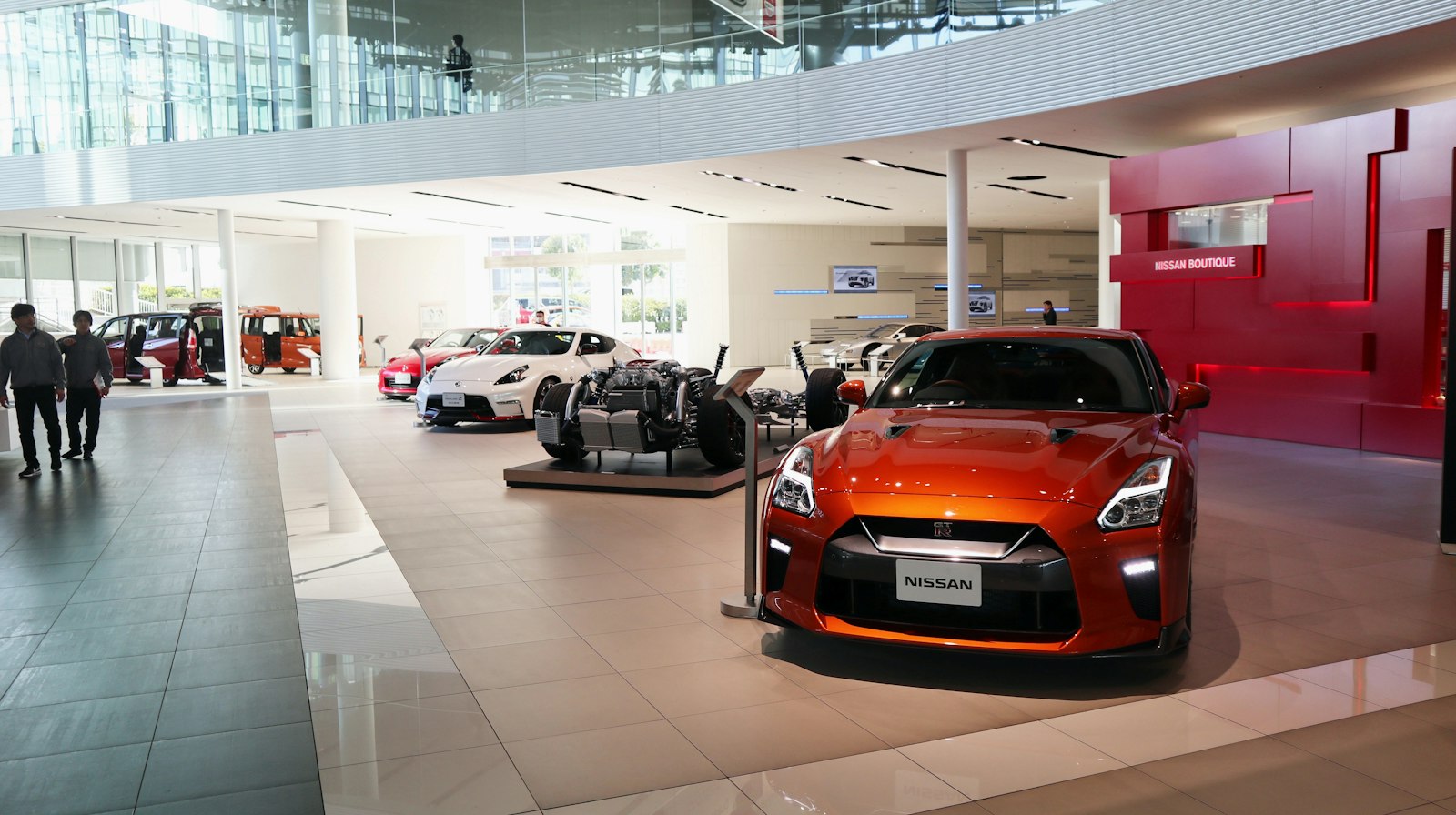
On 10 September, Nissan announced it would reorganise its Japanese factories into three specialised hubs and work toward building roughly one million vehicles a year in Japan.
Nissan has made this promise before. In July 2015 it announced that its Kyushu plant would start building the Rogue for North America, 100,000 units a year, and said the purpose was to help restore annual Japanese production to one million units in fiscal 2016.
Same target. Same plant. Same export programme. Eleven years apart.
Last fiscal year Nissan built 557,576 vehicles in Japan.
What was actually announced
The reorganisation itself is coherent. Tochigi becomes a High Tech Hub: sports cars on one line, electrified vehicles plus the Serena and Elgrand on another. Nissan Motor Kyushu becomes the Global Model Hub, taking the Note and Kicks from Oppama and adding a new global B-segment car alongside the Rogue and X-Trail. Nissan Shatai Kyushu specialises in body-on-frame: Patrol, Armada, QX80, Caravan.
Chief Monozukuri Officer Teiji Hirata framed it as building “products in Japan that can succeed at home and around the world” by organising production around vehicle families.
Now read what the release does not contain. No investment figure. No yen amount at all. No fiscal year for any of the model transfers. No export volume target. The one-million figure is described as a “long-term ambition,” which in corporate disclosure is a phrase that carries no date.
Getting from 557,576 to a million is a 79 percent increase, roughly 442,000 additional vehicles a year, announced with no capital attached.
The number the plan is actually built around is 64 percent
To see what Re:Nissan is really doing, you have to strip China out, because Nissan’s own capacity targets are stated excluding China.
In fiscal 2025 Nissan built 2,902,992 vehicles globally, of which 661,761 were in China. That leaves 2,241,231 outside China, against a pre-restructuring capacity base of 3.5 million.
That is about 64 percent utilisation.
Re:Nissan’s answer is to cut capacity from 3.5 million to 2.5 million units, closing or consolidating seven sites and moving from 17 plants to 10 by fiscal 2027. Do the arithmetic on the same output and utilisation rises to roughly 90 percent.
Nothing about that improvement requires selling a single additional car. The plan fixes the ratio by shrinking the denominator. That is a legitimate and probably necessary response to having built factories for a company 40 percent larger than the one Nissan now is. It is just worth naming plainly, because “90 percent utilisation” and “demand recovered” are very different sentences.
Nissan is adding shifts on exactly the vehicles the tariff punishes hardest
Here is the part that does not obviously add up, and it is the most interesting thing in the announcement.
Japanese-built vehicles entering the United States were hit with a 25 percent tariff under Proclamation 10908 from 3 April 2025. Relief came later: a Federal Register notice effective 16 September 2025 set 15 percent as a ceiling rather than an additional layer, so that the base rate and the Section 232 duty together total 15 percent.
Fifteen percent of what, though? An ad valorem duty is charged on value. The more expensive the vehicle, the larger the cheque.
Nissan’s CFO has confirmed that operational improvements include a third shift at Nissan Shatai Kyushu. Nissan Shatai Kyushu builds the Patrol, the Armada and the Infiniti QX80 — large, expensive, body-on-frame SUVs sold overwhelmingly in the United States. They are the single worst products in the portfolio to expose to a value-based tariff, and they are the ones getting the extra shift.
Meanwhile Nissan’s US production rose 24.2 percent in the first half of 2026. The company is expanding on both sides of the tariff wall simultaneously. Either it has concluded the duty is survivable, or it has no American capacity available for these platforms. Which of those it is tells you almost everything about the next five years.
What the tariff already cost, in Nissan’s own bridge
The scale is in Nissan’s own results presentation. In the bridge explaining the move in operating profit from fiscal 2024 to fiscal 2025, the bar labelled “Tariff” reads minus ¥286.0 billion.
Because the auto tariffs took effect on 3 April 2025 — the first days of the fiscal year — the prior year’s tariff cost was effectively nil, which means that year-over-year swing approximates the absolute cost. Nissan does not publish a standalone tariff expense line, so treat it as the best available approximation rather than a disclosure.
Against that, fiscal 2025 operating profit was ¥58.0 billion on ¥12.0 trillion of revenue, a margin of half a percent. The net loss was ¥533.1 billion, including ¥366.2 billion of impairments, following a ¥670.9 billion loss the year before. Two years, roughly ¥1.2 trillion gone.
Automotive free cash flow was minus ¥480.8 billion. Three of the four agencies that rate Nissan have it below investment grade: Ba2 at Moody’s Japan, BB- at S&P, BB at Fitch. In July 2025 the company raised about ¥860 billion in bonds and sold its Yokohama headquarters in a twenty-year leaseback.
The currency is doing work the strategy will get credit for
Rivals are doing their own arithmetic on the same problem — see Honda’s cost overhaul. Nissan built its fiscal 2026 plan on ¥150 to the dollar. In the first quarter it actually got ¥160.
A ten-yen move is an enormous, invisible subsidy to anything built in Japan and sold in America, and it arrived at the same moment as the export recovery. Japan-to-North America exports rose 22.2 percent in the first half of 2026 after falling in fiscal 2025.
Some of that is industrial strategy. Some of it is the foreign exchange market. The honest question for the one-million ambition is what it looks like at ¥130, and nothing in the September release answers it.
Europe is disappearing and nobody is watching
One number in the monthly data deserves far more attention than it is getting.
Nissan’s exports from Japan to Europe fell 51.0 percent in the first half of 2026. In July alone they fell 71.7 percent, to 1,100 vehicles.
That is not a slowdown. That is an exit happening in real time — and it follows the pattern we found when Nissan called July a growth story while its own numbers showed China collapsing.
The September release argues that exports give Nissan “greater resilience through broader geographic demand.” Its own export data says the opposite is happening: one destination market is collapsing while the other absorbs everything, which concentrates rather than spreads the risk — and the one absorbing it is the one with the tariff.
What to remember
Forget the hub names. Remember the two documents.
In 2015, Nissan said Kyushu would build the Rogue for America and restore Japan to a million cars a year. In 2026, Nissan said Kyushu would build the Rogue for America and restore Japan to a million cars a year. The first attempt failed in a world with no tariff, a healthier balance sheet and a larger company.
The difference this time is not the plan. It is that the plan now has to work.
Do you believe Nissan this time, or have we heard this one before? Tell us in the comments.