
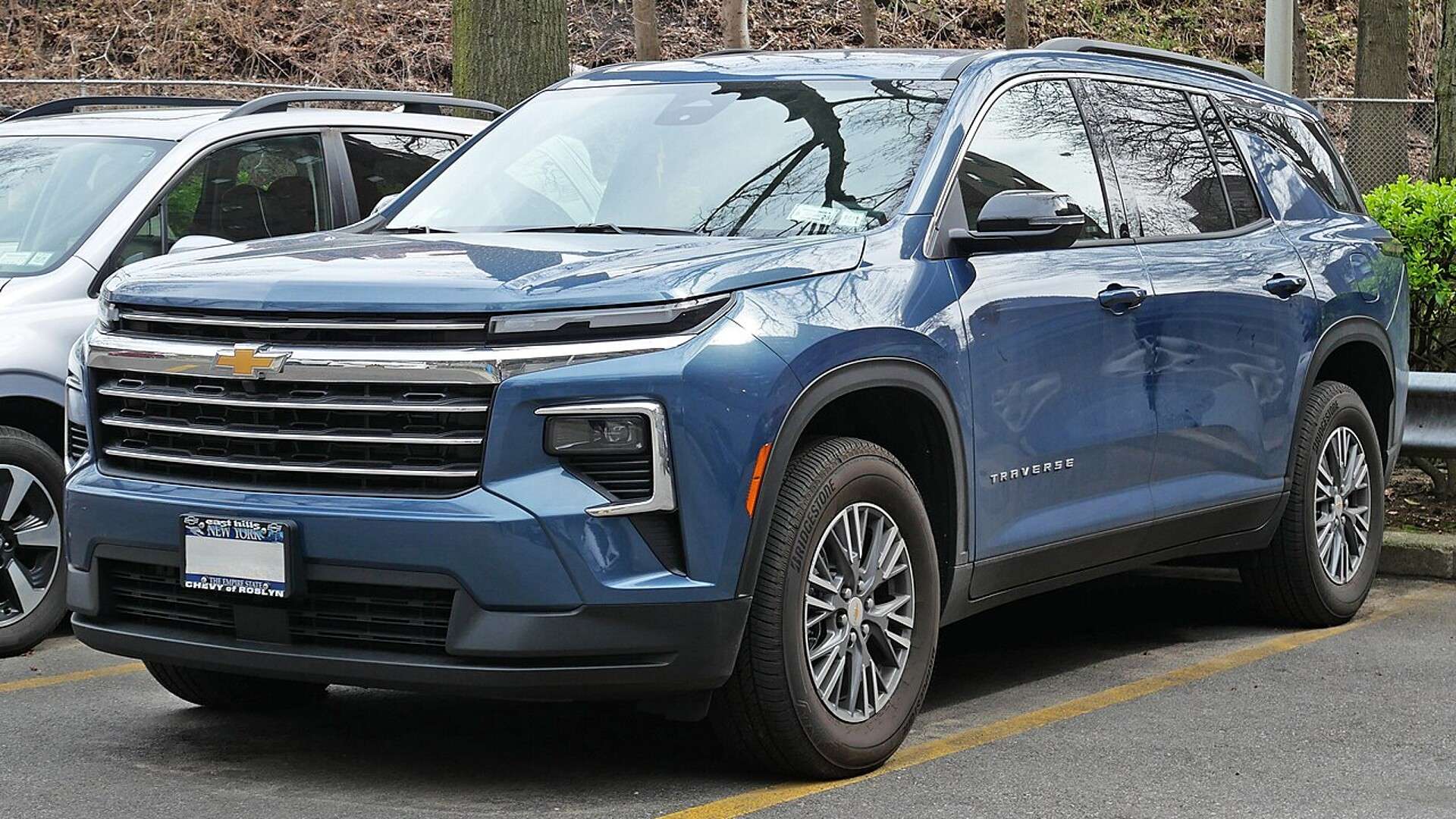
General Motors gave a federal judge two reasons to throw out a lawsuit over the brakes on 2025 Chevrolet Traverses. The judge pointed out that they cancel each other out.
Owners in Barron v. General Motors LLC allege that the master brake cylinder assemblies in five 2025 GM models can fail and leave drivers with partial or total loss of braking. GM asked the U.S. District Court for the Eastern District of Pennsylvania to dismiss their warranty claims, arguing in part that the alleged problem is a design defect the warranty doesn’t cover. It also asked the court to dismiss their unjust-enrichment claim on the grounds that an express warranty already governs the dispute.
“But this argument strains credulity,” U.S. District Judge John F. Murphy wrote in a May 18 opinion. “Which one is it?”
GM lost that round. Murphy denied its motion to send the case to arbitration and denied its motion to dismiss. The only claims he dropped were three state lemon-law counts the owners had already withdrawn. The court docket shows GM filed a notice of appeal to the Third Circuit on June 5, answered the amended complaint on July 10, and received a scheduling order on July 16. Five months after that ruling, the same law firm has filed a second case on behalf of six more owners.
Six more owners, same five models
Fehrmann et al. v. General Motors LLC, No. 2:26-cv-07669, was filed Oct. 6 in the same Philadelphia federal court by Sergei Lemberg of Lemberg Law, who also represents the Barron plaintiffs. Five of the six new plaintiffs bought 2025 Traverses. The sixth bought a 2025 GMC Acadia.
The complaint seeks to represent people who bought or leased any of these 2025 models in Illinois, Kentucky, Michigan, Ohio or Texas:
- Chevrolet Traverse
- GMC Acadia
- Buick Enclave
- Chevrolet Colorado
- GMC Canyon
None of the named plaintiffs owns an Enclave, Colorado or Canyon. The complaint’s case for including them rests on GM’s own paperwork (more on that below).
The complaint describes each owner’s experience in some detail. Each account below is an allegation that GM has not yet answered in court.
The lowest mileage: Stephen Worthington of Medina, Ohio, bought a Traverse High Country on May 8, 2025. In July, at about 361 miles, the complaint says warning lights came on and “the brake pedal became harder to depress than usual.” His dealer bled the hydraulic system and gave the SUV back on July 9. The complaint says the problem continued. On a second visit starting July 30, the dealer replaced the master brake cylinder, and he got the Traverse back Aug. 13.
The backorder: Alexie Wise of Washington, Indiana, bought her Traverse LT on April 5, 2025, at a dealership in Henderson, Kentucky. According to the complaint, warning lights came on in July, and pressing the brake pedal produced a loud crunch that “sounded like stepping on a bag of potato chips.” When she brought the SUV to a dealer in Jasper, Indiana, on July 9, at about 4,051 miles, the complaint says she was told the parts were on nationwide backorder and that it was safe to keep driving. The complaint says the brakes kept malfunctioning. The master cylinders were replaced Aug. 11. The complaint says she spent more than a month waiting for parts.
The longest stay: Stephanie Fehrmann of Breese, Illinois, says her Traverse LT showed warning lights in July while she was backing out of a parking space, at about 3,692 miles. On the drive to the dealer, the complaint says, braking took much more pedal pressure, and it “felt to her as though the vehicle had no power brakes.” The SUV was out of service for 36 days.
The other three plaintiffs are:
- Jeff Mellinger of Ionia, Michigan: His Traverse High Country’s pedal “depressed unusually low” at about 1,609 miles, and the SUV was out of service for 27 days.
- Rachel Solak of Newport, Michigan: On her first visit, the dealer found nothing to fix. On the second, it replaced the brake booster assembly.
- Marlene Jennis of Sour Lake, Texas: She owns the Acadia. It was in the shop for 21 days starting Dec. 19, 2025, at about 14,258 miles. She has a chronic mobility condition, and the complaint says the dealer didn’t give her a comparable loaner and the vehicle she got instead was hard for her to get in and out of.
In every case, the work was done at a dealer. The lawsuit isn’t about who paid for the repairs. It’s about the weeks without a vehicle, the owners’ claim that they overpaid for SUVs with a defect, and what GM knew before it sold them. In his May ruling, Judge Murphy found that the Barron plaintiffs’ allegations of overpayment and time without their vehicles were enough for the case to continue. He wrote that whether the 27-, 29- and 31-day outages in Barron were reasonable is a question for “discovery, summary judgment, and maybe trial, but not the motion to dismiss stage.”
What the complaint says GM knew
Both lawsuits rely heavily on GM Service Update N242482170. The Fehrmann complaint says GM issued it on Dec. 9, 2024, and that it told dealers to inspect, and if needed replace, brake master cylinder assemblies on the 2024 Traverse and 2025 Buick Enclave. The complaint says the 2024 Traverse problem involved a missing “internal cartridge seal” in the eBoost module. (eBoost is GM’s electronic brake booster, which is built into the same assembly as the master cylinder.) The update never covered the 2025 Traverse, Acadia, Colorado or Canyon. We broke down that service update and the parts involved last week.
The complaint also alleges that GM knew about the problem from several other sources:
- Pre-production testing, including brake testing at its Milford Proving Ground. The complaint quotes GM describing a brake facility that can run “1,900 stops in 2½ days.”
- Reports from dealers soon after the 2025 models began shipping
- Higher-than-expected orders for replacement master cylinders
- Owner complaints to NHTSA
Those NHTSA complaints are public. As of Oct. 19, NHTSA’s database has 184 complaints about the 2025 Traverse, and 117 of them list a brake component. The other four models:
- 2025 Acadia: 40 of 67 complaints
- 2025 Enclave: 15 of 38
- 2025 Colorado: 10 of 27
- 2025 Canyon: 3 of 8
These are unverified owner reports, and one complaint can list more than one component. One of the newest Traverse complaints, filed May 6, 2026, describes a Traverse LT at about 30,000 miles whose brake pedal “traveled completely to the floorboards with zero resistance” when the owner started it.
Is there a recall?
No. As of Oct. 19, NHTSA’s recall database shows no recalls for the 2025 Traverse, Acadia or Enclave. The 2025 Colorado and Canyon have open recalls, but none involves brakes.
There is a federal investigation. On Aug. 21, NHTSA’s Office of Defects Investigation upgraded a probe it opened in April 2024 into an engineering analysis, EA26006, covering an estimated 1,164,820 vehicles that use GM’s eBoost system. All five models in the lawsuits are on the list. The agency counts 745 reports, 22 crashes or fires, and six injuries. It lists no deaths.
On paper, the investigation covers a different failure than the lawsuits. NHTSA is looking at sudden loss of brake assist that GM has linked to fractured spindles inside the eBoost unit. The lawsuits allege leaking master-cylinder seals, and the Fehrmann complaint doesn’t mention the federal probe. Both problems, though, are in the same brake module.
NHTSA’s summary describes how GM says a spindle failure plays out. ABS, stability control and traction control keep working until the vehicle comes to a complete stop. Then they shut off, warning lights and a “Service Brake System” message come on, and the vehicle’s speed is limited to 70 km/h, or 43 mph. NHTSA wrote that some of the reports it has received “describe symptoms inconsistent with GM’s description,” with brake assist lost immediately rather than after a stop.
On Sept. 15, the agency sent GM a 10-part information request that asks for, among other things, its own engineering assessment of the defect and counts of complaints, crashes, warranty claims and lawsuits. GM’s response is due Oct. 30.
What owners should know
Neither lawsuit has been certified as a class action, and there is no settlement. Owners don’t need to do anything to stay eligible for either case.
The court filings and NHTSA records describe the same warning signs:
- A red brake warning light, an ABS light, or a “Service Brake System” message
- A brake pedal that suddenly feels hard
- A brake pedal that sinks toward the floor
If any of these show up, get the vehicle to a dealer. Owners can check for open recalls by VIN at NHTSA.gov/recalls and report a problem to the agency on the same site.
As of Oct. 19, GM had not responded to the new complaint in court. The docket shows a waiver of service was executed on Oct. 8. The Barron case has had a scheduling order since July, and GM’s Third Circuit appeal was docketed June 9.
NHTSA’s Sept. 15 letter asks GM to count the lawsuits over these brakes. Fehrmann was filed three weeks later. GM’s Oct. 30 answer will show whether it made the list. If you drive one of the five 2025 models in these suits, has your brake pedal ever felt off, and what did the dealer say?
Top photo: A 2025 Chevrolet Traverse LT, the trim owned by three of the six plaintiffs in the new lawsuit. Photo: Kevauto via Wikimedia Commons (CC BY-SA 4.0)