
The getaway car in five North Texas armed robberies was easy to describe: a black Hyundai Santa Fe with a blue fuzzy cover on the steering wheel. Federal prosecutors told the jury that surveillance footage put that same SUV, fuzzy cover and all, at every one of the stores.
The jury convicted Charles Lenard Brownlee, and a federal judge sentenced him to 60 years. Now his appeal is asking the U.S. Court of Appeals for the Fifth Circuit a question that has nothing to do with upholstery and a lot to do with anyone who drives in Texas, Louisiana or Mississippi: When police search a license plate reader database to work out where a car has been, is that a Fourth Amendment search that needs a warrant?
A three-judge panel, Chief Judge Jennifer Walker Elrod and Judges Priscilla Richman and Irma Carrillo Ramirez, heard the case, United States v. Brownlee, No. 25-10855, on Oct. 5 in New Orleans. The court has posted the full 43-minute recording. It has not said when it will rule.
Five Cash Stores in 12 days
According to the U.S. Attorney’s Office for the Northern District of Texas, Brownlee robbed five Cash Store locations at gunpoint between May 9 and May 21, 2024, in Grand Prairie, Fort Worth, Euless, Hurst and Grapevine. He wore a disposable medical mask and switched caps and outfits from one robbery to the next.
The outfits changed. The SUV, prosecutors said, did not.
The government’s case went well beyond the steering wheel. A witness at the Euless robbery saw the robber drop a Black & Mild cigarillo and climb into a black SUV with a blue fuzzy steering-wheel cover, and DNA on the cigarillo was consistent with Brownlee, prosecutors said. An FBI cell-site analyst testified that phones tied to him were at or near each store during the robberies. His girlfriend pleaded guilty to conspiracy and testified that the two planned the Fort Worth and Euless robberies together and that she drove the getaway car. Police arrested Brownlee shortly after the Grapevine robbery and found two loaded guns, a medical mask and a blue hat worn during the Euless robbery in the vehicle he was in.
A jury convicted him in March 2025 of Hobbs Act robbery and conspiracy, five counts of brandishing a firearm during a crime of violence and being a felon in possession of a gun. U.S. District Judge Reed O’Connor sentenced him to 720 months in July 2025 and ordered $21,123.47 in restitution.
“Pattern of life”
The appeal centers on how investigators found that particular Hyundai. Brownlee’s attorney, James Matthew Wright, told the panel that police ran warrantless queries through two systems: Flock Safety’s fixed-camera network and Motorola Solutions’ Vigilant database, which draws heavily on cameras mounted on moving vehicles. He called the two “stunningly comprehensive.”
Wright cited trial-record testimony from a Grapevine police detective who, he said, described Flock as giving police a person’s “pattern of life,” while Vigilant “tells you where the vehicle lives.” According to Wright, the record shows the Hyundai was scanned four minutes after the Grapevine robbery, about 200 yards from the store, and five times in one area of Arlington. He said officers went to the home of Brownlee’s cousin because Vigilant showed the car had been there. Justice Department attorney Michael Weisbuch countered that the address likely came from a mismatch in the sister’s Texas Department of Public Safety records, and Wright later allowed that he may have misspoken, while pointing to testimony that officers went there because of Vigilant hits.
Starting with only a general description of a black SUV, Wright argued, police found “literally a needle in a haystack” in about two and a half hours. He also told the court that the government didn’t use the plate-reader data only to find Brownlee. Prosecutors put the system’s records in front of the jury as trial exhibits.
The district court denied his motion to suppress without an evidentiary hearing. Wright said that court essentially accepted the government’s position that a plate-reader query could not be a search at all.
“Episodic,” and his sister’s car
Weisbuch argued that plate readers capture “episodic” snapshots of cars in public, not the near-continuous, public-and-private tracking the Supreme Court has treated as a search with GPS trackers and cell phone location records. Citing 30 days of plate-reader data the defense had before filing its motion, he put the figure at an average of “maybe nine hits per day.” He added that a man robbing stores in busy commercial areas would naturally pass more cameras than most drivers.
Weisbuch also argued that Brownlee may not be able to challenge the searches at all. The Hyundai belonged to his sister, she drove it regularly, and, Weisbuch told the court, she was behind the wheel somewhere else when Brownlee was arrested in a different car. Police querying her plate, he said, learned nothing about Brownlee in particular.
Wright’s answer came from the movies. Arguing that Brownlee couldn’t lose his privacy rights just because he wasn’t driving, he said that would be like claiming Miss Daisy had no standing to contest surveillance of her own car in Driving Miss Daisy. Later, a voice from the bench asked Weisbuch whether that wasn’t “kind of a cute analogy.” Weisbuch agreed that it was.
The judges pressed both sides on where the line sits. One asked Weisbuch whether the data was “really episodic when it so permeates everything.” Another asked whether the answer would change once cameras are on every corner. Judge Ramirez asked why, if a GPS tracker on a car is a search, a network of cameras tracking the same car isn’t “just a more advanced way to accomplish the same thing.” Weisbuch said it would be, if it produced GPS-like data, and that this record wasn’t close. He argued the larger question of how many cameras is too many is “a political issue” for lawmakers to settle.
The cameras saw the steering wheel too
Plate readers are usually described as machines that read plates. In rebuttal, Wright told the panel the record shows more than that: a Vigilant camera captured enough of the inside of the Hyundai “to see the steering wheel.” On the court’s recording, someone can be heard finishing the thought: “fuzzy steering.”
So the fuzzy cover prosecutors used to tie the SUV to five robberies was visible to the very camera system now on appeal.
What a ruling would mean for drivers
Fifth Circuit decisions bind federal courts in Texas, Louisiana and Mississippi. In March, the same court held in United States v. Porter that a live plate-reader alert in Gautier, Mississippi, a city with no more than 10 cameras, was not a search. That opinion described plate readers as providing “only periodic information about a vehicle’s location.” Wright argued Porter involved a real-time hotlist hit, not a retrospective reconstruction of someone’s travels.
If the panel sides with Brownlee, police in those three states could need a warrant before searching plate-reader history in federal cases, and evidence from warrantless searches could be thrown out. Asked whether he wanted a blanket rule against the cameras, Wright described a narrower request: a holding that police using these databases the way they did in this case conducted a search. A government win would extend Porter from a single live alert to a retrospective search of a car’s history.
Other courts are working on the same question. On Oct. 1, a federal judge in Tulsa suppressed evidence from a warrantless Flock search in a drug case. Wright told the Fifth Circuit that similar appeals are pending in the Fourth and Eleventh Circuits. Weisbuch, who said he argued the Eleventh Circuit case, was asked what that court decided. “Stay tuned,” he said.
Texas has roughly 13,000 Flock cameras, according to an estimate cited by The Texas Tribune. State Sen. Lois Kolkhorst, R-Brenham, has said on Facebook that she supports an effort to ban automated license plate readers, which she expects the Senate to take up when the Legislature convenes in January.
Brownlee’s appeal also challenges how the trial court treated his Hobbs Act robbery counts. His convictions and sentence stand unless the panel rules otherwise. Wright ended his rebuttal by describing what the camera network can reveal about anyone: when they go to work, when they’re out late, when they go to church on Sunday. “That’s a search,” he said.
Prosecutors used a steering-wheel cover to tie one SUV to five robberies. The Fifth Circuit has to decide whether police needed a warrant to go looking for it.
If police can rebuild where your car has been over the past month with a database query, should that take a warrant?
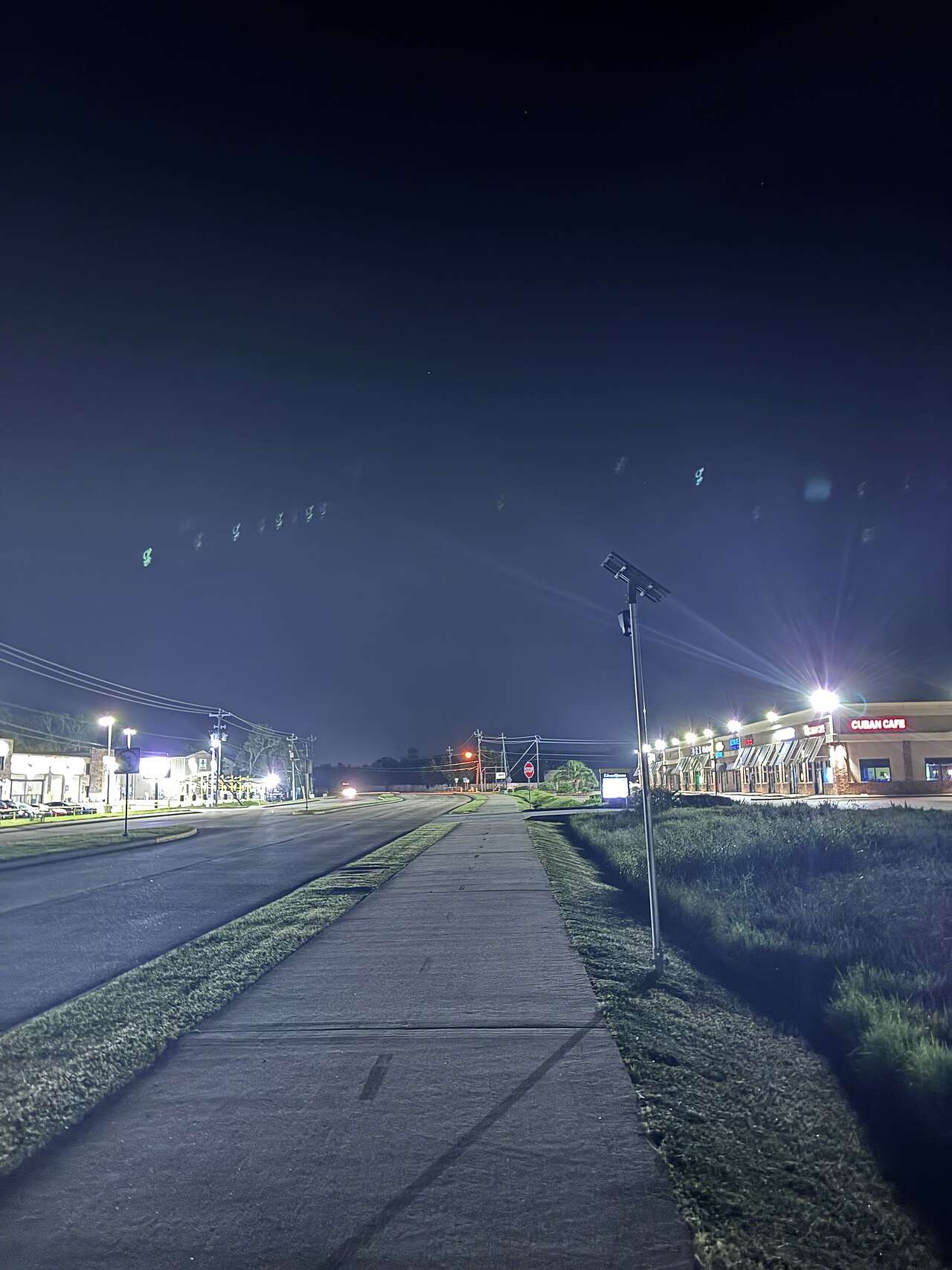
Top photo: A Flock plate reader in Kemah, Texas. Photo: BigPipNic / Wikimedia Commons (CC0)