
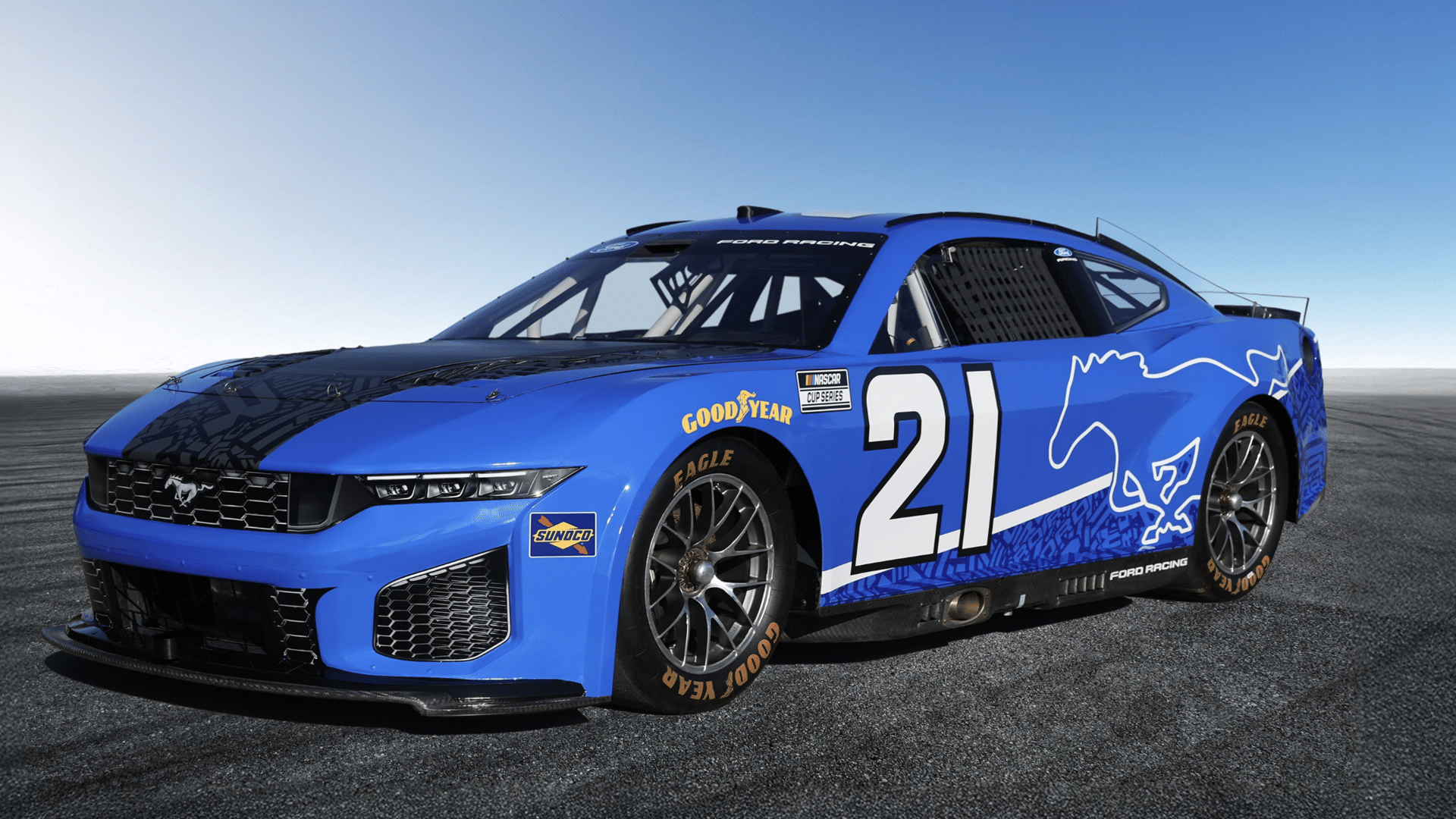
Ford showed its next NASCAR Cup car on Veterans Day. It did so in a museum at Daytona, the same day 12 of its drivers raced Mustangs on the speedway’s road course, and none of those Mustangs were Cup cars.
The new car is the 2027 Cup Series Mustang. Ford unveiled it on Wednesday as part of the run-up to its first Proud to Honor Veterans Day Classic. The body is modeled on the 795-hp Mustang Dark Horse SC, a road car you can actually buy, and its signature feature is an aggressive new nose. Ford says that nose improves cooling on the road car and adds downforce on the race car. Ford Racing global director Mark Rushbrook summed up the idea this way: “Racing makes our road cars better, and our road cars make our race cars better.”
The car’s racing debut comes at Daytona Speedweeks, which ends with the 69th Daytona 500 on Feb. 21.
What carries over from the road car
Very little. When Ford launched the road car in January, it listed a supercharged 5.2-liter V8 and a seven-speed dual-clutch transmission. You won’t find either one in a Cup car.
NASCAR’s Next Gen spec sheet sets the rules for every Cup car:
- a naturally aspirated, fuel-injected 358-cubic-inch engine
- a five-speed manual sequential transaxle
- a steel-tube chassis built by a single supplier
- a symmetric composite body, where manufacturers get to style “OEM-specific design elements”
Horsepower is set by NASCAR according to track type and size, not by how much power Ford built into the road car.
Related Articles
- A Florida Sheriff’s Office Needed a Reporter, Not an Alarm, to Catch 900-Plus Flock Plate Searches. Now Two Ex-Deputies Face Charges
- Watch: A White Sedan Left the Road and Went Down a Narrow Staircase Within 15 Seconds, Camera Clock Shows, Then a Tow Truck Arrived
So the 795 hp is a number for the brochure. What does carry over is the shape of the car, and Ford is using that to the limit. On the road car, the new front fascia adds brake cooling. A new aluminum hood with a large vent helps cool the engine and improves the front-end aero. With its rain tray removed, Ford says that vent “creates 2.5 times the downforce of the standard Mustang Dark Horse hood vent.” Add the Track Pack’s carbon wing and ducktail decklid, and the road car makes 620 pounds of rear downforce at 180 mph.
The Cup car can’t copy all of that. The spec sheet says air leaving the radiator exits through hood louvers that NASCAR controls. That means the front fascia and nose are where Ford’s styling freedom actually turns into lap time.
Third Mustang body in five seasons
This will be the third Mustang shape of the Next Gen era. NASCAR’s 2021 Next Gen overview said the platform was meant to give manufacturers “greater latitude” to make race cars look like street cars. Ford is taking full advantage. When it announced the switch in January, NASCAR noted that the current Dark Horse body had won the 2024 title with Joey Logano and 19 races in its first two seasons.
The reasoning for the change is clear. In a series built on identical chassis, body shape is one of the few areas a manufacturer controls. A front end that’s better in traffic or on restarts is worth more than any marketing campaign. The risk is that a new body resets the knowledge teams have built up, right before the season’s biggest race.
The exhibition race
The cars that actually raced at Daytona were the Mustang Dark Horse R, not the Cup car. Ford’s lineup announcement placed 12 drivers into six two-driver teams, one team for each military branch. Each car wore a livery based on a vehicle, ship or aircraft from that branch. Ford’s livery breakdown listed:
- Air Force: the F-22 Raptor
- Space Force: the X-37B orbital test vehicle
- Navy: an Arleigh Burke-class destroyer
- Coast Guard: a Sentinel-class Fast Response Cutter
- Marines: an Assault Amphibious Vehicle
Ford put the event on with NASCAR, IMSA, HSR and Blue Star Families. It also set up a Proud to Honor Fund, with all donations going to six military and veteran nonprofits and part of the ticket money going to Blue Star Families. The broadcast ran 8–10 p.m. ET on USA Network.
What it means for Dark Horse SC owners
If you own a Dark Horse SC, the Cup car is good publicity, not a parts catalog. The parts that will matter on track days are the road car’s own aero pieces.
Related Articles
- An Indianapolis Address Allegedly Held 16 Stolen Cars Mid-Teardown, and the Arrest Came With a Racketeering Charge
- Honda Took Almost 5 Years to Find a Divide-by-Zero Bug That Kills Steering Assist in 635,808 Pilots, MDXs and TLXs
Take the hood vent. Removing the rain tray unlocks the extra downforce, and it also leaves an open path from the air above the hood straight into the engine bay. That’s fine at a track and a bad idea on a wet commute, so make putting the tray back in part of your post-track routine.
Expect the body panels to cost real money if you crash. The aluminum hood with standard hood pins, the reshaped fascia and, on Track Pack cars, the carbon wing and wheels are expensive to repair. Before you enter a track-day event, make sure your insurance actually covers driving on a track. Many street policies don’t.
Who it’s for
The car makes its first competitive start in February at Daytona. Ford’s argument is that you can now buy the car that inspired the race car’s face. The weakness in that argument is that everything else about the two cars is different. Does a borrowed nose make a race car a relative of the road car, or is that just Ford selling a grille?
Images Via: Ford