
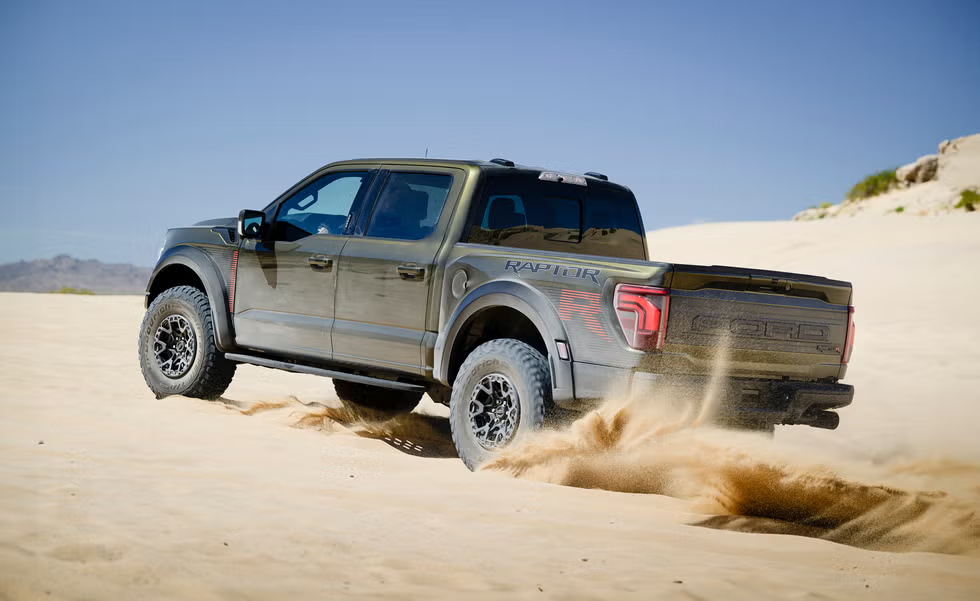
If you’ve been holding out hope that Ford would drop a V-8 into the Ranger Raptor or Bronco Raptor and crown them with an R badge, you can let that dream go. The man in charge of Ford Performance just made it clear those trucks aren’t getting the hotter treatment, and his reasoning for the Ranger in particular might sting a little: according to him, the smaller Raptor may already be packing more muscle than it knows what to do with.
Ford Performance Shuts the Door
Carl Widmann, the chief engineer at Ford Performance, was asked directly whether a Bronco Raptor R or Ranger Raptor R was in the works, the kind of meaner, more powerful trim that would sit above the current trucks. He didn’t leave any wiggle room, saying he hasn’t seen any plans for a truck like that, which is about as flat a no as you’ll get from someone in his position.
10 Car Accessories You’ll Actually Use
That answer matters because the R badge means something specific in Ford’s world. The F-150 Raptor R sits at the top of the food chain with its 5.2-liter supercharged V-8, and plenty of enthusiasts assumed Ford would eventually trickle that philosophy down to its smaller off-roaders. For now, that’s not happening. The F-150 Raptor R stays alone at the summit, while the Bronco Raptor and Ranger Raptor keep their twin-turbocharged 3.0-liter V-6 setups.
The Numbers Actually Back Him Up
Testing backs up Widmann’s logic. The Ranger Raptor that was put through its paces weighed 5,372 pounds and got to 60 mph in 5.3 seconds. The heavier Bronco Raptor, tipping the scales at 5,764 pounds, needed 5.6 seconds to hit the same mark. So even though the Bronco has the bigger number on the spec sheet, the Ranger is the quicker truck off the line thanks to its lower weight.
Neither one, though, is anywhere near the F-150 Raptor R. That truck launches to 60 in 3.6 seconds, a figure that makes both V-6 trucks look downright relaxed by comparison. The gap isn’t small, and it’s exactly why the idea of an R version of the smaller Raptors was so appealing to enthusiasts in the first place. There’s clearly room above the current trucks, even if Ford isn’t interested in filling it right now.
Why Enthusiasts Should Care
For the people who actually buy these trucks, this is the difference between a lineup that keeps escalating and one that’s content to hold its ground. Raptor buyers have been trained to expect more, and the F-150 Raptor R proved Ford was willing to go all in when it wanted to. Hearing that the company has no appetite to do the same for the Ranger and Bronco lands as a bit of a letdown, even if the existing trucks are genuinely fast.
Check out: 10 Best Safety Items for Your Car
The frustrating part is that the headroom is sitting right there. There’s already a Ford Performance software calibration available that pushes these trucks to 455 horsepower and 536 pound-feet of torque, which is a meaningful jump over the stock figures. Ford could simply make that tune standard and instantly close some of the gap to the R-badged world, no new engine required. The capability exists. The will, at least for now, does not.
The Bigger Picture
None of this is set in stone, and Widmann didn’t slam the door so hard that it can never open again. Automakers change course all the time when the market shifts or a competitor forces their hand, and Ford could decide down the line that the time is right to hand the Ranger or Bronco Raptor a couple of extra cylinders. The calibration that’s already on the shelf gives them an easy first move if they ever want to take it.
For now, the message is that Ford thinks its smaller Raptors are plenty truck as they sit. Whether enthusiasts agree is another matter entirely. The real question is how long Ford can preach restraint on a model line built entirely on the promise of more, especially when the company already has the parts and the software to deliver it.
Images Via: Ford