
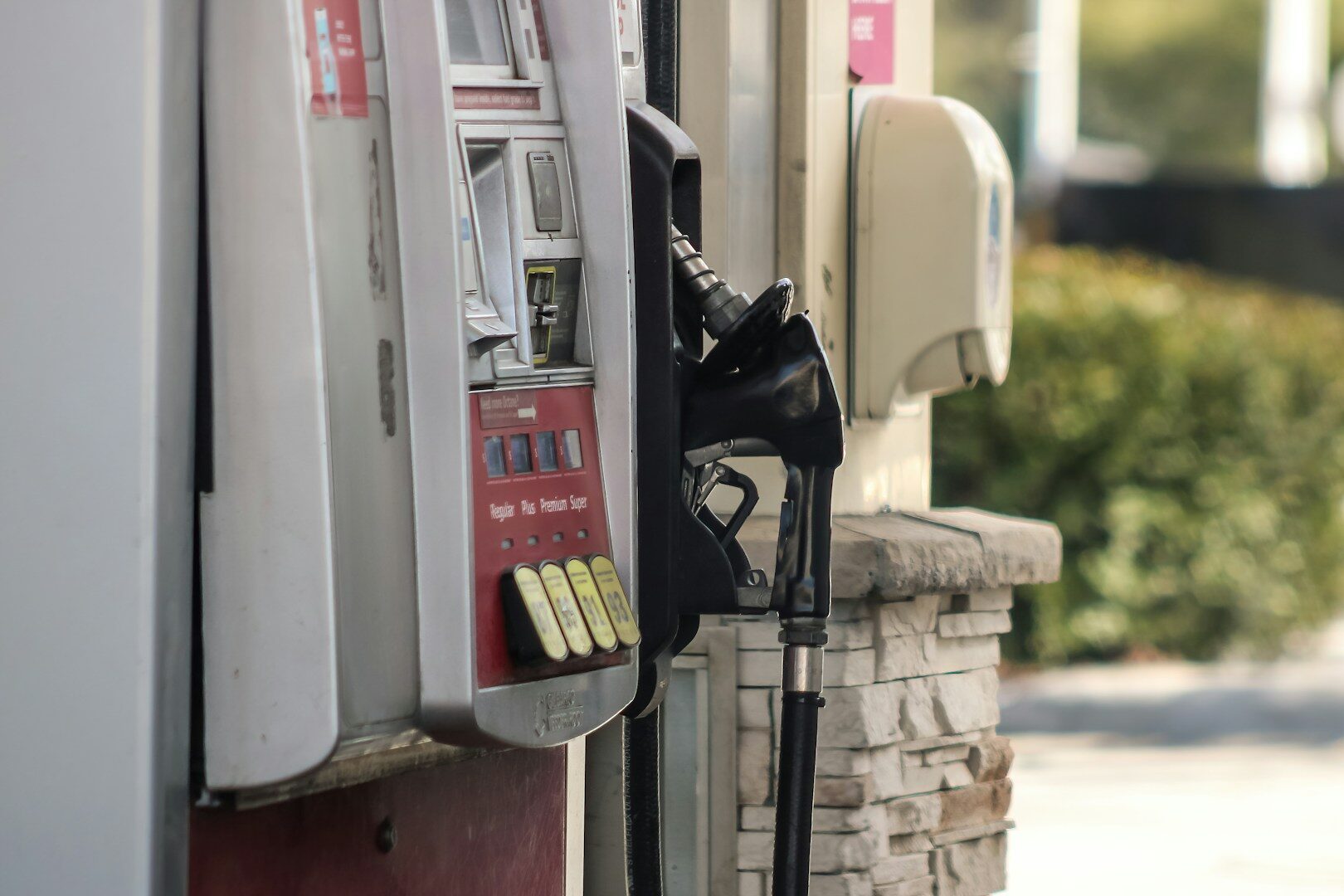
AAA’s national gas price average moved again this week, climbing ten cents to $3.943 a gallon. If that trajectory feels familiar, it should. Gas has been drifting back toward $4 since the ceasefire with Iran collapsed, and the culprit this week isn’t a gas station owner padding margins. It’s a crude oil market pricing in risk from a shipping lane seven thousand miles away.
Garage-worthy EDC gear, on sale this week.
Check This Out: 5 Genius Garage Upgrades Under $100 That Make a Big Difference
AAA pointed directly at instability along the Strait of Hormuz this week, with WTI crude settling at $79.60 a barrel, up from the mid-$60s a month ago. AAA’s own weekly data shows gasoline demand held flat and supply barely moved. The jump at the pump has nothing to do with how much gasoline Americans are buying and everything to do with a stretch of water most drivers couldn’t find on a map.
But the national average is the least interesting number in AAA’s weekly release. Buried further down the page is the one that actually explains what you pay at your specific pump: the state-by-state list. Line up all fifty states and Washington, D.C., and the gap between the cheapest gas in the country and the most expensive is $2.12 a gallon. That’s not a rounding error. It’s the price of dinner, every single fill-up, just for living in the wrong ZIP code. Sustained spikes like this don’t stay abstract, either. Some school districts have already had to eat six-figure monthly fuel overruns during past run-ups just to keep buses running.
Read Next: 10 Emergency Car Products You Hope You Never Need
According to the U.S. Energy Information Administration, crude oil accounts for roughly half of what you pay at the pump nationally, with refining, distribution, and taxes splitting the rest. That means state and local policy, not oil markets, decides most of the gap between what your neighbor two states over pays and what you pay. Nowhere is that clearer this week than a twenty-five mile stretch of the Indiana-Illinois border.
Same Refinery, Different Planet
BP’s Whiting Refinery sits in Whiting, Indiana, close enough to see the Chicago skyline from the property line. It’s one of the largest refineries in the country, and its gasoline supplies both Indiana and Illinois through the same pipelines and the same terminals. Same crude oil. Same refining process. Same molecules, more or less.
Yet this week, Indiana is averaging $3.318 a gallon, the cheapest gas in the country. Illinois is averaging $4.127. That’s an 81-cent gap between two states that share a fence line and, quite often, a fuel truck.
The difference isn’t chemistry. It’s paperwork. Illinois carries one of the heavier state gasoline tax burdens in the country, and the Chicago metro area is required under the Clean Air Act to sell a reformulated gasoline blend engineered to cut smog in dense urban areas. Roughly a third of the gasoline sold in the U.S. falls under some version of that requirement, and it always shows up at the pump. Indiana has neither that tax load nor that blend mandate. Same refinery. Different rulebook. Illinois drivers pay for the rulebook every time they fill up, whether they realize it or not.
That’s worth remembering the next time someone blames the gas station on the corner for a high price. The attendant didn’t set your state’s tax rate or write the Clean Air Act. Your legislature and the EPA did that years ago, and you’ve been paying the invoice ever since without ever seeing an itemized version.
The West Coast Isn’t Expensive. It’s Cut Off.
California ($5.406), Hawaii ($5.439), and Washington ($4.985) round out the priciest gas in the country this week, and the instinct is to blame state taxes and move on. Taxes matter, but the bigger issue is geography. California requires its own boutique summer gasoline blend, refined by a shrinking number of in-state refineries running close to full capacity just to keep up with demand. When even one of them has an unplanned outage, there’s no cushion. Gulf Coast refineries can technically send gasoline west, but it takes time to arrive, and by the time it does, the shortage has already priced itself into every pump in the state.
Hawaii and Alaska have it worse in a different way. There’s no pipeline fix at all. Every gallon arrives by tanker ship, and shipping is never the cheapest way to move fuel.
The EV Charging Irony Nobody Prices In
Buried in AAA’s same weekly release is a number worth pausing on if you think electric vehicles sidestep this entire mess: the most expensive public EV charging in the country this week isn’t in California. It’s West Virginia, at 52 cents per kilowatt-hour, ahead of Hawaii and Alaska. West Virginia has no state EV mandate and burns more coal than almost anywhere in the country, and its drivers are still paying the highest premium at the plug.
That’s not really about electricity generation. It’s the same scarcity story as gasoline, just with a different fuel. Public charging prices track station density and competition, not what’s happening at the power plant. Fewer chargers per driver means less pressure to keep prices down, the same dynamic that keeps gas prices high in towns with only one station. The energy source changes. The economics of scarcity don’t.
This Week’s Numbers, State by State
Here’s where every state stood as of July 16, according to AAA’s daily fuel price survey, listed by regular-grade average with diesel alongside for the truck and towing crowd.
| State | Regular | Diesel |
|---|---|---|
| Alabama | $3.588 | $4.738 |
| Alaska | $4.671 | $5.244 |
| Arizona | $4.124 | $5.066 |
| Arkansas | $3.559 | $4.551 |
| California | $5.406 | $6.594 |
| Colorado | $3.961 | $4.771 |
| Connecticut | $4.013 | $5.250 |
| Delaware | $3.853 | $4.869 |
| District of Columbia | $4.073 | $5.487 |
| Florida | $3.952 | $5.179 |
| Georgia | $3.729 | $4.926 |
| Hawaii | $5.439 | $6.918 |
| Idaho | $4.043 | $4.742 |
| Illinois | $4.127 | $4.958 |
| Indiana | $3.318 | $4.940 |
| Iowa | $3.797 | $4.635 |
| Kansas | $3.616 | $4.441 |
| Kentucky | $3.563 | $4.590 |
| Louisiana | $3.534 | $4.648 |
| Maine | $3.973 | $5.320 |
| Maryland | $3.881 | $4.971 |
| Massachusetts | $3.960 | $5.232 |
| Michigan | $4.077 | $4.948 |
| Minnesota | $3.863 | $4.785 |
| Mississippi | $3.498 | $4.615 |
| Missouri | $3.607 | $4.426 |
| Montana | $4.004 | $4.576 |
| Nebraska | $3.809 | $4.506 |
| Nevada | $4.559 | $5.372 |
| New Hampshire | $3.931 | $5.167 |
| New Jersey | $3.957 | $5.007 |
| New Mexico | $4.043 | $4.915 |
| New York | $4.103 | $5.421 |
| North Carolina | $3.653 | $4.913 |
| North Dakota | $3.681 | $4.442 |
| Ohio | $3.795 | $4.840 |
| Oklahoma | $3.550 | $4.325 |
| Oregon | $4.514 | $5.319 |
| Pennsylvania | $4.007 | $5.389 |
| Rhode Island | $3.944 | $5.073 |
| South Carolina | $3.679 | $4.905 |
| South Dakota | $3.850 | $4.436 |
| Tennessee | $3.558 | $4.724 |
| Texas | $3.547 | $4.668 |
| Utah | $3.997 | $4.790 |
| Vermont | $4.048 | $5.212 |
| Virginia | $3.767 | $4.924 |
| Washington | $4.985 | $5.899 |
| West Virginia | $3.799 | $4.765 |
| Wisconsin | $3.714 | $4.753 |
| Wyoming | $3.961 | $4.654 |
What Actually Matters Here
None of this means gas prices are about to spike into crisis territory. WTI at $79.60 a barrel is elevated, not alarming, and there’s room to climb before prices threaten the highs from earlier this year. What matters is reading this list correctly every week it lands in your inbox. The number next to your state rarely tells you something unique about your state. Mostly, it tells you two things: how nervous the oil market is about a shipping lane most of us will never sail through, and how many taxes and blend requirements your legislature piled onto every gallon years before you ever noticed.
A gallon of gasoline refined in Whiting, Indiana, doesn’t know it’s about to cross the state line into Illinois. The molecules don’t change on the drive over. The price tag does. That’s not really an oil story. It’s a policy story wearing an oil story’s clothes, and it repeats itself in this list every single week.
Related Articles
- Potential Keystone Pipeline Disruption Raises Gas Price Concerns
- Media Quietly Walks Back Its Gas Price Panic