
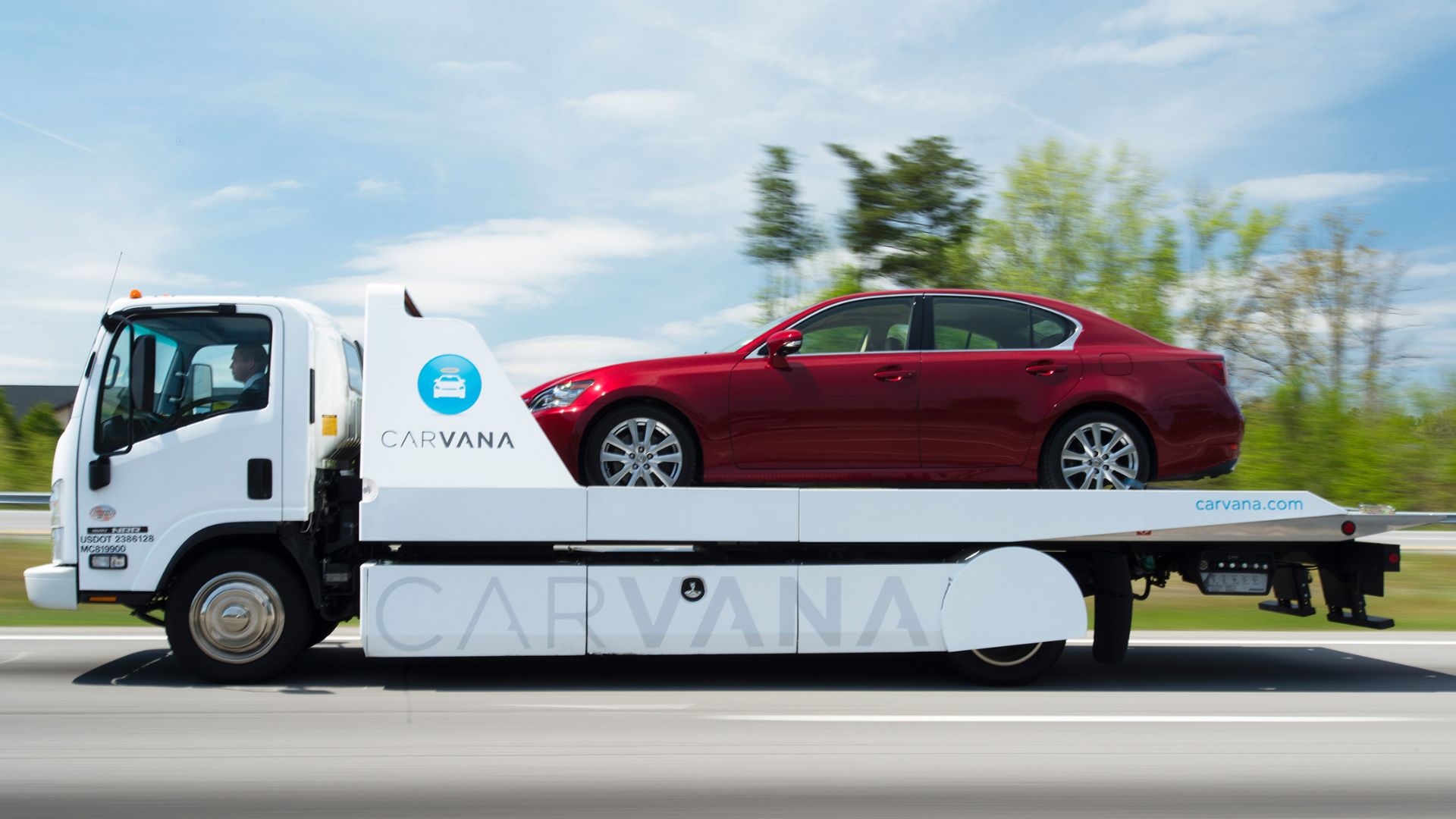
A Chrysler Dodge Jeep Ram store in Casa Grande, Arizona used to sell thirty to fifty new vehicles a month. That’s a normal number for a rural CDJR store. Last May, it sold more than seven hundred. The cars didn’t change. The brand didn’t change. The zip code didn’t change. What changed is who signs the dealer agreement, and that detail explains more about the future of car retail than any horsepower figure or infotainment upgrade will this year.
The buyer is Carvana. The company best known for glass vending-machine towers and a return policy generous enough to make traditional dealers wince now owns franchised new-car dealerships — Stellantis stores, selling Chrysler, Dodge, Jeep, and Ram vehicles. And it didn’t need to change a single state law to do it.
According to Carvana’s own SEC filings, the company spent $160 million acquiring five franchised Stellantis dealerships during 2025, paying $101 million in cash and assuming $59 million in trade vehicle floor plan payables. Its first-quarter 2026 filing shows a sixth dealership added for $11 million. Trade press coverage this summer put the running total at seven stores for a combined $171 million, the same cumulative figure disclosed in Carvana’s own filings, suggesting at least one more deal closed before the company’s next quarterly report catches up.
The Casa Grande store, Carvana’s first, is the one getting attention. Carvana bought it in March 2025, back when it was an ordinary Chrysler Dodge Jeep Ram franchise. It now reportedly ranks among the highest-volume CDJR stores in the country.
None of that is really the story. How many new Jeeps one Arizona dealership can move isn’t the interesting part. How Carvana got permission to move them at all, and who is paying to keep the experiment running, is.
The Loophole Nobody Had To Sue For
Here’s what most car buyers don’t know: an automaker cannot legally sell you a new vehicle directly across most of the United States. Franchise laws passed decades ago, originally meant to stop manufacturers from undercutting the independent dealers who’d already sunk money into showrooms and service bays, require new vehicles to move through independently owned, state-licensed dealers. That rule is the entire reason Tesla spent a decade fighting state by state for the right to sell its own cars, and it’s why Scout Motors is currently petitioning the Department of Justice to gut those same state laws. It’s also why Volkswagen’s own franchised dealers sued to stop Scout from attempting to sell direct in the first place.
Carvana skipped the fight. It didn’t ask permission to sell new cars without a franchise. It bought franchises. Every Stellantis store Carvana owns is a fully licensed, state-approved new-car dealership, indistinguishable on paper from the one down the street still run by a family that’s held the franchise for three generations. Carvana just routes that franchise’s inventory through a nationwide website, a home-delivery network, and financing built for online buyers instead of one lot’s walk-in traffic. It isn’t tearing down the century-old system protecting car dealers. It’s fully licensed to operate inside it, at a scale that system was never designed to handle.
Stellantis’s Own Bank Is Financing Its Disruption
Here’s the part that should raise eyebrows well beyond Carvana’s own boardroom. New-car dealers don’t pay cash for the vehicles sitting on their lot. They borrow against that inventory through what’s called floor plan financing, then pay the loan down as each car sells. The interest on unsold inventory is one of the quieter, ongoing costs of running a dealership, and manufacturers generally want their captive finance arms handling that lending, both for the interest income and the leverage it gives them over how a store operates.
Carvana’s floor plan lender for these Stellantis stores is Stellantis Financial Services, the automaker’s own captive lender. Per Carvana’s regulatory filings, the credit line backing this inventory grew from $214 million to $257 million between the 2025 annual report and the first-quarter 2026 filing, priced at roughly one-month SOFR plus 2.25 to 3.25 percentage points depending on how much of the store’s retail financing also runs through SFS. In plain terms, Stellantis’s own bank is financing the new-vehicle inventory sitting inside the company trying to prove it can sell Jeeps and Rams faster than a chunk of Stellantis’s traditional dealer body.
That’s an unusual position for an automaker’s lender to be in. Nissan’s captive finance arm spent this year in court against its own Manhattan dealers, and a GMC dealer on Long Island is suing General Motors, accusing the automaker of starving the store of inventory it needed to hit sales targets. Captive finance arms are usually a source of friction between manufacturers and the independent dealers carrying their brand. At Carvana’s Stellantis stores, that same financing relationship is functioning as fuel instead.
Why the Paperwork Is Worth More Than the Building
There’s a smaller detail buried in the same filings worth knowing if you’ve ever wondered why a public company would pay real money for a struggling small-town dealership. Carvana books part of each purchase price as an indefinite-lived intangible asset, separate from the land, the building, or the vehicles on the lot. That intangible is the franchise right itself: the legal permission to sell new Stellantis vehicles under that nameplate, in that territory, indefinitely. It doesn’t depreciate. A struggling small-town Chrysler store can be worth more on paper than the buildings sitting on the property, because that paperwork is the one thing state franchise law says you can’t simply create from scratch.
Why Stellantis Is Letting This Happen
Why would an automaker allow this, let alone help fund it? Stellantis reported an estimated $2.7 billion loss through the first half of 2025, a period defined by bloated dealer inventory and a North American business that needed both cash and proof its vehicles could still move. A buyer willing to pay cash for underperforming stores, absorb their floor plan obligations, and multiply their sales volume more than tenfold is not a threat worth fighting. It’s a release valve.
That doesn’t mean every Stellantis dealer should relax. It means the pressure, for now, is landing on the smallest and weakest stores in the network, the ones a factory quietly wants gone anyway.
A Different Kind of Disruption
Carvana’s stores are arriving alongside a broader reshuffling of how cars change hands. Amazon started selling used cars through its marketplace last year, Hertz followed by listing its own rental fleet on Amazon, and General Motors has started requiring dealers to route certified pre-owned sales through its own CarBravo platform instead of third-party listings. Each of those moves inserts a new layer between a shopper and a car. Carvana’s Stellantis play is different in one important way: it isn’t building around the franchise system. It bought a badge and stepped inside it.
Every other company that has tried to sell new cars directly to the public in the last decade has had to lobby a legislature, survive a lawsuit, or wait out a regulator. Carvana just bought the paperwork.
That’s the real story behind a rural Arizona dealership suddenly moving seven hundred new trucks a month, and it’s worth remembering the next time a car company insists direct sales are impossible without changing the law. Sometimes the law was never the obstacle. The dealership license was for sale the whole time.