
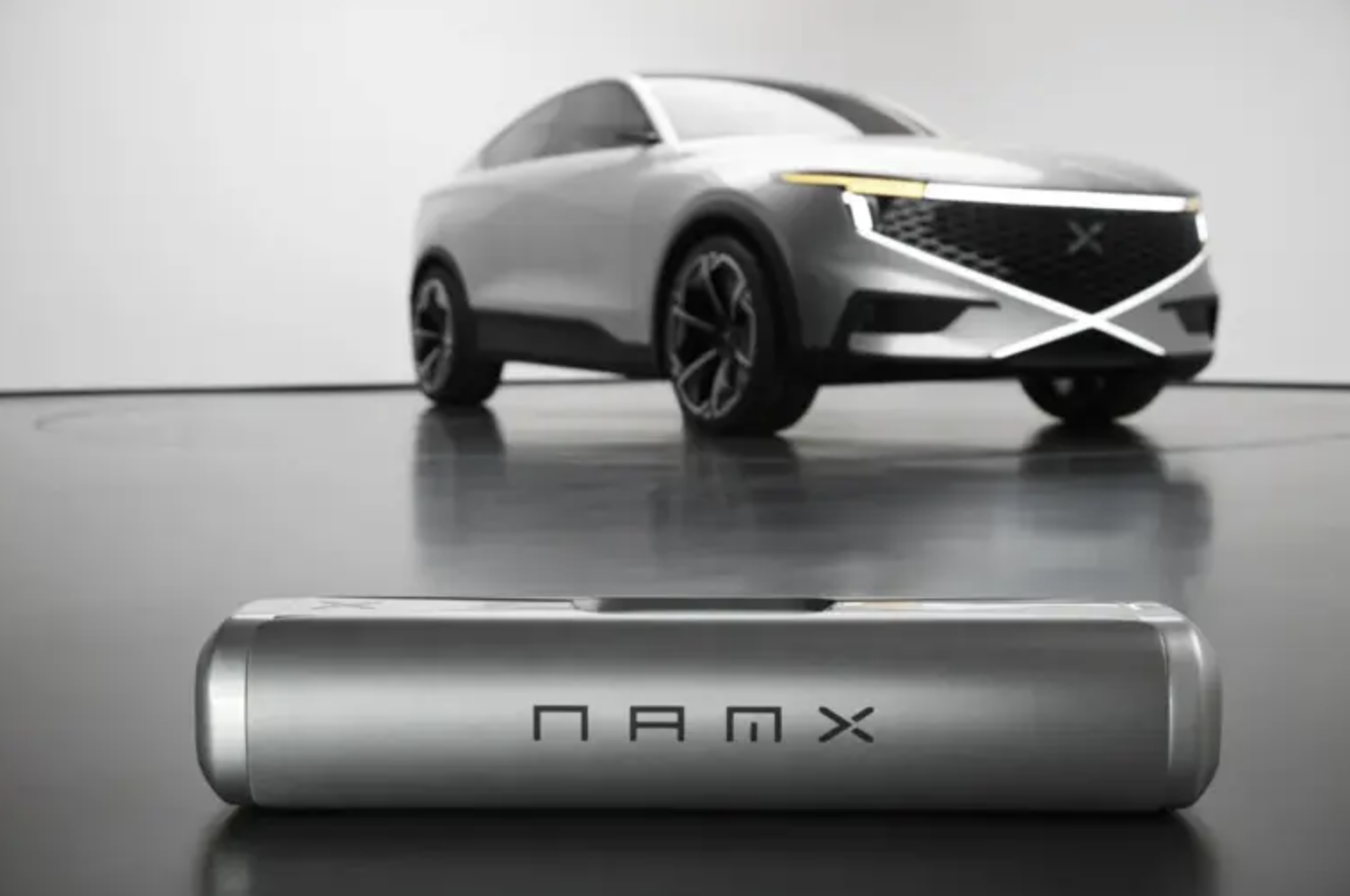
There’s a number bouncing around about the NamX HUV: 932 miles of range, five seconds to refuel. It’s a great number. It’s also not one the company has ever published.
Go to NamX’s own pre-order page and the figure sitting next to both trim levels is 800 kilometers — 497 miles. Not 1,500 km. The capsule page says all six removable bottles can be pulled “in less than two minutes,” which is a perfectly reasonable claim and roughly twenty-four times longer than five seconds. Somewhere between the French startup’s marketing copy and the aggregator churn, a decimal point went on vacation.
So let’s talk about what the HUV actually is, because the real engineering is more interesting than the fake numbers.
Eight kilograms, six bottles, one problem
NamX’s pitch is a dual-tank architecture. A fixed 5 kg carbon-composite tank lives in the floor, and behind a glass panel above the rear bumper sit six removable capsules holding 3 kg combined — 8 kg of hydrogen total. Empty capsules pop out via the key fob or a phone app; you swap them at one of the 4,000 “CapXtores” NamX says it wants scattered across European dealerships, gas stations, parking garages, and supermarkets.
Here’s the thing enthusiasts should notice immediately: the capsules are 37.5% of the fuel supply. The other 5 kg still lives in a fixed tank that can only be filled at a real 700-bar dispenser. The capsules are a range extender bolted onto a conventional fuel-cell car, not a replacement for hydrogen infrastructure. NamX’s own wording — the capsules “complement the main tank to optimise the HUV’s range” — is accurate. The framing that this car frees you from stations is not.
Related Articles
- Honda’s Best-Selling EV Just Died. Turns Out It Was Never Really Honda’s Car
- Volkswagen Wants to Axe Half Its Lineup. It Just Spent Three Years Building the Half It’s About to Kill
Now run the efficiency math. Toyota’s Mirai carries 5.6 kg and is rated by the EPA at 402 miles, which works out to roughly 72 miles per kilogram in a low-slung, rear-drive sedan built on a Lexus platform specifically for slipperiness. NamX wants 497 miles from 8 kg, or about 62 miles per kilogram — from a two-box coupe-SUV that in GTH form makes 550 horsepower and runs to 62 mph in the low fours. Getting within 14% of a Mirai’s fuel economy while carrying an SUV’s frontal area and an extra 200-plus horsepower is an aggressive target, and it’s the number most worth watching when a validated prototype finally shows up.
What a 0.5 kg hydrogen bottle actually weighs
This is where the capsule concept meets physics. Compressed hydrogen storage is not weight-efficient, and it doesn’t get better when you make the vessels small.
The Department of Energy’s most recent program record on 700-bar Type IV onboard storage puts system gravimetric capacity at 1.71 kWh per kilogram of system mass. Hydrogen carries about 33.3 kWh/kg, so that’s roughly 5.1% hydrogen by weight — about 19.5 kg of tank, liner, boss, valve, and plumbing for every 1 kg of gas. Apply that to a 0.5 kg capsule and you get something in the neighborhood of 10 kg, or 21 pounds, per bottle. And that figure comes from a large, optimized single-tank system; small pressure vessels carry proportionally more end-cap, boss, and valve mass, so the real capsule is likely worse.
Six of those is well north of 120 pounds of hardware riding above the rear axle, high and far back — the worst possible place for mass on a vehicle you’ve just given 550 horsepower. It also means the “just swap them yourself” experience involves repeatedly lifting a 20-pound carbon-wrapped pressure vessel at bumper height. Anyone who has wrestled a full 20-lb propane tank into a truck bed knows how that goes on a rainy Tuesday.
There’s a regulatory wrinkle too. A hydrogen tank permanently mounted in a car is certified as part of the vehicle and inspected on the vehicle’s schedule. A tank that leaves the car and rides in a delivery van to a supermarket becomes a transported pressure vessel with its own dangerous-goods handling, labeling, and periodic requalification regime — and thousands of them cycling through retail locations is a compliance apparatus, not a product feature. NamX has said nothing publicly about who owns that liability chain, and it’s the question any serious investor should ask first.
The infrastructure argument cuts both ways
NamX built its whole thesis on hydrogen stations being scarce and unreliable. That part is true, and the data is worse than the pitch deck suggests.
California — the largest light-duty fuel-cell market on earth — had 66 open retail stations in late 2023. By the 2025 joint assessment from the California Energy Commission and CARB, that was down to 50 open stations with 11 more offline for at least 30 days, and network availability averaging about 60%. Roughly 14,128 registered FCEVs were sharing that.
Related Articles
- Ford’s New Remote Kill Switch Isn’t Really About Stopping Car Thieves. It’s About Owning The Off Switch.
- A Thief Couldn’t Start This Stolen Porsche, So He Dragged It Down the Street Like a Shopping Cart
Europe is moving the other direction on paper. Under Regulation 2023/1804, member states must deploy publicly accessible hydrogen stations with at least 1 tonne/day capacity and a 700-bar dispenser no more than 200 km apart along the TEN-T core network, plus one in every urban node, by the end of 2030. Which creates an awkward strategic problem for NamX: its capsule network is a workaround for a station shortage that EU law is scheduled to fix roughly when the car is supposed to arrive.
Read the reservation terms before you send €1,000
Pininfarina’s 2022 announcement put the HUV on sale in Q4 2025 at €65,000 to €95,000. Today the pre-order page lists €75,000 for the 300-hp GT, €95,000 for the 550-hp GTH — and delivery in Q4 2028. That’s a three-year slip and a €10,000 increase on the base car, both already baked in before a production example exists.
The reservation itself costs €1,000, and the terms are worth reading in full. Cancel before signing a purchase order and you get your money back minus a 15% processing fee — €150 gone — with refunds processed within 60 days. The contract also states plainly that NamX guarantees nothing about development progress, final delivery dates, final design, final specifications, or final price, all of which may change between reservation and purchase. That document was last updated in September 2022.
None of this makes the capsule idea dumb. Decoupling a portion of the energy storage from the vehicle is a genuinely clever answer to a real problem, and NamX has a Pininfarina-shaped body most startups would kill for. But the practical takeaway for anyone reading a “932 miles, five-second refuel” headline is simple: the manufacturer says 497 miles and two minutes, most of the fuel still requires a station that may or may not be working, and the deposit is 85% refundable on a car scheduled to arrive in 2028.
Images Via: NamX