
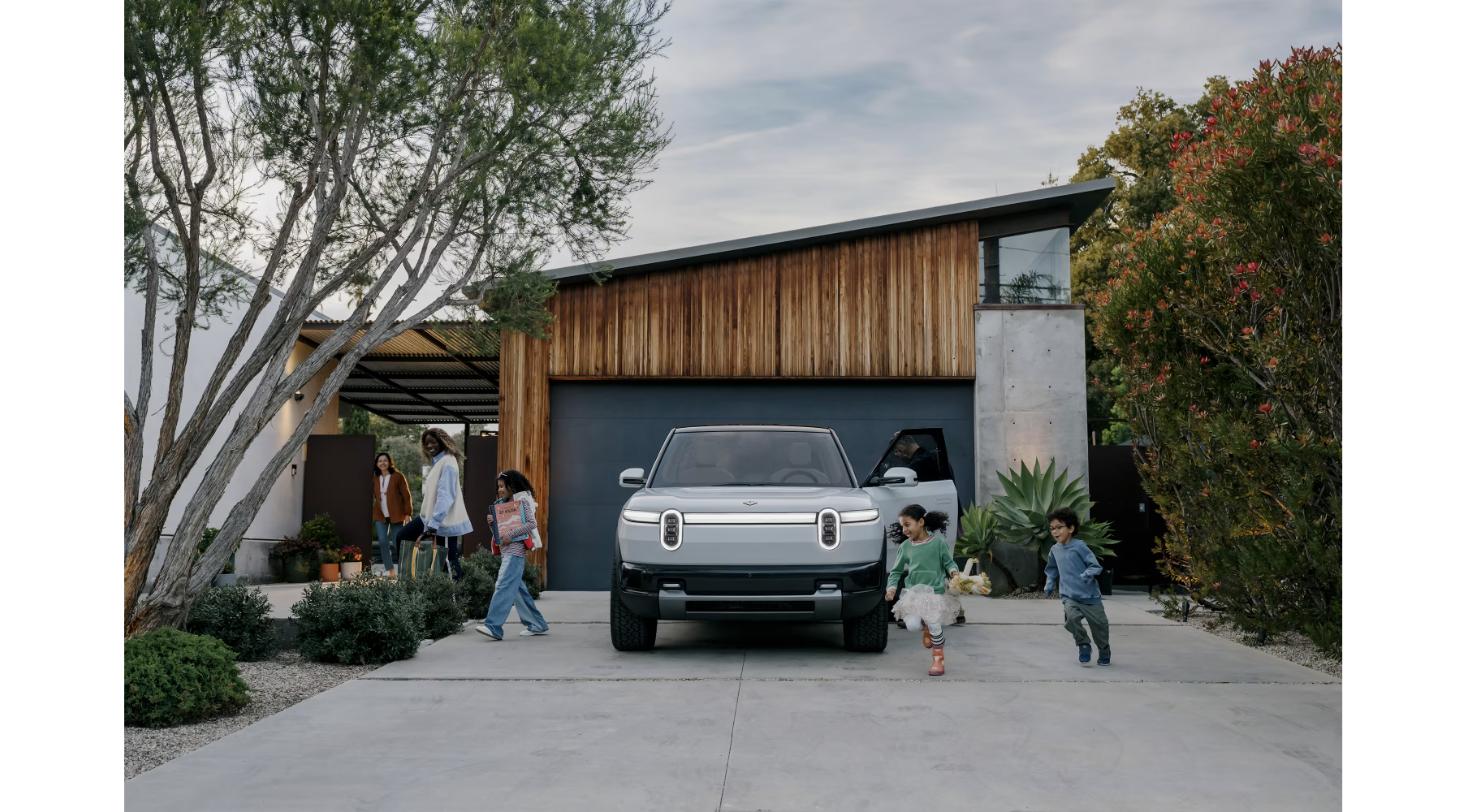
Rivian wants investors to notice one number from its first-quarter 2026 report, filed the same week the first Rivian R2 SUVs reached customer driveways: $119 million in consolidated gross profit. It’s the kind of figure a young automaker loves to put in a headline, because for most of Rivian’s public life, gross profit has been a negative number chasing a positive one. Keep reading the release, though, and a less flattering number shows up: the automotive segment — the part of Rivian that actually designs, builds, and sells vehicles — posted a gross loss of $62 million for the same quarter. Every dollar of that celebrated profit came from somewhere else: software, services, and vehicle subscriptions, up 49 percent year over year on the back of electrical-architecture licensing and maintenance revenue.
Rivian did not get healthier by selling cars. It got healthier by selling code.
That distinction is the real story hiding underneath the loudest announcement Rivian has made in years: the start of public customer deliveries for R2, the mid-size SUV that is supposed to be the vehicle that finally makes Rivian’s core business — building and selling cars — work as a business. R2 isn’t just a smaller, cheaper Rivian. It’s a rescue mission wearing a nice paint job.
The Engineering Tell
Look at what Rivian actually changed on R2, and the priorities become obvious. The SUV is nearly 2,000 pounds lighter than the R1S, rides on a wheelbase of just 115.6 inches, and runs what Rivian calls a streamlined electrical architecture built for less complexity, not more capability for its own sake. None of that is about chasing a better 0-60 time. It’s a parts-count and assembly-time reduction exercise, the same playbook Tesla ran when it went from the hand-built Model S to the mass-market Model 3: shed mass, shed wiring, shed the exotic manufacturing steps that make a vehicle a joy to engineer and a nightmare to build a hundred thousand times a year.
Wait, really: Rivian’s first-quarter cash burn from operations did not just get a little worse than a year earlier. It nearly quadrupled, from $188 million to $703 million, largely because R2 pre-production and ramp costs hit the books before most retail customers had even placed an order. Ramping a new vehicle program is always the most expensive phase of its life. Rivian chose to run through that phase while its existing lineup was already unprofitable, betting that R2’s cost structure earns the burn back before the company’s roughly $4.8 billion cash cushion runs out.
Why Georgia Just Got Bigger
Buried in the same earnings release is a decision that shows how seriously Rivian is treating its economics problem. The company increased the planned first-phase capacity of its Georgia manufacturing plant by 50 percent, to 300,000 vehicles a year, specifically to improve cost efficiency, and restructured its Department of Energy loan to match. Scale is the entire game in car manufacturing — it’s the difference between paying a supplier retail prices for stampings and paying wholesale. A plant that was already going to be big just got bigger, before it has built a single production vehicle. That isn’t a company hedging its bets. That’s a company that has already decided volume is the only way out of the hole it’s in.
It also puts Rivian in a position Toyota admitted to when it delayed the electric Highlander: betting an entire new vehicle strategy on a single, unproven factory before that factory has shipped a real production run. Rivian is making that bet in Georgia. Toyota made a version of the same bet with its own supply chain. Neither company particularly wants that parallel drawn.
The Robotaxi Detail Nobody’s Pricing In
Here’s the part of the R2 story that reads like a footnote and isn’t. In March, Rivian and Uber announced a partnership in which Uber will invest up to $1.25 billion in Rivian, not as a simple check, but paid out in tranches tied to Rivian hitting specific autonomous-driving milestones. The vehicle underneath that deal is R2. Uber, or its fleet partners, are expected to buy 10,000 fully autonomous R2 robotaxis to start, with an option for 40,000 more by 2030, deploying first in San Francisco and Miami in 2028 and scaling to 25 cities by 2031.
That means every ordinary R2 sold to a family in the suburbs is doing double duty. It is a retail sale, and it is also a rolling data-collection unit for the perception and autonomy stack Rivian needs validated before Uber’s money actually shows up. Volkswagen structured its own investment in Rivian the same way, releasing roughly $1 billion only after Rivian’s technology cleared winter testing. The auto industry has quietly moved into an era where partner capital doesn’t arrive as a lump sum anymore. It arrives as an earnout, gated on engineering milestones, which spreads Rivian’s development risk across balance sheets that aren’t Rivian’s own.
It’s a clever way to fund a capital-intensive business without diluting shareholders further. It also means Rivian’s stock is now, in part, a bet on regulatory approval for robotaxis that don’t yet exist in commercial service, and that regulatory path is not guaranteed to be smooth. Plenty of states are still arguing over what a robotaxi is even allowed to do without a steering wheel or a human behind it.
What This Actually Means for Rivian R2 Buyers
None of this changes what a customer gets for $57,990 in an R2 Performance: a competent, good-looking mid-size electric SUV with real off-road numbers and Rivian’s usual software polish. But it does change how you should read the news that deliveries have started. This isn’t a company casually expanding its lineup downmarket the way some legacy automakers keep publicly hedging their own EV bets depending on who’s in the White House. Rivian doesn’t have that luxury. It is using one vehicle program to solve three problems at once: a manufacturing cost problem, a balance-sheet problem, and an autonomy-validation problem, while its existing lineup still loses money on every unit sold.
Rivian reports second-quarter earnings on July 30. The number worth watching isn’t revenue, and it isn’t the delivery count. It’s whether the automotive segment’s gross margin, the actual business of building cars, starts closing the gap on its own, or whether Rivian is still, in effect, running a software company that happens to give away a car with every subscription.
Building a good electric SUV was never the hard part for Rivian. Building the same SUV profitably, tens of thousands of times a year, in a factory that doesn’t exist yet, is the bet the entire company is now riding on.