
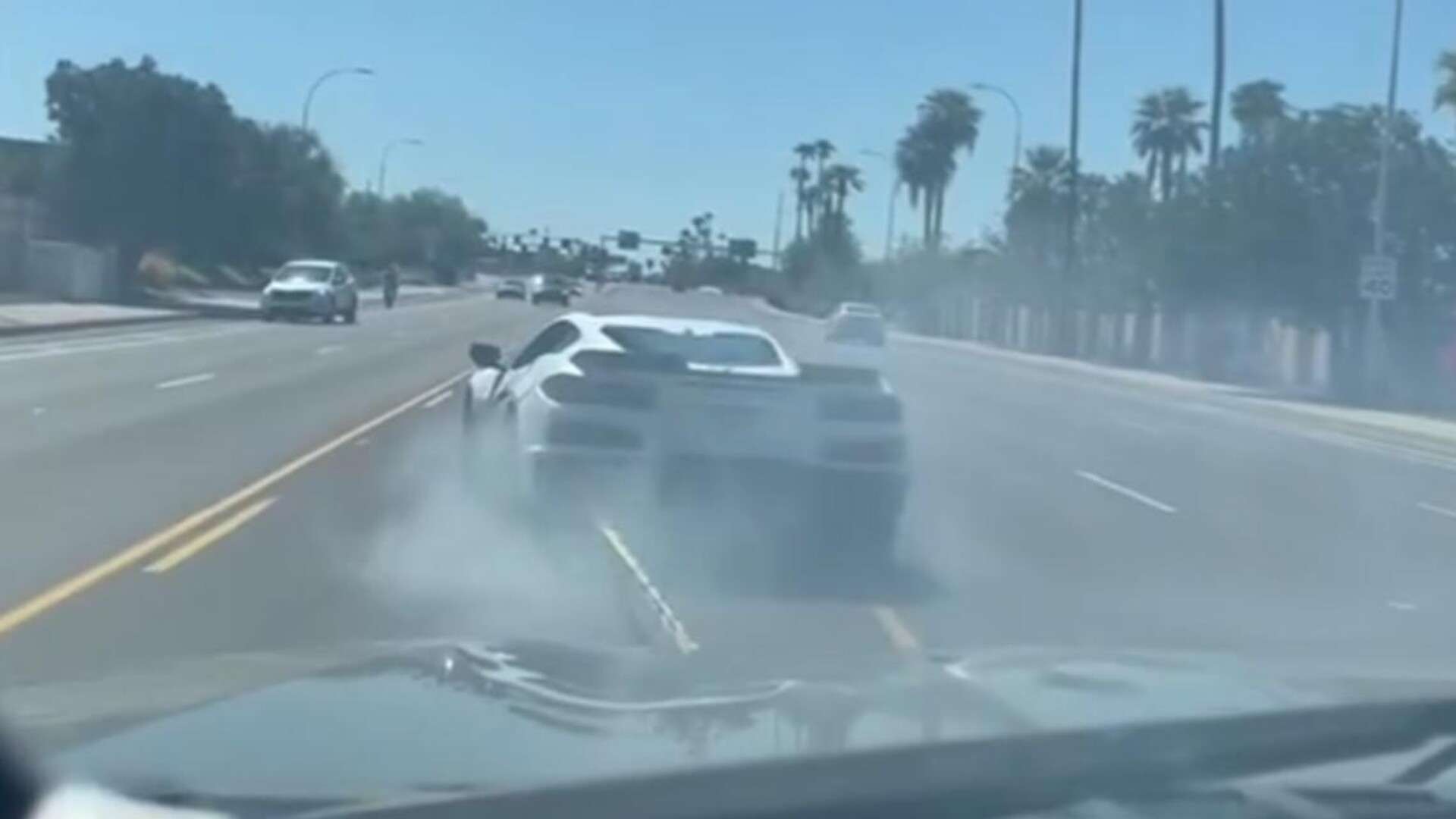
On the night of Sept. 9, 2025, a white C8 Corvette went over the Mill Avenue Bridge above Tempe Town Lake fast enough that the car’s own camera recorded triple digits. Tempe police described the footage as showing the car “hitting 140 mph and blowing through red lights.” Arizona’s Family, which aired the clip, read the number as 142. A motorcycle officer tried to pull the driver over. According to police, he ran the red lights and was gone.
The getaway lasted one night. On Sept. 10, officers spotted the same Corvette, and the department says the driver “even tried to run from police” a second time. This time a patrol car fired a Grappler, the nylon net launched from a push bumper that snags a fleeing car’s rear tire and drags it to a stop. Tempe impounded the car and, in the department’s words, “booked the driver on a felony.” Police named him as Mazen Alassmari, and Arizona’s Family reported the booking charge as felony flight.
Video showed this Corvette hitting 140 mph, blowing red lights. The driver even ran from police the next day! Officers grappled the sports car, impounded it, and arrested the driver on a felony. We hear your concerns about dangerous driving — and we’re taking action! https://t.co/t4vOK7DkNh
— Tempe Police Department (@TempePolice) October 11, 2025
The Auto Wire covered the arrest when it happened in October 2025 and again in February, when body-camera footage of the stop came out. Tempe turned the arrest into a public message. Its October 2025 post of the video closed with “We hear you. We act.” and a promise of “zero tolerance for reckless driving” under the city’s Vision Zero traffic-safety program. A year later, the half of that slogan aimed at the car is the half the public record can confirm. The half aimed at the driver is much harder to find.
What the Maricopa County court index shows
Felony cases in Maricopa County are prosecuted in Superior Court. A search of the court’s public criminal case index on Sept. 30, 2026, for the name Tempe police released, first by full name and then by last name alone, returned “Sorry, no matches to your query” both times. The same index returned pages of results for a common name, so the search itself was working.
That does not mean the driver walked, and it does not mean he did what police say he did. A booking is an arrest, not a charge. The Maricopa County Attorney’s Office decides whether a felony gets filed, and a case can sit in review for months. It could also be indexed under a different spelling, or have been handled as misdemeanors in Tempe Municipal Court, whose records sit behind a state lookup that could not be searched. No public statement from Tempe police on the case turned up after the October 2025 post.
The calendar is not the problem yet. Under Arizona’s statute of limitations, prosecutors have seven years to bring a class 2 through class 6 felony and one year to bring a misdemeanor, counted from when the state discovers the offense. A felony flight charge for September 2025 can be filed until September 2032. Any misdemeanor charge for the same two nights of driving had to be filed by September 2026.
The charges the video points to
Felony flight is ARS 28-622.01. A driver who willfully flees or tries to elude a marked police vehicle running its emergency signals commits a class 5 felony. For a first offense, the sentencing table in ARS 13-702 runs from six months at the mitigated end to 2.5 years aggravated, with a presumptive term of 1.5 years. A class 5 felony also carries probation of up to three years under ARS 13-902.
The speed is a separate offense. Arizona’s excessive speed law makes driving more than 20 mph over the posted limit a class 3 misdemeanor, and 140 mph clears that bar on any road in Tempe, freeways included. Reckless driving under ARS 28-693 is a class 2 misdemeanor with a possible license suspension of up to 90 days.
Arizona’s racing statute does not need a second car. It bans any “exhibition of speed or acceleration” on a street, wording that reaches one Corvette on an empty bridge. A first conviction is a class 1 misdemeanor with a fine of at least $250 and a possible 90-day suspension. A second within 24 months becomes a class 6 felony, with at least 10 days in jail or prison before any release.
Tempe is not the only place where a Grappler stop and the charge sheet do not quite line up. Hillsborough County deputies grappled a wanted driver on I-75 earlier this month, and his 16 felony counts do not include fleeing.
The 20-day impound that does not wait for a verdict
The Corvette went to the impound lot the night of the stop, and Arizona built that step to move faster than the courts. ARS 28-3511 requires an officer to impound a vehicle when the driver is racing or driving recklessly and the officer reasonably believes letting him keep driving puts others at risk of serious bodily injury or death. The hold lasts 20 days, and the statute says an insurer owes no benefits for charges or fees tied to immobilization or impoundment.
Tempe adds a $150 administrative fee for every car held under the 20-day law, separate from the tow company’s towing and storage charges, according to the police department’s vehicle impound page. Owners are entitled to a poststorage hearing, which the department schedules by appointment on weekdays. The city does not publish the tow yard’s storage rates, so the final bill depends on who hooked the car.
Tempe’s street-racing summer and the Grappler
Tempe has been blunt about the strategy. During a two-week street-racing operation in late June 2025, Sgt. Matthew Barker told Arizona’s Family that racers who come to Tempe “will add your car to our collection.” Operation Street Shield produced 310 vehicle stops, 82 arrests and 43 impounded vehicles, the station reported.
The Corvette run came eight days after a street race on Rio Salado Parkway, east of Rural Road and a few minutes from the bridge, ended with a Ford Mustang hitting a photo-enforcement sign. All five people in the Mustang were thrown from the car; police later said none of the injuries were life-threatening, Arizona’s Family reported.
The Grappler is a local product, built in a Peoria, Arizona, workshop. In 2023 it cost about $5,000 per unit, and nearly 1,000 had been installed on police vehicles nationwide, with the Arizona Department of Public Safety as the largest customer, Fox 10 Phoenix reported. The goal is to end a pursuit early and slowly, before it turns into something worse. In the Corvette stop it worked as designed, and nobody was hurt. Our explainer on why almost nobody actually has one covers the cost and adoption problem. Not every pursuit-ending tool ends as cleanly: a family is suing after spike strips meant for a stolen Jeep killed a mother on I-64.
When Tempe’s Grappler stopped the wrong car
The same tool has cost Tempe before. In October 2023, Tempe officers helping the Maricopa County Sheriff’s Office chase an aggravated-assault suspect in Guadalupe grappled a white Buick Verano they believed matched the suspect’s car. It was the wrong car. A woman and her daughter were inside, and body-camera video shows officers ordering them out with weapons drawn, ABC15 reported after getting the footage through a public-records request. Neither was hurt. No officers were disciplined, and the department told the station its officers are trained on identifying suspect vehicles.
The net punctured the Buick’s gas tank, and the car was declared a total loss, with damage near $10,000, ABC15 reported in a follow-up. Tempe paid a little over $500, and that money went to a rental company. The owner never filed a notice of claim, which under Arizona law ended her case before it began. ARS 12-821.01 gives anyone with a claim against a city 180 days from the damage to file one, and the claim must name “a specific amount for which the claim can be settled.” A late claim is barred. If the city does not answer within 60 days, the law treats the claim as denied.
What comes next for the Corvette case
For the driver police named, the next date belongs to prosecutors. Felony flight stays fileable until September 2032, and if a case is filed, the Superior Court index is where it should appear. For everyone else on Tempe’s roads, the two Grappler cases set out the rules. A car held under the 20-day law comes with a right to a poststorage hearing and a $150 city fee that no insurer has to cover. A car damaged by police action comes with a 180-day window to file a claim with a dollar figure attached, and the city can deny it simply by staying quiet for 60 days.
Tempe took the Corvette off the road in a single night, and a year later no felony case under the driver’s name shows up in Superior Court’s public index. The city promised it would act. The car part was fast. Should cities keep leaning on the Grappler and the 20-day impound to deal with triple-digit drivers, or does taking the car let the system skip the slower work of winning a conviction?