
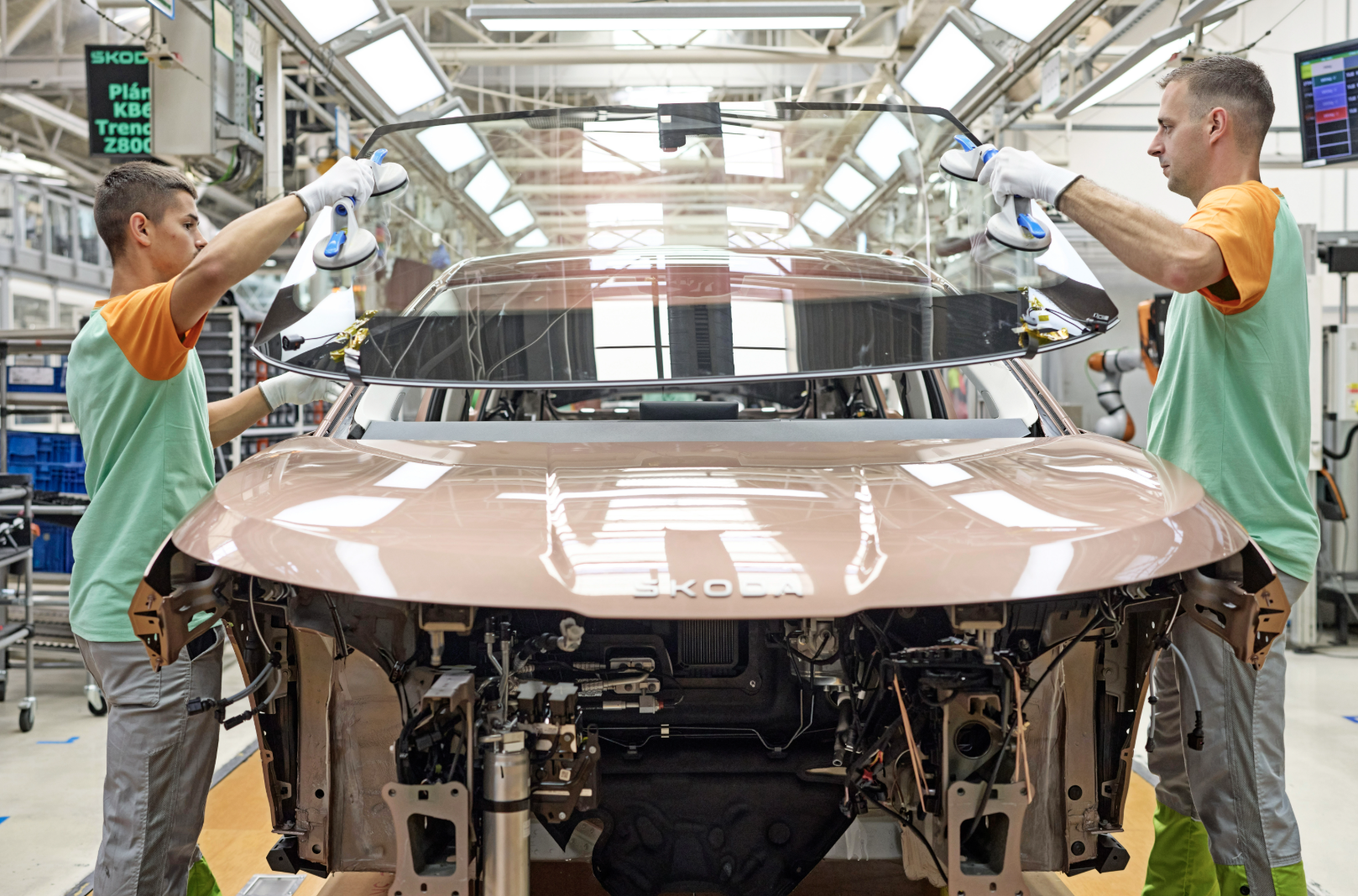
Škoda’s new Peaq flagship SUV comes with flush door handles, a panoramic roof with electronic shade control, and bidirectional charging. Every one of those features is engineered to make you look at the car. None of them is the actual story here.
The real story is happening on the floor of Škoda’s Mladá Boleslav plant, where a production line built for gasoline Octavias years ago is now turning out three separate electric models and a combustion wagon on the same conveyor, without missing a beat. That’s not a footnote buried in a press release. That’s the whole point, and it says more about where the EV transition actually stands in 2026 than any spec sheet does.
A Line Built for Gas, Now Running Four Cars at Once
On August 6, Škoda confirmed series production of the Peaq, its first entry into the large SUV class and, at 4.87 meters long, the biggest vehicle the brand has built since joining Volkswagen Group. It shares the Modular Electric Drive Matrix platform with the Enyaq and Elroq, and it rolls down the same Mladá Boleslav line as both of those EVs and the combustion-engine Octavia Combi.
That line wasn’t designed for any of this. It was built for gasoline cars. The Enyaq became the first EV to run down it in 2020. The Elroq followed in January 2025. The Peaq is now the fourth model sharing space with a wagon that still burns gasoline, and getting it there wasn’t just a scheduling trick. Škoda says it engineered larger production skids for ergonomics and safety, added a new manipulator just to install the Peaq’s third-row seats, and retooled the press shop, body shop, and paint shop to keep material flowing across four completely different vehicles.
Andreas Dick, Škoda’s chief production officer, called the Peaq “the pinnacle of our range in terms of comfort, spaciousness and technology.” Fair enough. But the more impressive engineering achievement isn’t the car. It’s the line that can build it next to a gasoline wagon without slowing down.
That flexibility is worth pausing on, because the alternative approach just failed spectacularly elsewhere in the Volkswagen empire. Volkswagen’s own showcase EV plant, converted at enormous expense starting in 2019, became the site of employee protests this summer as the company reportedly weighed its closure. Betting an entire factory on one product category turned out to be a bet on a demand curve that never arrived on schedule. Mladá Boleslav made the opposite bet: keep gasoline and electric lines interchangeable, and let customer orders, not five-year plans, decide the mix.
The Number Škoda Didn’t Put in the Headline
Buried near the bottom of the release is a figure that undercuts the flagship narrative: in the first half of 2026, only about 23% of vehicles built at Škoda’s Czech plants were fully electric. Three of the four models on that Mladá Boleslav line run on batteries. Yet fewer than one in four cars leaving the Czech Republic actually does. Do the math and the picture is obvious: the gasoline Octavia Combi, not the electric trio getting the press attention, is still carrying the volume.
Here’s the detail worth remembering: Škoda had to relocate Octavia Combi production to a second plant in Kvasiny back in May, alongside the standard Octavia liftback, specifically to free up floor space at Mladá Boleslav for the Peaq. Combustion-engine capacity wasn’t cut to make room for electric cars. It was moved down the road. That’s a very different story than “Škoda goes electric,” and a far more honest one.
Why a Budget Brand Suddenly Has a Flagship
There’s a margin story hiding here too. Škoda built its reputation as Volkswagen Group’s value brand, the place you went for Golf-adjacent practicality at a discount. The Peaq inverts that positioning: a seven-seat flagship with the largest battery Škoda has ever fitted, a 91 kWh pack good for more than 640 kilometers of range, three power outputs, available all-wheel drive, and premium touches like flush handles and bidirectional charging the brand has never offered before.
None of that is generosity. Battery packs cost roughly the same per kilowatt-hour whether they’re bolted to a compact city car or a full-size SUV, which is why the profit margin on cheap EVs runs thin across the industry compared with gasoline cars in the same price bracket. A bigger, better-equipped EV that buyers will actually pay more for is one of the few reliable ways to make electric production profitable rather than merely compliant with emissions targets. Building it on the shared MEB platform, with engineering costs spread across Volkswagen, Audi, Cupra and Škoda alike, is what lets the group’s traditionally cut-rate brand suddenly build something this ambitious without its own dedicated R&D budget, at a moment when Volkswagen’s profit engine in China is sputtering badly.
The Feature That Regulators Are Still Arguing About
Flush door handles look sleek in Škoda’s own press photos. They’ve also become one of the more contentious design trends of the EV era, for reasons that have nothing to do with styling. Motorized handles can fail to deploy after a crash or a power loss, and Chinese regulators moved to ban hidden handles by 2027 after a fatal crash exposed how first responders couldn’t get trapped occupants out fast enough. In the U.S., a pending lawsuit accuses Tesla’s electronic door handles of trapping a couple inside a burning car after a crash in Washington state.
None of that guarantees Škoda’s implementation will fail the same way. It does mean the brand chose, deliberately, a feature that regulators and courts are actively picking apart on safety grounds, one that will also almost certainly cost more to fix after a minor parking-lot scrape, since a motorized, sensor-laden handle isn’t a $40 stamped piece of plastic.
Bidirectional Charging Nobody Nearby Can Plug Into
The same caution applies to bidirectional charging, a feature that sounds like the future and functions, for most buyers, like a rounding error today. Using a car’s battery to power a house or sell electricity back to the grid requires a compatible bidirectional charger, compliant home wiring, and, in most markets, a utility program actually willing to pay for the power sent back. General Motors learned this the hard way after building roughly 250,000 EVs with vehicle-to-home hardware, only to discover the bottleneck was never the car. It was the missing chargers, tariffs, and installers needed to use it.
Putting the capability in the Peaq is a reasonable bet on where charging infrastructure eventually goes. For the vast majority of buyers picking one up in Mladá Boleslav or Munich this year, it isn’t a feature they’ll actually use anytime soon.
What to Remember Here
The Peaq will get covered as a spec sheet: seven seats, a huge battery, flagship trim. That’s fair; it’s a genuinely impressive vehicle. But the more durable story is the assembly line underneath it, one that has spent six years quietly absorbing electric models without ever fully letting go of the gasoline car paying the bills.
Škoda didn’t build a factory for the future it’s hoping for.
It built one for the future it isn’t sure about yet, and that hedge, not the panoramic roof, is the real engineering story here.