
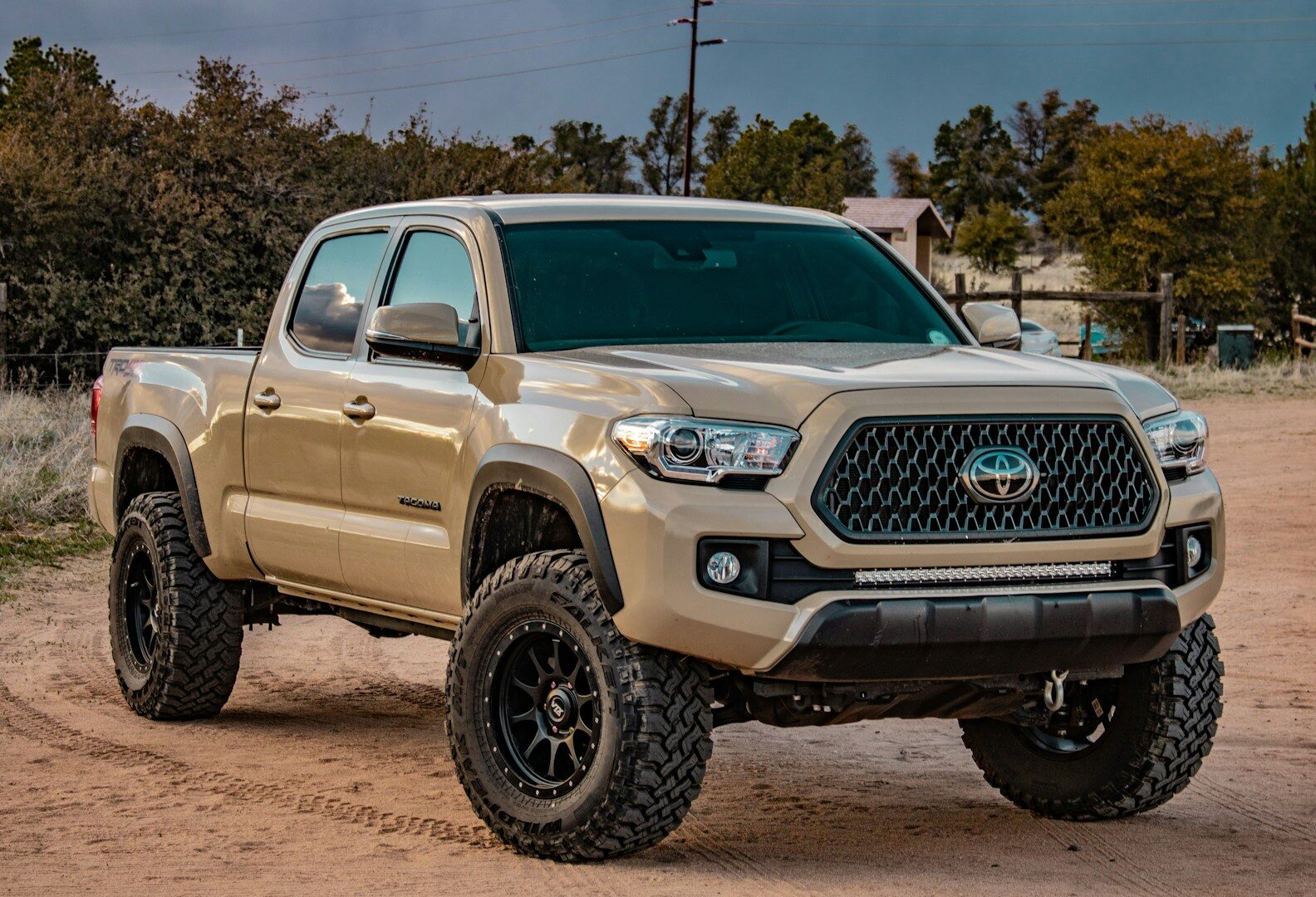
Toyota just told 48,000 Tacoma owners that the shocks on their truck can rot from the inside and drop parts on the road. The obvious story is corrosion. The more interesting story is why a two-year-old truck platform already runs three completely different suspension systems depending on which TRD badge you paid for — and why the cheapest of the three just failed.
On August 6, Toyota filed a recall covering roughly 48,000 model-year 2024-2025 Tacoma TRD Off-Road trucks. The problem lives on the shock absorbers: the external oil reservoir bolted to each Bilstein monotube shock can corrode to the point that it detaches from the shock body. When that happens, Toyota’s own recall notice warns, it can create a road hazard and “increase the risk of a crash or injury to another road user.” Read that line again. Toyota isn’t only worried about the truck’s owner. It’s worried about the driver behind them who has to swerve around a chunk of shock absorber sitting in a traffic lane.
The fix is straightforward. Dealers will inspect the front and rear shock assemblies and replace them with improved units at no charge, with notification letters going out by early October. Owners with questions in the meantime can call Toyota at 800-331-4331 or the NHTSA safety hotline at 888-327-4236, or check their VIN anytime at NHTSA.gov. If you own a 2024 or 2025 Tacoma TRD Off-Road, that covers what you need to do.
Buyer’s guide: Best Accessories for Toyota Tacoma Owners
Here’s what the press release doesn’t say, because press releases never do: how many field reports or warranty claims it took before Toyota decided this was recall-worthy, or precisely what conditions let a sealed reservoir corrode enough to fall off a truck that’s barely two years old. Those numbers exist inside Toyota’s defect report to federal regulators. They simply aren’t the numbers the company chose to hand out on recall day.
Now for the part that actually matters. Not every Tacoma has this shock. When Toyota redesigned the Tacoma for 2024 — its first ground-up overhaul since 2015 — it built three distinct suspension packages for three distinct off-road trims, and marketed all three under the same “capable in the dirt” pitch. According to Toyota’s own launch materials, the TRD Off-Road rides on monotube Bilstein remote-reservoir shocks. Step up to the TRD Pro and you get FOX’s three-way adjustable QS3 internal-bypass shocks with their own remote reservoirs. Go further still, to the overlanding-focused Trailhunter, and the truck wears Old Man Emu 2.5-inch forged monotube shocks co-developed with ARB. Same truck, same TRD lettering stamped on the fender, three different suppliers, three different price points, three different engineering philosophies.
That kind of trim-based segmentation isn’t unusual — automakers split suspension hardware by trim all the time. But it puts this recall in context. The trim that got recalled is the entry point into TRD off-roading, the one Toyota sells to buyers who want the look and the low-range transfer case without paying TRD Pro or Trailhunter money. It’s also the only one of the three wearing the component now corroding from the inside.
Wait, really? Yes — and here’s the second thing worth knowing. Toyota’s own spec sheet says that Bilstein design was chosen specifically for “extended wheel travel and greater heat dissipation.” A remote-reservoir shock works by piping hot oil out of the shock body into a separate canister where it has more surface area to cool. That’s a real engineering advantage on rocky trails. It’s also, by definition, another joint, another seal, another piece of metal hanging off the truck — one that gets sprayed with mud, road salt and water crossings every time the truck does the thing it was marketed to do. The feature that makes the shock better off-road is the same feature now failing because of off-road use. That’s not a coincidence. That’s a tradeoff Toyota’s engineers made, and the recall is the bill coming due.
None of this means Bilstein builds bad shocks. The company supplies remote-reservoir units to plenty of automakers and aftermarket buyers without this failure mode showing up at scale. It means Toyota’s specific reservoir mounting or coating on this application didn’t hold up to the corrosion exposure the truck sees in real-world use — and “improved units,” in recall-speak, is corporate shorthand for admitting exactly that.
There’s a repair-cost angle worth remembering once the warranty clock runs out, too. A remote-reservoir monotube shock is not a $60 strut off a parts-store shelf. Bilstein’s own reservoir-equipped shocks retail well into the hundreds of dollars per corner in the aftermarket. Toyota is covering this repair now because federal law requires it to. A TRD Off-Road owner outside the recall window, or a used buyer years from now who inherits a corroded reservoir Toyota never caught, will not get that same free pass.
Toyota isn’t alone in learning this lesson this summer. Volkswagen quietly recalled 57,851 Atlas SUVs over a vanishing backup camera. Subaru pulled back more than half a million vehicles over a mislabeled tire rating, and NHTSA’s own recall log has been unusually busy in recent months. Every one of these traces back to the same pressure: automakers are stacking more trims, more trim-specific suppliers, and more differentiated hardware onto shared platforms faster than they can validate all of it in the field before real owners put real mud on the truck.
Remember this the next time a salesperson walks you around a Tacoma and points at a TRD badge like it means one specific thing. On this truck, it means at least three different things, built by three different suspension companies, sold at three different prices. Toyota’s marketing sells the badge as a single promise. This recall is proof the engineering underneath it was never actually one truck.