
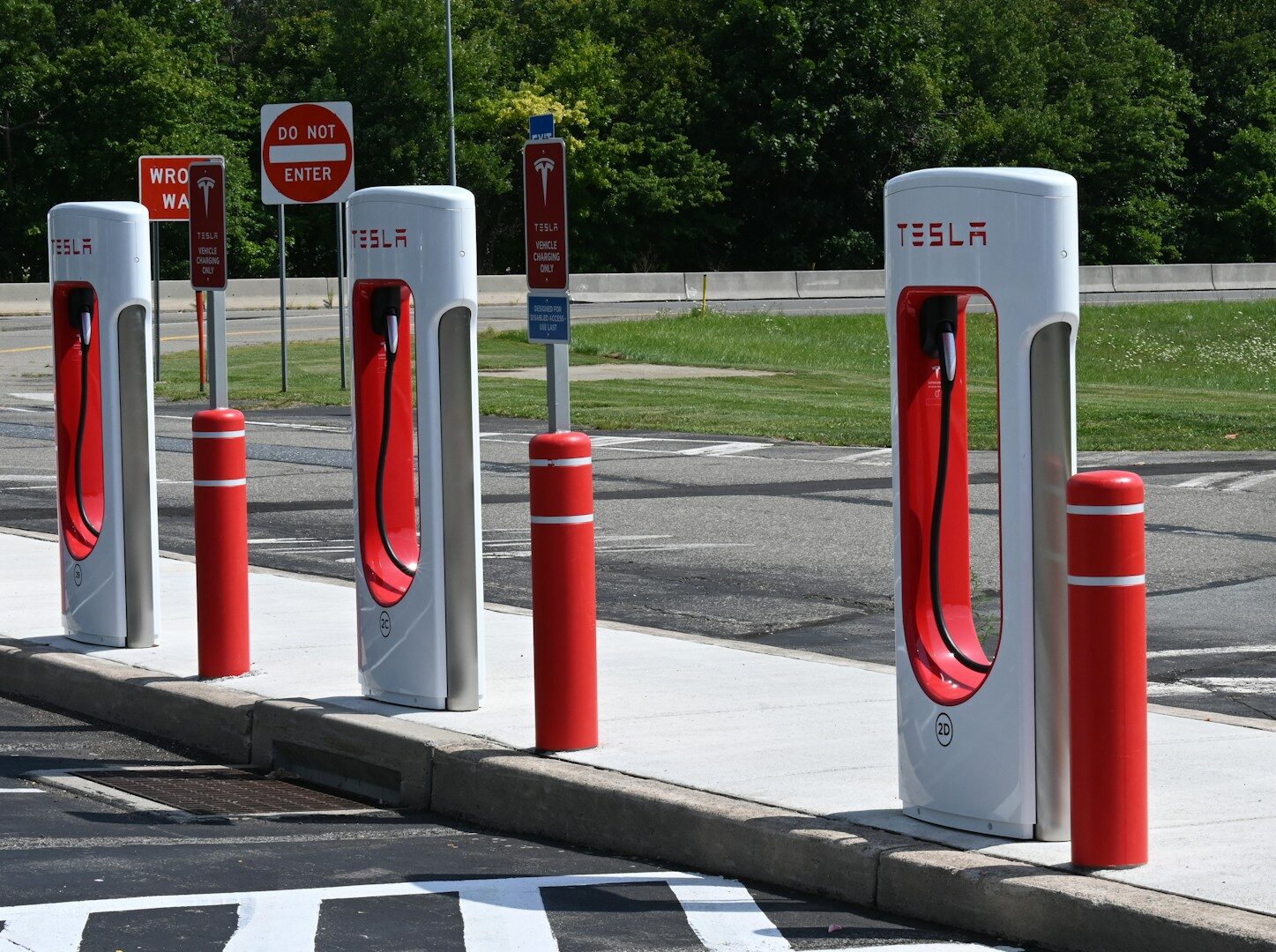
General Motors wants you to believe its 2027 electric vehicles are finally free of the adapter problem. Every Cadillac, Chevrolet, and GMC EV built for that model year will come standard with a native NACS port, the same connector shape Tesla popularized and still operates the busiest version of. Pull up to a compatible Supercharger and there’s no dongle hanging off the end of the cable.
That’s the headline. It isn’t the real story.
The real story is that General Motors, a company that spent over a decade helping build the Combined Charging System into America’s fast-charging standard, is now the one paying to unwind it. And while GM dismantles a piece of its own engineering legacy, it’s quietly assembling something that may end up mattering more than the plug: a single piece of software sitting between every GM EV owner and every charging network in the country.
Here’s what actually happened. According to GM’s own announcement, every EV the company currently sells under Cadillac, Chevrolet, and GMC can already reach NACS chargers today, either through a factory port or a $275 adapter. By the 2027 model year, the adapter requirement disappears for that specific use case. The Escalade IQ, Escalade IQL, Lyriq, Optiq, Vistiq, Bolt, Blazer EV, Equinox EV, Silverado EV, Sierra EV, and both Hummer EV body styles all get NACS ports built in at the factory.
Here’s the part the announcement undersells: the adapter drawer in your trunk isn’t closing. It’s rotating its stock. GM’s own FAQ confirms a 2027 EV with a native NACS port will still need a separate NACS-to-CCS adapter to reach a CCS fast charger, plus a J1772 adapter for the Level 2 equipment still bolted to office parking lots and apartment complexes nationwide. GM sells those accessories for $189 and $67, or $256 as a bundle. The company isn’t getting out of the adapter business. It’s changing which adapter you’re buying.
That’s worth sitting with. CCS is the connector GM itself championed. SAE standardized it in 2012 with backing from GM, Ford, Chrysler, and the German automakers, specifically so the industry wouldn’t be stuck depending on Japan’s CHAdeMO or a single company’s proprietary hardware. It became the default plug for nearly every fast-charging station built in this country over the following decade. Now GM is telling the standard it helped write: thanks, we’re moving on, and handing the adapter bill for that decision to the customer who now has to carry both plug types.
Ford went through this exact transition first, striking its own Supercharger access deal back in 2023. Rivian, Honda, and nearly every other automaker selling EVs in North America followed. GM is late to this particular party, not early.
So why did the standard GM helped write lose? Partly physics. Tesla’s connector does with one compact interface what a CCS combo head needs two separate pin arrays to do, combining AC and DC charging in a smaller, lighter housing. That’s a real packaging advantage for automakers and a real cost advantage for anyone manufacturing the hardware. But the bigger reason is that Tesla’s network simply worked, reliably, at a scale competitors spent a decade trying to match. SAE didn’t ratify Tesla’s plug as the formal J3400 standard until 2023, and only after Tesla opened its patents. That ratification, not any sudden technical breakthrough, is what gave GM’s lawyers cover to walk away from a standard the company had spent ten years defending.
The plug is not the ambitious part of this announcement. Energy Pass is. Built into the MyChevrolet, MyCadillac, and MyGMC apps, it registers a driver once and then handles authentication and billing across Tesla Supercharger, IONNA, Electrify America, and ChargePoint, with EVgo coming later, a combined footprint GM says covers nearly 70% of the country’s DC fast chargers. Layer in Plug & Charge, the vehicle-to-charger authentication standard that lets a car and a charger handshake and bill each other automatically, and GM has built the thing EV owners have actually been asking for: one login instead of six.
That’s the part worth watching, and it’s a bet with a catch. GM is routing its customers’ billing relationship through Tesla’s Supercharger network, the same network Tesla has had to settle lawsuits over for cutting off paying customers’ charging access during fee disputes. Energy Pass assumes that back end stays clean. History says that’s not guaranteed.
GM isn’t trying to win the charging war by owning chargers this time. It already tried that: GM is a founding member of IONNA, the charging network seven automakers built specifically to reduce their collective dependence on Tesla. Now its marquee charging pitch to customers is frictionless access to Tesla’s network anyway. Instead of owning the electrons, GM is trying to own the account that pays for them, the same evolution OnStar went through, from a safety service bolted onto the dashboard into a subscription business built on data and convenience.
None of this is happening in a vacuum. GM has spent this same stretch of 2026 quietly recalibrating its entire EV bet, restarting its Ultium battery plant in Ohio while Tennessee converts to grid storage and Indiana gets sold outright, and retooling a Lansing plant that was supposed to build electric Cadillacs into one that builds gas-powered ones instead. A native NACS port is a small, customer-friendly win. It’s also exactly the kind of headline a company reaches for when the less flattering parts of its EV strategy are unfolding one press release later.
Drivers will notice the missing dongle first. They should pay more attention to the app.
The connector war is over. The receipt war just started.