
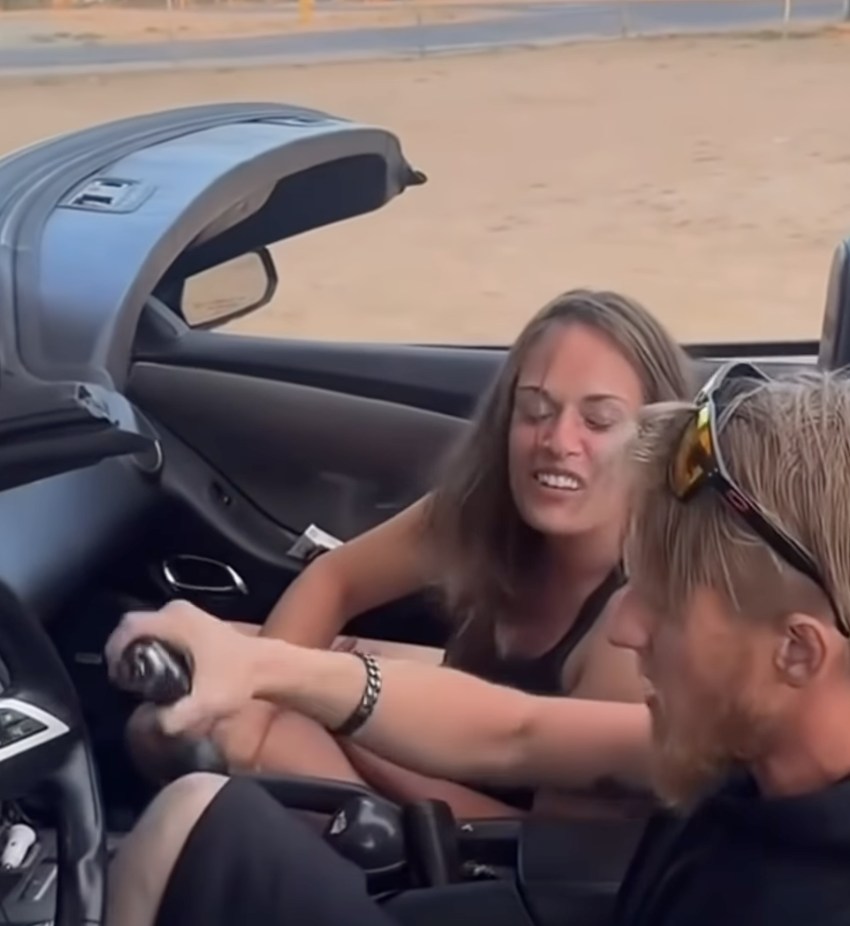
A Camaro Ended Up In a Hesperia Bedroom. The Charge Sheet Is the Interesting Part.
Every so often a crash report reads less like a traffic collision and more like a fever dream. This is one of those.
At 7:22 p.m. on August 12, deputies from the Hesperia station were sent to the 11700 block of Hesperia Road for a vehicle into a house. According to the San Bernardino County Sheriff’s Department’s own written statement, the people who lived there got out on their own. Then the part that isn’t routine: arriving deputies watched the driver keep accelerating into the home, which started a small fire.
Both the driver and his front-seat passenger ignored orders to get out. Deputies went in and physically removed them. While they were pulling the driver out, the department says he grabbed one of their firearms. He was subdued and booked into the High Desert Detention Center. The passenger — described in the release only as a 39-year-old Hesperia resident — was taken to a hospital for her injuries. Case number 192605216, if you want to follow it.
Related Articles
- Hyundai Cut Crash Test Review Time By 90 Percent. That’s Not Even Close to the Interesting Part.
- GM’s New Parts Ban Is Definitely a Safety Policy. It’s Also a Very Convenient Revenue Strategy.
Scene video has been making the rounds online, which is why you’ve probably already encountered this one. But the document worth reading is the charge list, because it tells you things the video doesn’t.
Four counts, and one conspicuous absence
The department lists four: Penal Code 148(d), Penal Code 69(a), Vehicle Code 23152(a), and Vehicle Code 23152(g).
Start with the two DUI counts. Section 23152 is the workhorse California drunk-driving statute, and it’s split into subdivisions that do very different jobs. Subdivision (a) is the impairment count — being under the influence of alcohol, period, proven by how you drove and how you performed. Subdivision (g) covers the combined influence of alcohol and a drug.
Now notice what’s missing: subdivision (b), the 0.08 percent count. That’s the per-se number, the one everybody thinks of as “the DUI.” Its absence at booking is not an oversight and it’s not exculpatory. It usually means the chemical result wasn’t back yet. A breath device gives you a number at the roadside; a blood draw goes to a county or contract lab and can take weeks. Booking charges get filed on what’s in hand, and prosecutors amend later. Anyone reading a booking sheet as the final word on a DUI case is reading it wrong.
The (g) count is the tell that a blood draw likely happened, since you cannot establish a drug on a breathalyzer.
The gun charge is narrower than it sounds
Penal Code 148(d) is the “attempted to take an officer’s firearm” provision, and it comes with a specific-intent requirement that a lot of people don’t realize is written into the statute. Prosecutors have to show a direct but ineffectual act — the statute names two: the officer’s holster strap being unfastened by the defendant, or the firearm being partially removed from the holster. A hand landing on a duty belt during a struggle isn’t automatically 148(d). It’s also a wobbler, chargeable as a misdemeanor or a felony depending on how the DA reads the facts.
PC 69(a) is resisting an executive officer by force or threat, a separate and heavier animal than the garden-variety misdemeanor resisting count.
What’s not on the list is Vehicle Code 23153 — DUI causing injury — even though the department says the passenger went to the hospital. That’s a charging decision that can change once medical records and the collision investigation land.
Why a car keeps accelerating into a wall, and why it catches fire
Here’s the mechanical piece nobody explains. A car pinned against a structure with the throttle open is one of the ugliest thermal situations in the automotive world, and it has nothing to do with the fuel tank.
Drive wheels spinning against a fixed obstacle dump enormous energy into two places. The first is the tires: rubber against pavement or against wall material generates friction heat fast, and shredded rubber and cord are perfectly happy to ignite. The second, on an automatic, is the torque converter. Hold a car at stall against a load and converter fluid temperature climbs steeply within a minute or two. Transmission and power steering fluid are flammable, the lines are plastic and rubber, and a catalytic converter operating at normal temperature — several hundred degrees — is sitting right underneath. Add a crushed front clip with severed wiring and a still-live battery, and you have ignition sources stacked on top of accelerants.
Related Articles
- Dodge Is Building a Cop Car Again Because Police Never Cared About the V8 in the First Place
- Stellantis Recalled 900,000 Vehicles Over a Backup Camera Bug. That’s Not Even the Interesting Part
This is also why “just reach in and shut it off” is worse advice than it sounds. Push-button ignitions typically require a sustained press to kill a running engine, and reaching across a wrecked dash means reaching past airbag modules that may not have fired yet. Side-curtain and knee bags can deploy late in a secondary impact sequence. Deputies staging back until they can control the occupants is not indecision; it’s the correct read on a car that is still making power.
What this costs, and who pays
For the homeowner, the sequence is predictable and grim. The homeowners policy pays the dwelling repair first under Coverage A, then the carrier subrogates against the driver’s auto liability insurance to get it back. Loss of use covers the hotel while the wall is rebuilt.
The problem is what’s on the other end of that chain. California only raised its minimum liability limits on January 1, 2025, when SB 1107 took effect — to $30,000 per person and $60,000 per accident for bodily injury, and $15,000 for property damage. The prior property damage floor had been $5,000. Fifteen grand does not rebuild a bedroom wall, remediate smoke and fire damage, and replace the contents. It doesn’t come close. A minimum-limits policy against a car-into-house loss is a rounding error.
That’s the practical takeaway for readers who own a home near a wide arterial: check your dwelling coverage and your loss-of-use limits, because you are the one funding the gap, not the guy who hit you.
There’s a second wrinkle worth knowing. Auto liability generally responds to negligent driving, including impaired driving, because impairment is still negligence. But California insurers routinely raise the willful-act exclusion when conduct crosses from bad judgment into deliberate. A driver alleged to have kept accelerating into an occupied structure after the initial impact is exactly the fact pattern where a carrier starts asking whether the second phase was an accident at all. That coverage fight is separate from the criminal case and can take longer to resolve.
And the car
Whatever generation Camaro this was, it’s a total. GM ended sixth-generation production at Lansing Grand River after the 2024 model year, which means the pool of clean survivors only shrinks from here. Every one of these that gets folded into a bedroom nudges the remaining nice ones up a little.
Small consolation to whoever has to rebuild that wall.
Images Via: Streetpeopleoflosangeles