
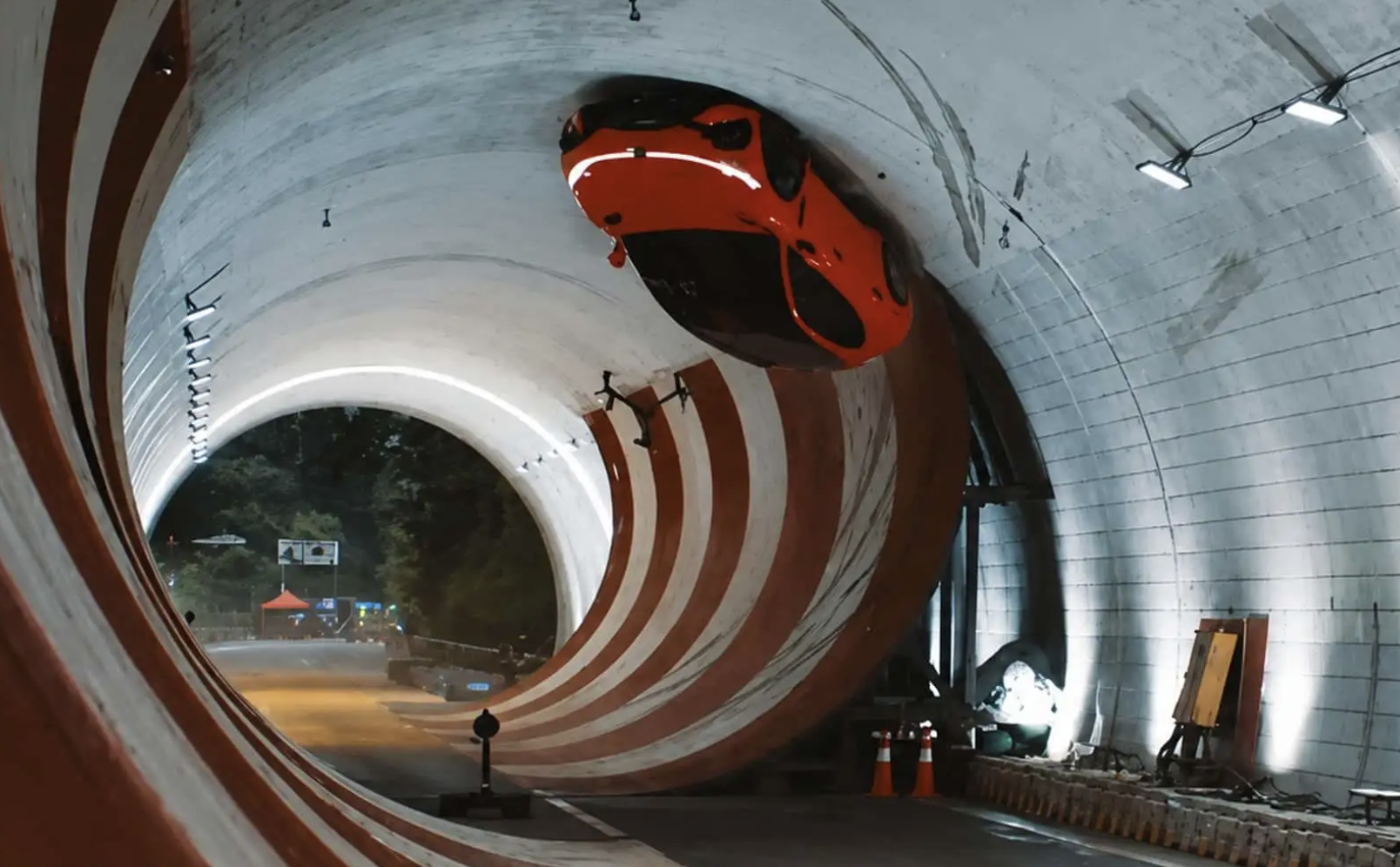
Sixteen years ago Mercedes ran a spot in which an SLS AMG corkscrewed around the inside of a tunnel, and people have been arguing about whether it was real ever since. Voyah — Dongfeng’s premium electric brand, headquartered in Wuhan — decided the way to launch a new crossover was to go do it again, on camera, with a car you can walk into a showroom and buy.
The company says the Passion S ran a full 360-degree rotation around the wall and ceiling of a closed test tunnel in Wuhan, entering at roughly 130 km/h with about 16 degrees of steering lock, in production trim with no lightening and no effects. When the internet immediately called AI on it, Voyah released the footage again as a single uncut take. A clip of an earlier attempt — a camouflaged prototype falling off the ceiling and hitting the floor — did more for the company’s credibility than the polished version ever could.
So let’s talk about what actually makes this hard, because most of the commentary has it backwards.
The math doesn’t care how heavy the car is
The trick is a wall of death, which carnival motorcyclists were doing on wooden drums a century before anyone put a battery in a crossover. To stay stuck to a curved surface at the top of the arc, the car needs its centripetal acceleration to equal or exceed gravity. That gives you a minimum speed of the square root of g times r — gravity multiplied by the radius of the curve.
Notice what isn’t in that equation: mass. A 2.5-tonne SUV and a 1.6-tonne supercar need exactly the same minimum speed on the same radius. Every “but it’s so much heavier than an SLS” take you’ve read this week is, on the core physics, wrong.
At 130 km/h — call it 36 metres per second — the car has enough speed to hold any arc with a radius up to about 133 metres. That’s an enormous margin, which tells you the loop Voyah built is far tighter than that. On a 40-metre radius, the same speed generates about 3.3 g pressing the car into the surface. On 20 metres, it’s closer to 6.6 g.
Which is where the mass does come back and bite, just not the way people assume. Weight doesn’t change whether the car sticks. It changes everything downstream of sticking: the vertical load through four contact patches, how far the suspension compresses under multiple g of loading while inverted, the twisting load through the shell as the car transitions from floor to wall, and the load rating of the ramp structure Voyah had to build inside that tunnel. Heavy doesn’t make the physics harder. It makes the hardware bill harder.
The one number Voyah hasn’t published is the radius of the loop — and that’s the only number that determines how difficult this was. Everything else is theatre.
An EV has an unfair advantage here, and nobody’s mentioning it
Here’s the part that’s genuinely more interesting than the stunt. Turning a combustion car upside down is a lubrication and fuel-delivery problem before it’s a grip problem. A wet-sump engine’s oil pump picks up from the bottom of the pan; invert the car and the pickup is in air within about a second. Fuel pickup in the tank has the same issue. This is why aerobatic aircraft engines use inverted oil systems and flop-tube fuel pickups, and why race cars that see sustained cornering loads run dry sumps with scavenge stages.
An electric car has none of those failure modes. There’s no crankcase, no sump, no fuel tank pickup. The drive units are sealed and use electric pumps. Coolant loops run under pressure. There’s no engine to lose oil pressure and no mechanical vacuum pump to lose, because the brakes are boosted electrically. A few seconds inverted is, from the powertrain’s point of view, a non-event.
That’s the honest technical story: this maneuver got substantially easier the moment cars stopped having engines. Voyah is the first to actually go do it with a stock vehicle, which is worth something. But the barrier that made it a CGI job in 2010 was as much plumbing as it was nerve.
One more myth to bury: “low centre of gravity from the battery” gets cited constantly here. At the apex of the loop the car is hanging from the ceiling and CG height contributes essentially nothing to whether it stays there. It matters on the entry and exit transitions. It is not why the car didn’t fall.
The car underneath the stunt
Strip the tunnel away and the Passion S is a five-metre coupe-style electric crossover on an 800-volt architecture, with rear-drive and dual-motor versions, an 81 or 98 kWh pack, and Huawei’s Qiankun ADS 5 with four lidar units — including the 896-line unit — standard on every trim. Voyah’s pricing spans roughly 229,900 to 279,900 yuan, which is somewhere around $34,000 to $41,000 depending on the day’s exchange rate.
That’s the actual headline. Four lidars as standard equipment at that price would have been flagship hardware two years ago. China’s price war has produced a strange inversion where specification climbs while transaction prices fall, and the stunt exists precisely because spec sheets have stopped being a differentiator. When every rival has lidar and 800 volts, you go find a tunnel.
The business context backs that up. Voyah’s own exchange filing shows 13,189 deliveries in July, up nine percent year over year, with year-to-date volume of 89,453, up 31 percent. Growing, but growth decelerating month to month against the cumulative figure — the profile of a brand that needs a volume model to land.
You’re not getting one
For European readers, there’s a path: Stellantis and Dongfeng signed a non-binding memorandum in May covering a Stellantis-led 51/49 joint venture to sell Voyah-branded vehicles in designated European markets, with potential localisation at the Rennes plant in France. Note “non-binding” and note that the release explicitly conditions everything on implementation agreements and approvals. Building in France also happens to sidestep EU tariffs on Chinese-built EVs, which is not a coincidence.
For American readers, there’s no path at all. The Commerce Department’s connected vehicle rule prohibits manufacturers owned by or subject to the jurisdiction of China from selling connected vehicles in the United States beginning with model year 2027 — regardless of where the vehicle is assembled. Voyah is a subsidiary of a central state-owned enterprise running Huawei software. That’s about as squarely inside the rule as a company can be.
So enjoy the video. Appreciate that the failure clip is the most honest thing any automaker has published this month. And understand that what you’re watching is a very expensive demonstration that an electric crossover’s fluids don’t care which way is up.
Images Via: Voyah