
Eight Miles, Two Million Dollars, and the Number Nobody Is Talking About
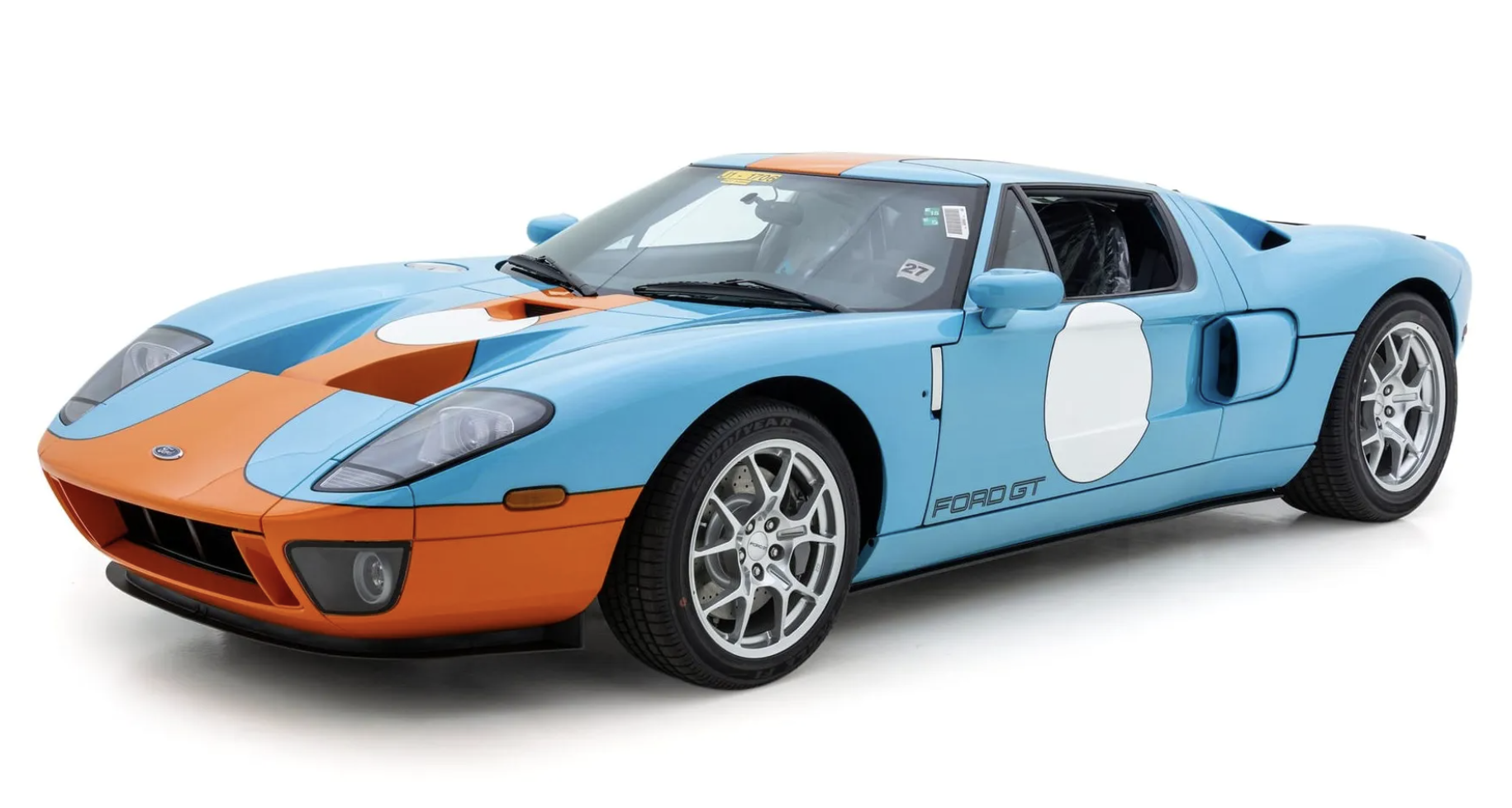
The headline figure from Bring a Trailer’s August 4 auction is $2,101,000 — a 2006 Ford GT Heritage Edition with eight miles on the odometer, and the highest recorded sale for a first-generation GT in Classic.com’s database. That’s the number that traveled. It isn’t the interesting one.
The interesting one is $451,000.
That’s the gap between what the car brought at auction and what a dealer had been asking for the same VIN, sight unseen, a few weeks earlier. Chassis 1FAFP90S06Y401706 surfaced in Maryland Heights, Missouri as a fixed-price listing at $1,650,000 on May 19, 2026. Nobody wrote the check. Two and a half months later, the same eight-mile car in an open-bid format produced $2.1 million. Same paint, same odometer, same everything — a 27 percent swing generated entirely by putting two buyers in a room and letting them look at each other.
If you own something rare and you’ve been quietly shopping it through a broker, that’s your data point for the year.
The mileage cliff is steeper than you think
Heritage Edition values in 2026 have not been climbing on a smooth ramp. They’ve been climbing in tiers, and the tiers are sorted almost purely by odometer.
Related Articles
- One Rivian Hire Reveals the Company’s Real Plan for Commercial Vans
- A DUI Camaro Crash Ended Inside a Bedroom — the Insurance Gap Is the Real Story
Pull the year’s results and the pattern is blunt. A 197-mile car brought $1,320,000 at Mecum’s Kissimmee sale in January. A 156-mile car brought $1,292,500 at Mecum Indy in May. Drop to 662 miles and you’re at $967,500 (RM Sotheby’s Miami, February). At roughly 4,000 miles, $793,500. At 13,000 miles, $660,000. At 15,000 miles, $681,500.
So the market pays roughly $600,000 to go from “driven a little” to “essentially never driven,” and then pays another $800,000 on top of that to go from “essentially never driven” to “still has the assembly-line grease pencil on it.” Meanwhile, an 8,000-mile Heritage went unsold at Barrett-Jackson’s Scottsdale fall auction in October 2025. There is no reward for the middle of the range.
For context, Classic.com’s benchmark value for a first-gen Heritage Edition sits at $711,059, against $448,306 for a standard-livery first-gen GT. Call it a quarter-million-dollar premium for a paint code. Which brings us to the mechanical reality.
You are buying pigment
The Heritage package changed nothing under the skin. Same mid-mounted supercharged 5.4-liter modular V8, same 550 horsepower, same Ricardo six-speed transaxle, same hydroformed aluminum chassis and Brembos at all four corners. The blue and orange is a finish, not an engineering package. Every dollar of that premium is Gulf Oil nostalgia and a production cap of 343 cars.
That matters for two practical reasons. First, a livery is reproducible in any competent paint booth, and the spread between base and Heritage is now large enough to make a re-shoot financially attractive to the wrong sort of person. Build documentation and VIN verification aren’t paperwork fetishism at these prices — they’re the entire basis of the premium.
Second, “never driven” and “mechanically excellent” are not synonyms. Seals shrink. Fuel systems varnish. The GT runs a dry-sump oiling system that has no interest in sitting for twenty years. Hagerty’s model notes on the first-gen flag early-production electrical faults, suspension control arm issues, main seal oil leaks, and axle bolt failures across the run — all corrected under warranty at the time. A car that never visited a dealer likely never had those campaigns performed, and the warranty window closed roughly fifteen years ago.
The recall problem nobody wants to solve
Here’s the wrinkle specific to any low-mile 2005–06 GT, and it’s worth knowing before you bid.
Every 2005–2006 Ford GT built between February 20, 2004 and September 22, 2006 falls inside NHTSA recall 15V-319, Ford’s 15S21 campaign, covering Takata PSDI-4 driver-side inflators. Ford’s Part 573 filing puts the combined GT and Mustang population at 1,018,622 vehicles with an estimated defect rate of 100 percent, and describes the failure mode plainly: the inflator can rupture in a deployment event. A separate passenger-side campaign, 16V-384, swept in GTs sold or registered in high-humidity states.
Now solve that for a wrapper car. The remedy requires a dealer, and getting to a dealer requires either a transporter or miles on the odometer — and on this car, miles are worth something in the neighborhood of $100,000 apiece. Ford has used mobile technicians and towing for Takata remedies elsewhere, which is the only sane path here. But it means the “untouched since assembly” claim and “recall-complete” claim exist in tension, and the buyer of any static GT should be pulling the VIN through NHTSA’s free recall lookup rather than taking a listing’s word for it. Federal law bars dealers from delivering a new vehicle with an open recall; a twenty-year-old collector car changing hands privately carries no such obligation. The open campaign travels with the car.
Related Articles
- California Just Handed Waymo Its Biggest Robotaxi Expansion Yet — 18 Counties, No Driver
- Washington Dusted Off a 96-Year-Old Tariff Law Nobody Had Ever Used — and Detroit Is the Guinea Pig
What owners should actually do
If you have a low-mile first-gen GT, three things changed this month. Your agreed-value policy is almost certainly stale — a $700,000 declared value on a car the market now treats as a seven-figure asset leaves you underinsured on a monocoque that is difficult and expensive to repair correctly. Your exit strategy should probably involve an auction floor rather than a broker’s asking price. And if you were considering driving it, understand that the market has priced each mile at a rate that makes a weekend blast the most expensive tank of fuel in North America.
The rest of us get the better end of the deal. The eight-mile cars are now financial instruments. The 15,000-mile cars — same engine, same gearbox, same noise, sorted and serviced and actually usable — are trading at a third of the price. That’s not a consolation prize. That’s the correct car.
Images Via: Bring a Trailer