
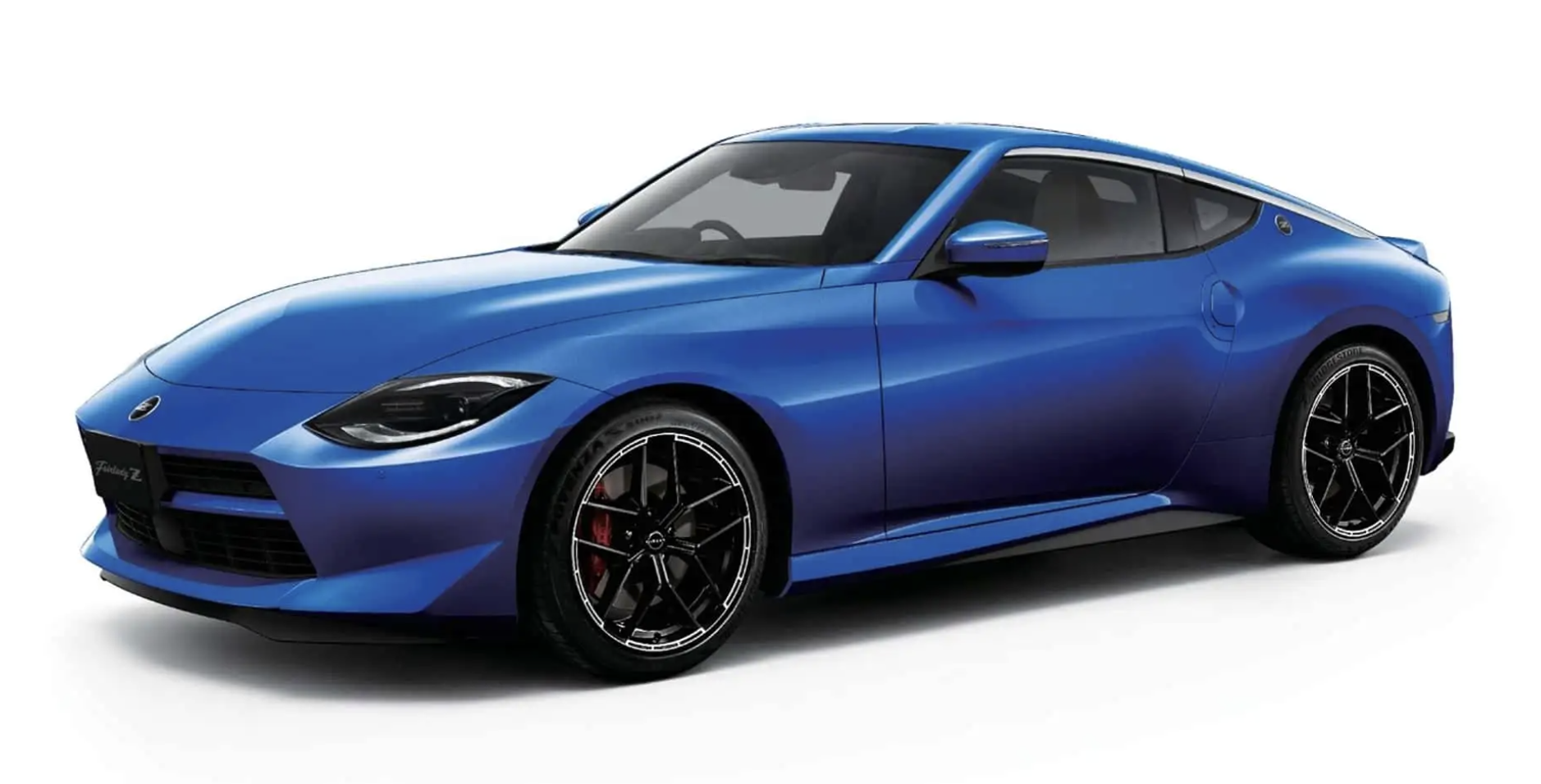
The Fairlady Z Nismo went on sale in Japan today with a third pedal, four years after the RZ34 arrived and roughly eight months after Nissan first showed the car at Makuhari Messe. Nissan says the six-speed was added because customers kept asking for it, which is corporate-speak for “we finally read the forums.” The interesting part isn’t that the clutch pedal exists. It’s what Nissan had to change around it. Nissan Newsroom
The gearbox isn’t new. The linkage is.
Pull up Nissan’s own Japanese spec sheet and the Nismo’s manual runs 3.794, 2.324, 1.624, 1.271, 1.000 and 0.794 on a 3.538 final drive — numerically identical to what the base Fairlady Z has been using all along. So this is the same close-ratio gearset, not a bespoke Nismo cluster.
What changed is everything bolted to it. Nissan’s North American documentation describes a new shift lever ratio producing a much shorter shift stroke, an upgraded EXEDY clutch relative to Sport and Performance grades, and a carbon-fiber composite driveshaft that replaces the steel unit used on automatic cars. Shift lever ratio is the lever arm between the pivot and the selector rail: shorten the throw and you multiply the effort at the knob while cutting travel. Done badly, that’s how you get a notchy, rubbery-feeling stick. Done well, you get the wrist-flick action Nissan is advertising. The carbon driveshaft matters more than it sounds, because reducing rotational inertia in the driveline is what lets revs drop quickly between gears — the thing that makes a manual feel crisp instead of syrupy.
Related Articles
- VW Plant Closures Blocked by a 1960 Law, Not Boardroom Politics
- Rocket-Powered EV Dies With Chinese Vacuum Maker’s Car Division
SynchroRev Match is standard on the Nismo manual, so the car will blip the throttle on downshifts for you. Purists can switch it off. Everyone else gets a system that meaningfully extends synchro life, since the gearbox isn’t being asked to scrub off a 2,000-rpm mismatch every time you grab third late.
The gearing math nobody puts in a press release
Sixth gear at 0.794 on a 3.538 final gives an overall top-gear ratio of 2.81. The nine-speed’s ninth gear at 0.596 on a 3.133 final works out to 1.87. Run those against the Nismo’s 285/35R19 rear tire and the manual is spinning roughly 2,200 rpm at 100 km/h where the automatic is loafing at about 1,450. That’s a 50% difference in cruising revs, and it explains why the manual actually posts a slightly worse WLTC figure than the automatic, 9.0 km/L against 9.2. On the EPA cycle, Nissan listed the automatic Nismo at 17 city, 24 highway and 19 combined, with manual figures still pending at the time the press kit went out. Buy the stick for the involvement. Don’t buy it expecting a fuel bill discount, and budget for a noisier interstate cruise.
GT-R rotors, and what they cost you later
The chassis story is the one worth reading twice. Nissan fitted the front axle with the two-piece drilled rotor previously used on the GT-R, changed the caliper color to bright red, retuned the suspension around the lower front-end mass, and switched to a low-friction steering rack. The U.S. materials specify a two-piece iron-aluminum construction with improved cooling channels, a 19-pound total saving, and a corresponding retune of the electric power steering to suit the new mass and damper calibration. Nissan Newsroom
Nineteen pounds sounds trivial until you note where it comes from. That’s unsprung and rotating mass at the front axle, which the suspension has to control over every bump and the engine has to accelerate through every gear. As a rule of thumb, mass removed from unsprung components buys several times its weight in body-mounted savings. That’s precisely why Nissan couldn’t just bolt the rotors on and call it a day: less unsprung weight changes the damper’s job, which changes steering feel, which is why the EPS got a new calibration.
Owners should know the ownership math too. A two-piece rotor uses an aluminum center hat pinned to an iron friction ring, allowing the ring to expand thermally without coning the disc and without pumping the pedal long. It runs cooler and stays flatter under repeat track abuse. It also costs substantially more to replace than a one-piece casting, and the floating hardware can tick or rattle when cold. That noise is normal. A shop unfamiliar with the design may try to sell you a warranty claim over it.
The quiet fix that track-day guys will care about most
Buried near the bottom of Nissan’s Japanese release: a chamber was added inside the fuel tank to stabilize fuel delivery during high lateral-G cornering, and the collision-mitigation braking system was updated to meet braking requirements for bicycles. Nissan applied the tank revision across every 2027 Z, not just the Nismo. Nissan Newsroom
Translation: the RZ34 could slosh fuel away from the pump pickup in sustained corners with a low tank, and Nissan built a baffled reservoir to stop it. Anyone who has watched a car stumble on the third lap of a long right-hander with a quarter tank knows exactly what that fixes. Aftermarket surge tanks exist for pre-facelift cars, and they are not cheap. The bicycle AEB update is regulatory housekeeping, and mid-cycle refreshes are typically where automakers absorb that kind of compliance work without redesigning a whole car.
Weights, prices and what you actually pay
The Japanese manual Nismo weighs 1,640 kg against 1,670 for the automatic, and both carry the 309 kW (420 PS) VR30DDTT with 520 Nm from 2,000 to 5,200 rpm. U.S. figures show 3,624 pounds for the manual and 3,677 for the automatic.Japanese pricing puts the Nismo at ¥9,752,600 for either transmission, with the mandatory special paint adding ¥49,500 or more on top. Nissan Newsroom
In the U.S., the Nismo lists at $67,260 with the six-speed as the standard transmission and the Nismo-tuned nine-speed as the option — the same money either way, with Sport at $44,480 and Performance at $54,480. No transmission tax in either direction is unusual and worth appreciating.
Related Articles
- Porsche Sold Its Own Consulting Arm, Then Paid Four Times as Much to Rent It Back
- Thieves Didn’t Hack This Lamborghini’s Security System. They Just Pointed a Gun at the Guy Holding the Keys
Context on supply: this is a car Nissan has struggled to build in volume. For the 2025 model year, Nissan reopened Japanese orders with a hard cap and ran a factory lottery for 500 Nismo allocations. The refresh was first shown publicly at Tokyo Auto Salon in January, with the Nismo MT car on the stand. If you want one, the constraint has historically been allocation, not demand. Nissan Newsroom nissannews
The rest of the refresh is heritage cosplay, and good cosplay at that. The Z badge returns to the nose for the first time since the Z32 went out of production, the front bumper stretches the nose to cut lift and drag, the wheels crib the Z31’s aero-dish pattern, and a new Unryu Green two-tone nods at the S30’s Grand Prix Green. Standard cars also get larger monotube dampers with 26.6% more piston pressure area. Nissan Newsroom Nissan Newsroom
Practical takeaway for buyers: there’s no spare tire, only a sealant kit with an expiration date printed on the bottle, so check it annually. Track the front rotor hardware at every pad change. And if you’re cross-shopping the two transmissions, understand you’re trading roughly 750 highway rpm and a bit of fuel economy for a driveline that finally matches the badge on the fender.
Images Via: Nissan