
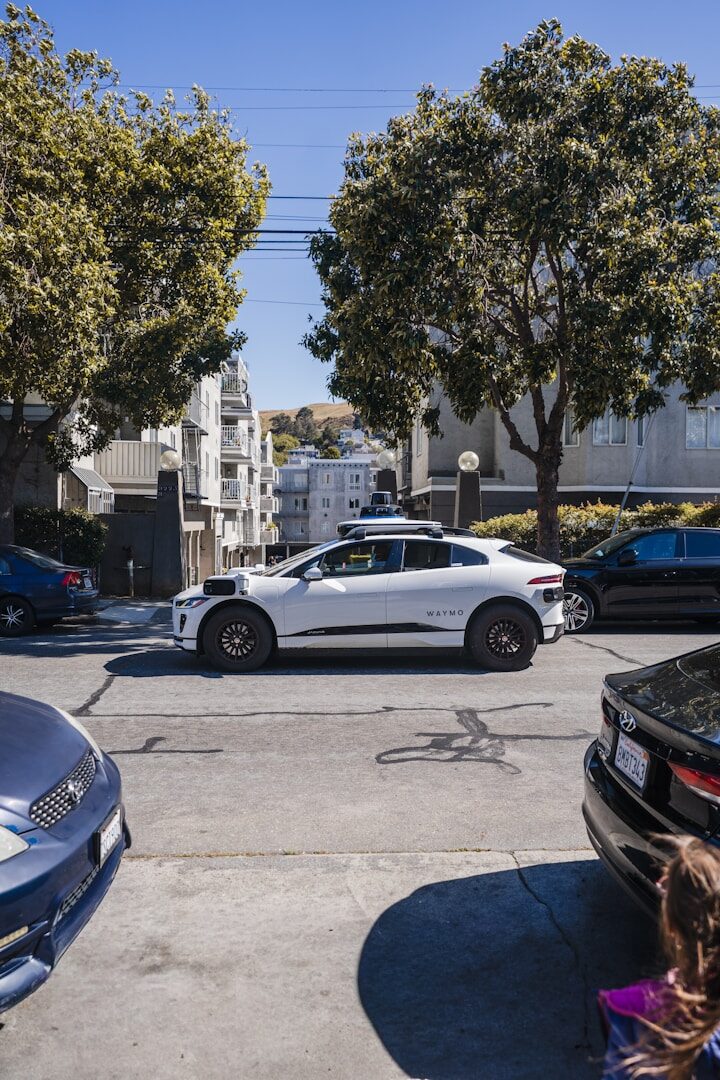
On September 1, Waymo opened public rides in Denver, San Diego and Tampa, pushing its driverless service to 14 U.S. cities. The same morning, Amazon’s Zoox said its retrofitted test fleet was heading to Houston and San Diego, its 11th and 12th American markets. Two days later Tesla put the Cybercab — no steering wheel, no pedals, no mirrors — into commercial service in Austin. And on Friday morning, NHTSA opened an audit query into whether roughly 1,000 of those Cybercabs were legally certified in the first place.
That last item is the actual story. The software argument is largely settled at this point. What isn’t settled is whether you’re allowed to mass-produce a car that nobody sits in front of.
The certification problem nobody outside the industry thinks about
America doesn’t pre-approve cars. There’s no federal agency that inspects a new model and stamps it street-legal. Manufacturers self-certify that their vehicle meets every applicable Federal Motor Vehicle Safety Standard, slap the compliance label on the doorjamb, and NHTSA polices the claim afterward.
Related Articles
- A Stolen Corvette Did Donuts For 100 People, Then Got Dumped on I-80. That’s Not a Bug, It’s the Business Model.
- Vehicle Data Access In Congress: What The REPAIR Act Fight Means For Repair Bills
This works fine when everyone’s building the same basic object. It gets weird when the object has no controls. Huge swaths of FMVSS are written around a human: where the steering column collapses in a crash, how much force a brake pedal needs, what the driver can see in the mirrors. Tesla’s position, according to NHTSA, is that a number of those standards simply don’t apply to a vehicle with no driver. The agency has opened investigation AQ26002 to look at the engineering work and the reasoning behind that call — specifically, how much of Tesla’s certification rests on declaring certain standards inapplicable. You can track it through NHTSA’s safety issue database.
The alternative path is a temporary exemption under 49 CFR Part 555, which comes with a hard ceiling of 2,500 vehicles per manufacturer in any 12-month window. That’s fine for a demonstration fleet and useless for the “individualized mass transit” pitch Tesla has been making since 2024. Self-certification has no cap. It also has no safety net if NHTSA disagrees with you.
This exact movie already ran once
Zoox self-certified its bidirectional pod in July 2022. NHTSA issued a Special Order that September, then opened audit query AQ23001 in March 2023 — the same investigative tool now pointed at Tesla.
The closing resume is worth reading if you want a preview of how these things end. NHTSA physically inspected two Zoox vehicles and, in December 2024, issued an inspection report documenting multiple apparent noncompliances. Zoox subsequently applied for an exemption under 49 U.S.C. §30114(a) for demonstration purposes. NHTSA granted it in August 2025 with conditions — including that Zoox obscure or remove every existing statement claiming the vehicle conformed to all applicable FMVSS. The population under investigation was 64 vehicles. The process consumed nearly two and a half years.
Tesla’s audit covers roughly 1,000 vehicles and lands on day one of commercial service rather than three years in. Same tool, different scale, different timing.
Waymo’s boring, expensive, extremely deliberate workaround
Meanwhile, the company with 4,000-plus cars on the road has never needed an exemption, because it kept the steering wheel.
Denver and San Diego riders get the Ojai, the Zeekr-built minivan running Waymo’s sixth-generation driver. It’s imported from Ningbo as a bare shell — the trucking world would call it a glider — with the connectivity hardware, compute and sensors installed stateside. That isn’t aesthetic preference. The Commerce Department’s connected vehicle rule bans covered VCS and ADS software of Chinese or Russian origin starting with model year 2027, with the hardware prohibitions following for model year 2030 (or January 1, 2029 for units with no model year). BIS lays out the staggered dates on its own compliance page. A vehicle that arrives with no telematics module and no sensors is, in the regulatory sense, not yet a connected vehicle.
One detail nobody talks about: the final rule carves out an exemption for parts imported for warranty or repair of vehicles with a model year before 2030. Whatever happens to new imports, the parts pipeline for the existing fleet has a defined runway. That matters more than it sounds if you run a body shop and expect to be calibrating robotaxi sensor arrays for the next decade.
What the launch cities actually signed up for
Each of the three new markets has a different legal spine, and it’s worth knowing which one you’re standing on.
Colorado preempted the issue years ago. Under Title 42, automated driving systems are declared a matter of statewide concern, and no state agency or political subdivision may hold an ADS to standards different from those set for a human driver. Denver doesn’t get a vote.
Florida is the interesting one for anyone who might get rear-ended by a robotaxi in Tampa. Statute 627.749 requires a fully autonomous vehicle engaged on an on-demand network to carry primary liability coverage of at least $1 million for death, bodily injury and property damage, plus PIP and uninsured/underinsured coverage. That’s roughly a hundred times Florida’s normal property damage minimum. If you tangle with one of these, the policy behind it is not the problem.
California made Waymo work for it. The CPUC’s disposition letter covering Advice Letter 0004 took nearly seven months and required a supplemental filing on how Waymo keeps unaccompanied minors out of its cars and how it handles riders during major service disruptions. San Diego’s Metropolitan Transit System and its Taxicab Advisory Committee both protested, arguing among other things that local governments should have a say. Staff tossed the protests as attempts to relitigate policy the commission already decided — it had explicitly declined to hand cities veto power. Twenty-nine organizations filed in support. Your local transit agency has less authority here than you’d assume.
The safety numbers, and why two credible sources disagree
Waymo’s safety hub reports 220.6 million rider-only miles through March 2026 and claims 94% fewer crashes causing serious or fatal injuries than human drivers over the same roads.
The Insurance Institute for Highway Safety ran its own independent analysis of federal reporting data from 2021 through 2024 and landed on 68% fewer police-reportable crashes across about 50 million autonomous miles, with 85% fewer single-vehicle crashes and 81% fewer injury crashes. City by city it ranged from 76% better in Phoenix down to 35% in San Francisco, and 4% worse in Austin on a small sample.
Both numbers are honest. They differ because AV operators must report fender-benders that humans routinely don’t, so IIHS had to discard roughly a quarter of the reported AV crashes as duplicates, off-road events, or non-events before any comparison was possible. Only Waymo voluntarily publishes miles traveled, which means nobody can calculate a crash rate for anyone else. That’s the real gap, and it’s the one insurers will care about when they eventually try to price an automated mile differently from a human one.
Practical notes for anyone about to ride one
Tesla’s own Cybercab FAQ is more informative than the launch event was. Two passengers maximum. Riders under 13 aren’t permitted at all; 13 to 17 need an adult. The car waits seven minutes at pickup before fees or cancellation. You can’t request a Cybercab specifically — you get what’s available for your group size. Step-in height is 16.5 inches with bench seating at wheelchair height, braille on the doors and overhead buttons, and 20.2 cubic feet of trunk. Cybercab rides remain limited to parts of Austin while the Model Y fleet covers Austin, Dallas, Houston, Miami and Tampa.
Related Articles
- VinFast’s India Localisation Reset: What It Means For The Thoothukudi Plant And Buyers
- Why Volkswagen Is Investigating Its Chinese Headlight Supplier Over 107 Fired Graduates
Waymo, for what it’s worth, has been sanded down by federal scrutiny already: NHTSA opened PE25013 over a robotaxi maneuvering around a stopped school bus in Atlanta, and PE26001 after one of its vehicles struck a child near a Santa Monica elementary school in January. That’s what the boring, exemption-free path still buys you.
And the rest of the world isn’t waiting
Pony.ai told the SEC in August it had expanded its Uber partnership to more than 2,000 robotaxis across five European cities, with over 4,000 vehicles under agreements in negotiation internationally. The same connected vehicle framework that forces Waymo to import gliders keeps Chinese operators out of the American market entirely, which is why they’re pouring into Europe, the Gulf, Southeast Asia and now Korea instead.
The scale race is real. But the constraint has moved. It’s not lidar cost, it’s not compute, and it’s not whether the car can handle an unprotected left. It’s whether a vehicle built with no controls can be certified, at volume, without asking permission first. NHTSA has answered that question once already, and the company that asked it ended up scrubbing the compliance claims off its own paperwork.