
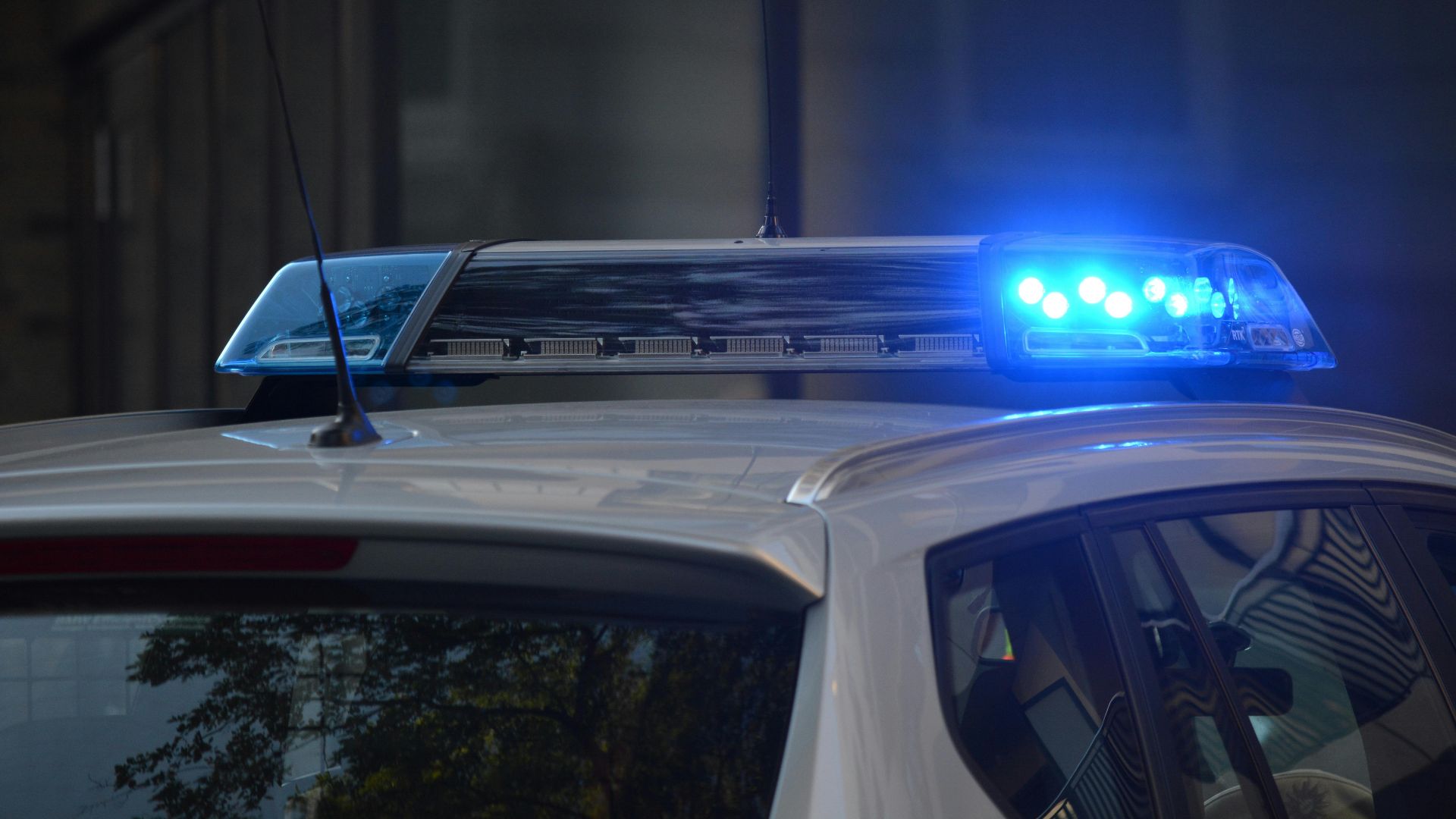
The Georgia State Patrol’s version of Monday’s fatal crash in Tucker leads with the stunt drivers. A group had reportedly been running donuts and blocking roads around DeKalb County for hours, shifting locations through the night, when troopers finally caught up with them near Kilman Drive. Several vehicles took off. One of them, a GMC pickup, didn’t get far.
Here’s the detail that didn’t make the headline. The trooper who hit that truck wasn’t chasing it. By GSP’s own account, a Crime Suppression Unit K9 trooper was simply traveling through the intersection of Mountain Industrial Boulevard and Hugh Howell Road, a half mile from where the group had scattered, when his cruiser collided with the pickup. Both vehicles caught fire. The trooper and his K9 climbed out through a window to go help. Anthony Angeles, 19, a passenger in the truck, died at the hospital. The driver, 20-year-old Emilio DeJesus of Conyers, survived with injuries GSP described as not life-threatening.
Chasing and converging are not the same thing. GSP’s Office of Professional Standards clearly thinks the difference is worth examining, since it opened an administrative review of the trooper’s actions the same day and placed him on leave. It’s worth the rest of us examining too, because that’s where the real story is hiding.
This isn’t really a story about a stunt-driving crew that refused to stop. Georgia already treats that behavior as a serious crime, arguably the most aggressively prosecuted version of it in the country. The real story is what the state’s enforcement response looks like once the lights come on, and Georgia has already supplied the data. Auto Wire reported it in December: over a recent five-year stretch, Georgia troopers initiated 6,760 pursuits and crashed in more than half of them, a rate over three times the national average for police pursuits.
Put plainly, saying yes to a pursuit in Georgia is close to a coin flip on whether it ends in a wreck. This week in Tucker, the coin came up bad.
Georgia Already Wrote the Toughest Stunt-Driving Law in the Country
Nobody can accuse Georgia of going easy on this. House Bill 534, signed in 2021, turned organizing an illegal drag race into a felony and created reckless stunt driving, O.C.G.A. Section 40-6-390.1, as its own standalone charge covering both drag racing and laying drags. A third conviction lets courts permanently seize the driver’s vehicle. In 2024, lawmakers went further, making it a crime to simply attend or watch a street takeover, punishable by up to 60 days in jail. Georgia’s list of arrestable offenses at one of these gatherings is longer than almost any other state’s.
None of that touches how a trooper’s cruiser is supposed to behave once a routine stop turns into a foot-to-the-floor moment. That’s a separate policy, decided separately, and it hasn’t gotten anywhere near the same legislative attention.
The Number Georgia’s Press Releases Never Mention
Some states restrict pursuits to felony-level offenses or require a supervisor’s sign-off before a trooper can give chase. Georgia’s policy reportedly leaves more of that judgment to the trooper in the moment, and the results show it. Nationally, roughly 15 percent of police pursuits end in a crash. Georgia’s rate is over 50 percent, more than three times the national figure, according to five years of the agency’s own pursuit records.
Zoom out further and Georgia isn’t just an outlier next door. Researchers combing through the fatal crash data NHTSA maintains nationally have counted more than 5,400 fatal pursuit-related crashes since 2009, and over 6,300 deaths, an average of nearly one fatality every single day in America. Georgia’s pursuit-heavy, crash-prone approach doesn’t miss that grim national baseline. It’s the outlier making the baseline look tame.
Why an Intersection Hit Like This One Is the Deadliest Kind
It doesn’t matter much, physically, whether a supervisor’s log books this as an official pursuit or a trooper simply converging on a scene. A cruiser closing fast on an intersection to intercept a fleeing vehicle behaves the same way either way: high closing speed, a driver split between radio traffic and the road, less margin to spot cross traffic. When two vehicles meet broadside instead of bumper to bumper, the impact lands on the doors, not on the crumple zones engineered to eat it. Angeles was riding on the side that took the hit. In T-bone crashes, that’s almost always the deadliest seat in the vehicle, regardless of who was driving.
The Fire, and Why a Trooper Had to Climb Out a Window
Both vehicles catching fire is its own tell. Federal fuel system integrity standards are built around surviving a serious impact without a fuel leak, so a fire breaking out on both sides of a T-bone collision points to real closing speed, not a minor tap. A trooper and his K9 exiting a patrol cruiser through the window, rather than the door, is usually a sign the door frame took enough side intrusion to jam it shut. None of that is a knock on the trooper personally. It’s a data point about how hard this specific kind of crash hits.
The New Law Targets the Crowd. The Crash Targets Whoever’s in the Passenger Seat.
Angeles wasn’t a bystander who could have been charged under Georgia’s new spectator law. He was riding in the truck. For comparison, Florida’s law goes further than Georgia’s, extending liability directly to the passengers and spectators of a street race when someone ends up dead. Georgia’s newest statute polices the crowd around a takeover. It has nothing to say about the chase that follows once that crowd scatters, or about the person sitting in the passenger seat when it ends badly.
These gatherings keep moving because they’re built to. Georgia’s Crime Suppression Units exist specifically because a single static bust doesn’t work on a group that treats a parking lot the way a flash mob treats a street corner, shifting locations to stay a step ahead of a response. It’s the same playbook seen in a recent street takeover that ended with a stolen Corvette abandoned on I-80, with a hundred spectators long gone before anyone could be charged.
This Isn’t the First Warning
GSP has been here before. Last year, a 19-year-old man died in Little Five Points when a woman fleeing troopers crashed. GSP’s own statement this week acknowledged as much, saying it shares “the responsibility of making sure those questions are answered.” That’s the right instinct. It just hasn’t yet turned into a policy change that shows up in the crash numbers.
What Should Actually Stick
Georgia decided illegal stunt driving deserved some of the harshest penalties on the books, up to seizing the car and jailing anyone who merely watches. That’s a defensible position. But a law that harsh deserves an equally hard look at the response it triggers, and right now that response wrecks more than half the time it’s used.
Georgia can now fine you for watching a street takeover from the curb. It still hasn’t figured out how to make the trooper responding to one less likely to crash than not, and until that changes, the state’s toughest driving law and its most predictable failure will keep sharing the same headline.