
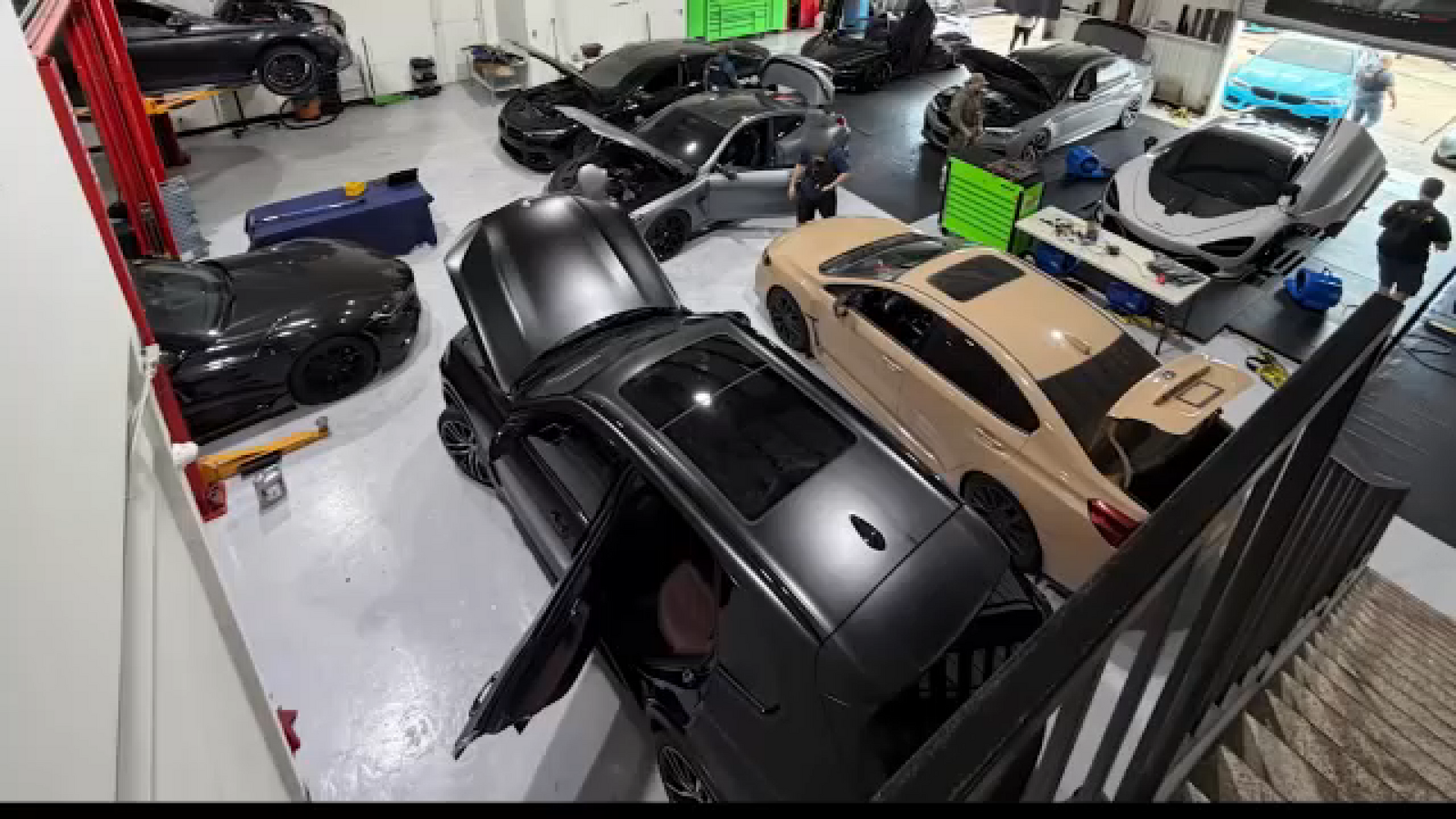
Twenty-eight exotic cars is not a collection. It is a laundry.
That is the part of the Malone Lam case worth your attention, and it is not the part the dollar figure captures. On September 8, Lam, a 22-year-old Singaporean citizen who had been living in Miami, pleaded guilty in federal court in Washington, D.C., to a racketeering conspiracy that the Justice Department says stole $245 million in cryptocurrency between October 2023 and May 2025. Across the wider enterprise, prosecutors put the number above $263 million.
The cars are where a lot of it went. Charging documents describe a fleet of at least 28 exotic vehicles ranging from roughly $100,000 to $3.8 million apiece. When one of the group’s money launderers was sentenced this spring, prosecutors named hardware: a widebody Lamborghini Urus, a Rolls-Royce Ghost worth more than $300,000, and a Porsche GT3 RS. The government says the vehicles were registered to shell companies.
Buyer’s guide: Best Car Security Cameras in 2026 for Parking and Theft Protection
So here is the question this case ought to force, and almost nobody asks it out loud: at what point is a car dealership legally required to wonder where $3.8 million came from?
Under federal law, essentially never.
A supercar is not the prize. It is the machine that does the work.
Start with the thing crypto thieves learn fast. Stolen cryptocurrency is the most traceable money ever invented. The ledger is public, permanent, and indifferent to who is reading it. Prosecutors describe the crew burning enormous effort on mixers, peel chains, pass-through wallets and VPNs precisely because the money screams. Stealing it was the easy part. Spending it was the job.
An exotic car solves that problem better than almost any other object you can buy. It carries seven figures of value in about 200 cubic feet. It is liquid worldwide. Limited-production cars often hold value or appreciate, so the “wash” can be cheaper than a mixer’s fee. And critically, nobody needs to lend you money to buy one. No lender means no underwriting, no income verification, no appraisal, no bank digging through where the down payment came from.
Compare it to a $3.8 million house. That transaction drags in a settlement agent, a title insurer, an escrow file and a paper trail that survives for decades. A $3.8 million car needs a wire and a bill of sale, and the title can read as an LLC nobody has ever heard of.
That asset density is exactly why exotic cars keep turning up at the center of organized crime cases, from cargo-theft rings in Southern California to key-cloning crews working luxury inventory. The car is not the trophy. It is the instrument.
The “temporary” exemption that is now 24 years old
Here is the first thing most car people do not know. Federal law, at 31 U.S.C. 5318(h), requires financial institutions to maintain anti-money-laundering programs, and the Bank Secrecy Act’s definition of a financial institution includes businesses that sell vehicles. Dealers were supposed to be inside the tent.
Then, in April 2002, Treasury and FinCEN wrote them out of it. The regulation still sits in the Code of Federal Regulations today at 31 CFR 1010.205(b)(1), exempting a “seller of vehicles, including automobiles, airplanes, and boats” from the requirement to have an anti-money-laundering program at all.
The stated reason, in the Federal Register notice itself, was that the agencies had not had “sufficient time and opportunity to analyze the nature of the businesses” and did not yet understand the money-laundering risk they carried. It was explicitly temporary. FinCEN promised a series of follow-up rules and set October 24, 2002 as the date by which any industry still lacking a proposed rule would simply have to comply.
That deadline passed during the George W. Bush administration. The exemption is still there. Two dozen model years of supercars have come and gone underneath a six-month placeholder.
Congress did close the crypto loophole. It was switched off before it ever opened.
Dealers are not entirely unwatched. Anyone who has sat in an F&I office knows Form 8300: under 26 U.S.C. 6050I, a business receiving more than $10,000 in cash must report it to the IRS within 15 days, and transactions between the same parties inside a 24-hour window are treated as related. The minimum penalty for willful disregard is $25,000.
But read what “cash” means. Per the IRS instructions for Form 8300, it is currency and certain monetary instruments. It does not include a check drawn on the payer’s own account, and it does not include a wire transfer. The retiree who pays $11,000 in hundred-dollar bills for a used Camry generates a federal filing. An anonymous LLC that wires $3.8 million for a hypercar generates none.
Congress noticed. Section 80603 of the 2021 Infrastructure Investment and Jobs Act amended 6050I so that “cash” includes digital assets, effective for returns filed after December 31, 2023. On paper, from New Year’s Day 2024, a dealer taking more than $10,000 in crypto would have to file a form naming the payer.
It never happened. In Announcement 2024-4, the IRS told businesses they “will not be required to include those digital assets” when calculating the $10,000 threshold until Treasury and the IRS publish implementing regulations. Those regulations still have not been published. The digital-asset reporting rules that did land in 2024 govern brokers and exchanges under an entirely different section of the tax code.
So the single rule Congress wrote specifically to make large crypto purchases visible at the point of sale has, to this day, never taken effect.
For contrast, look at housing. FinCEN finally issued a residential real estate rule in 2024 aimed at exactly this behavior, non-financed purchases made through entities and trusts. A federal court vacated it on March 19, 2026, and the government has appealed. Real estate at least got a rule and a fight. Vehicles never got the rule.
Look again at the alleged conduct with that in mind. Prosecutors describe false names on leases for Los Angeles houses renting at $40,000 to $80,000 a month, and bulk cash shipped through the mail hidden inside stuffed animals. People who mail cash inside plush toys are not behaving like people who believe the system is watching the showroom floor.
Now the government owns 28 supercars it does not want
Here is the second thing most enthusiasts have never thought about. A seizure is not a victory lap. It is a fleet management contract.
The U.S. Marshals Service is the primary custodian of seized property, and it is already enormous: 26,494 assets worth $7.6 billion on hand at the end of fiscal 2024. Every carbon-ceramic brake rotor, lithium battery, dry-sump oil system and set of $4,000 tires in a seized collection becomes a line item on a federal storage invoice while a case grinds through court for years.
Which is why the Justice Department does not simply park them. The Justice Manual’s section 9-115.310 authorizes interlocutory sale of property that is declining in value, before forfeiture is final, and if nobody contests the sale, prosecutors do not even need the judicial confirmation procedure of 28 U.S.C. 2001. Depreciating supercars are close to the textbook case. We saw the same arithmetic when Texas seized 60 trucks in an alleged oil theft ring, and the inverse of it when New York City kept crushing cars it should not have. Governments are bad at owning vehicles, and the vehicles know it.
There is a genuinely good outcome buried in this. Forfeiture money can reach the people who were robbed, and the Marshals reported $605 million distributed to victims and claimants in fiscal 2024. But it also means something concrete for the enthusiast market: this fleet will be sold, probably sooner than the case ends, and those cars will re-enter the used market carrying a chain of title that ran through a shell company, a federal seizure and a government auction. If you want a reminder that a clean-looking history report is not the same thing as a clean history, read what happened to the woman whose Nissan Rogue passed a Carfax check while wearing three VINs.
What to remember when the numbers fade
Forget the $245 million. Forget the nightclub tabs. The idea worth carrying out of this case is smaller and more durable than any of it.
Cryptocurrency is a ledger that never forgets. A car title is a ledger that barely asks.
That gap is not an accident of technology and it is not a failure of dealers, most of whom would happily follow a rule if one existed. It is a regulatory choice made in 2002, renewed by inaction every year since, and quietly reaffirmed when the one crypto-specific fix Congress passed was shelved before its first filing deadline. Twenty-eight supercars titled to shell companies is not a story about a clever 22-year-old. It is a story about the last large-dollar market in America where nobody is required to ask the obvious question.
Buyers of legitimate exotics will feel this eventually, because loopholes like this one usually close all at once and clumsily, after a case too embarrassing to ignore. This may end up being that case. And the retail side of the hobby is already dealing with fraud it never used to see.
So where should the line sit? Should high-end car dealers have to run the same anti-money-laundering checks a bank does, or would that just add paperwork and delay for honest buyers while the determined launderers move to boats, watches and art?
Should car dealers have to run the same money-laundering checks as banks? Tell us in the comments.