
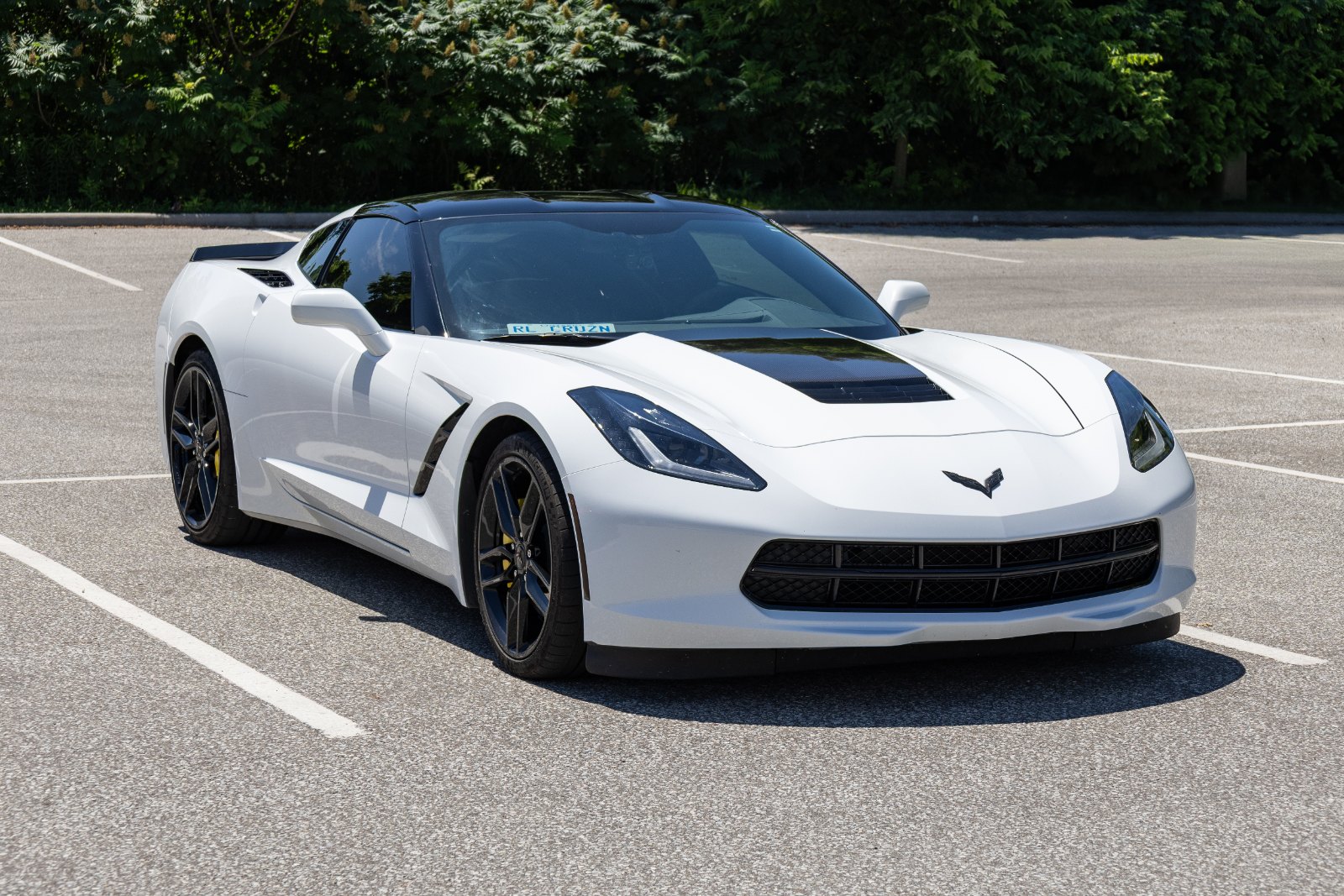
Somewhere inside that Corvette, behind a four-digit PIN, sits a settings screen that would have kept a 123 mph traffic stop from ever happening.
The California Highway Patrol says an officer clocked a teenage driver at 123 mph in a Corvette on a California highway, then turned the teen over to his parents. No crash. No pursuit. No injuries. Just a radar display holding three digits and a phone call a lot of parents have imagined and very few have ever received. Beyond the speed and the handoff, the agency has not publicly confirmed the driver’s exact age, the stretch of road, the model year of the car, or what citations were issued.
The easy version of this story is about the teenager. That is the least useful part of it.
The useful part is that General Motors has spent roughly a decade shipping a factory feature that will electronically stop a Chevrolet from exceeding 85 mph, and that Chevrolet’s own Corvette owner’s manual points owners toward it. Hardly anyone switches it on. No federal rule requires anyone to. And when California tried to mandate something considerably weaker than what the car already does voluntarily, the governor vetoed it.
This is not a story about a kid with a fast car. It is a story about an industry that solved speeding in software and then made the solution opt-in.
The car already came with a governor
Chevrolet’s Teen Driver system arms itself when a designated key fob is used. According to Chevrolet’s own documentation, a parent can set a speed warning anywhere between 40 and 75 mph and, separately, “set a maximum speed limit on the vehicle of 85 mph.” The stereo stays muted until the front occupants buckle up. Buckle to Drive can keep the car from shifting out of Park for 20 seconds if a belt is still unfastened. All of it sits behind a four-digit PIN, specifically so the teenager cannot quietly undo it on the way out of the driveway.
Then there is the part almost no owner has ever opened. Teen Driver keeps a report card: distance driven, maximum speed reached, overspeed warnings, and the number of times the accelerator pedal was floored. Chevrolet says the vehicle holds that record for up to 40,000 miles or 1,000 events.
The car keeps a ledger of its driver’s worst moments. It has been doing that for years.
Chevrolet’s 2022 Corvette owner’s manual sends owners to a Teen Driver section of their own. Whether the car CHP stopped was equipped with it, and whether anyone had bothered to configure it, is not public. But none of this is exotic hardware, an aftermarket box, or a line item on a window sticker. It is a menu.
The camera already reads the signs
Teen Driver is the blunt instrument. The precise one is Speed Limit Assist, which GM describes as using the vehicle’s front camera and embedded navigation to recognize posted speed limit signs and automatically adjust the vehicle’s maximum set speed. Chevrolet’s own phrasing deserves to be quoted directly: the system “lets you set a top speed that your vehicle will not exceed, even if you continue to press the accelerator pedal.”
That is not a chime. That is the throttle declining.
So the ability to read a posted limit, compare it against actual road speed, and then refuse to go faster is already built into a large share of the new cars sold in this country. It ships from the factory. It works. And it is treated, start to finish, as a matter of customer taste.
Europe stopped asking politely
Since July 7, 2024, every new vehicle sold in the European Union has been required to include intelligent speed assistance. Manufacturers pick from four permitted approaches: a cascaded audible warning, a cascaded vibrating warning, a haptic accelerator pedal that pushes back against the driver’s foot, or a speed control function that gently reduces speed. The driver can always override it. That escape hatch was written into the rule on purpose.
Sit with what that means. A Corvette delivered to a buyer in Germany is legally obligated to tell its driver he is speeding. The same car delivered to a buyer in California is not. Same platform, same supplier base, same engineers. Two different regulatory answers to an identical question.
California asked for less, and still got told no
This state has been circling the idea for years, and lawmakers have already taken one serious run at mandating speed limiters. Senate Bill 961 would have required that, beginning with the 2030 model year, every new passenger vehicle, motor truck, and bus sold or leased in California carry a passive intelligent speed assistance system to alert drivers when they exceeded the limit by more than 10 mph.
Read that slowly. Passive. An alert. Ten miles per hour over. Not a cap, not a limiter, not a throttle intervention — a notification, and only after the driver had already cleared the posted number by double digits.
Gov. Gavin Newsom vetoed the bill on Sept. 28, 2024, arguing that vehicle safety standards belong to federal regulators and that state-specific requirements would create “a patchwork of regulations that undermines this longstanding federal framework.”
You can argue federal preemption on the merits. The awkward arithmetic survives the argument: the mandate California rejected was weaker than the feature Chevrolet already gives away for free. Other states have gone the opposite direction and started ordering limiters installed by judges rather than waiting on Washington.
What 123 actually costs
In California, triple digits is not a garden-variety speeding ticket. The violation schedule courts use to score negligent-operator counts lists Vehicle Code 22348(b) — “Speed over 100 MPH” — as a two-point violation, the same weight the state assigns to reckless driving.
For a driver under 18, that math moves quickly. Two points inside 12 months triggers a 30-day driving restriction. Three points means a six-month suspension plus a year of probation. And the DMV is blunt about the calendar: a minor must serve the full term of any probation, restriction, or suspension “even if you turn 18 years old before the probation, restriction, or suspension ends.”
One stop. One conviction. Straight to the threshold.
Points do not stay at the DMV, either. In a state where driving safety record is a mandatory insurance rating factor, a major violation attached to a household policy tends to outlast the news cycle by several years — and a Corvette was never the cheap car on that policy to begin with. The financial tail on these stops is consistently longer than the headline, something a driver learned the hard way after a 156 mph run from police ended with a bill he had not counted on.
The statistical backdrop is not kind. NHTSA counted 11,775 deaths in speeding-related crashes in 2023, 29 percent of all traffic fatalities that year. Among drivers aged 15 to 20 involved in fatal crashes, 37 percent of the males were speeding — the highest rate of any group the agency measures. A teenager clocked at 146 mph in a BMW is not a freak event. It is the age bracket behaving exactly as the federal data says it behaves.
The part that will still matter in five years
Nearly every serious conversation about speeding is still framed as a behavior problem: better driver’s ed, tougher enforcement, more cameras, steeper fines. States are still arguing over how many hours of instruction a 16-year-old actually needs, and over who gets to decide what the speed limit should be in the first place. Those are real fights. They are also about a decade behind the hardware.
The cars already know. They know the posted limit. They know their own speed. They know when the pedal has been buried. At least one of them keeps the receipts for 40,000 miles. The distance between a car that knows and a car that acts is not an engineering distance. It is a permissions distance, and right now that permission belongs to whoever is holding the key fob.
We taught cars to read speed limit signs. We just never gave them permission to do anything about what they read.
A CHP officer spent part of his shift doing work a free software setting could have handled before that Corvette ever left the driveway. That is the real story here, and it will still be the story the next time a radar gun lights up with three digits.
Should safety features like this be on by default instead of buried in a menu? Sound off in the comments.