
Every October, Rivian’s trucks start acting possessed. Light bars pulse red, Camp Mode fills with crows and jack-o’-lanterns, and the cabin speakers do a convincing alligator impression. It’s a neat trick, and by now it’s expected. But this year the trick means something different than it did in 2024 or 2025, because for the first time, Rivian has to decide whether to put on the whole show twice.
That’s the part worth paying attention to. Not the swamp-gas sound effects. The software underneath them.
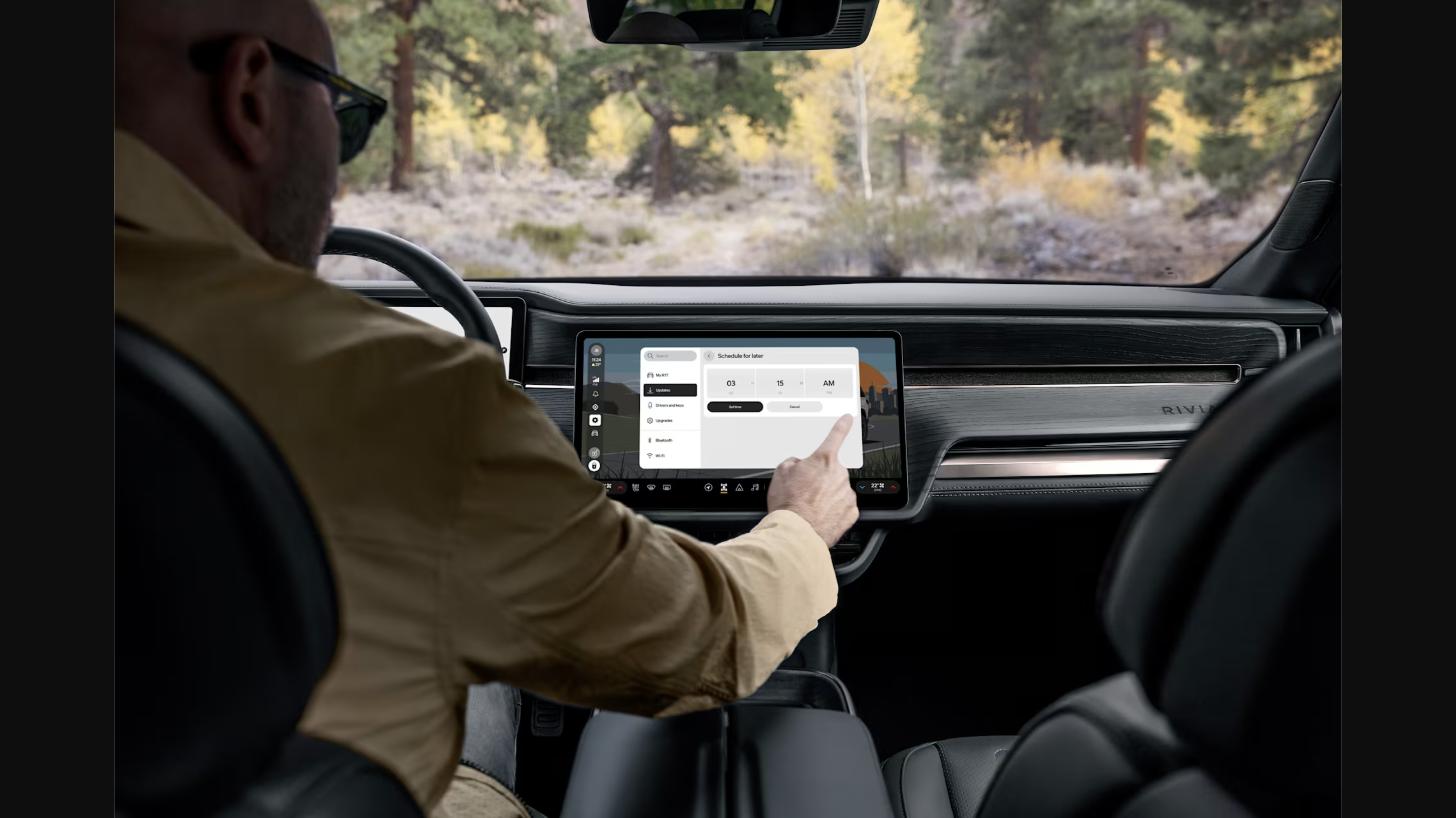
On September 4, Rivian began rolling out RivianOS 2 — internally, update 2026.31 — to eligible R1 and R2 vehicles. The company’s own description of it is blunt: a single, unified software stack running a redesigned interface, Unreal Engine 5 graphics, and what Rivian now calls an “AI-defined vehicle” architecture, retiring the “software-defined vehicle” language it used for years. The pitch, in Rivian’s words, is that every improvement “lands everywhere” — one codebase, one release train, whether you’re driving a six-figure R1 or the mass-market R2 that only started reaching driveways in June.
That’s a bigger deal than it sounds. Rivian’s own Halloween tradition is the cleanest evidence of why.
In October 2024, Rivian’s first Halloween software drop turned R1 trucks into rolling costumes: a Knight Rider-style K.I.T.T. mode, a Back to the Future time machine complete with an “88 mph” button, and a customizable Haunted Rivian that turned pedestrians into zombies and cyclists into headless horsemen on the driver display. A year later, the follow-up, “Spooky Swamp,” added alligator roars, a haunted player-piano melody, and flickering cabin lighting. Both updates were free, both arrived entirely over the air, and both were R1-only — R2 didn’t exist as a delivered vehicle yet. Even within R1, the show wasn’t equal: Gen 2 trucks, with newer exterior light bars, got the full effects lineup, while Gen 1 owners got a simpler green light animation.
Sit with that for a second. Rivian talks about software-defined vehicles as if every car in the fleet is an infinitely upgradable blank canvas. In practice, even inside one model line, what your truck could do for Halloween has depended on which year’s light-bar hardware happened to be bolted to it at the factory. Software doesn’t erase hardware limits. It just decides how many of them you notice.
R2 raises the degree of difficulty considerably. It isn’t a smaller R1 running the same electronics. Rivian built it on new hardware, with roughly 200 sparse TOPS of dedicated edge AI compute for the cabin and a streamlined electrical architecture, at a price point meaningfully below a comparably equipped R1. Getting one shared codebase to run identically well — same graphics engine, same responsiveness, same seasonal light show — on a cost-engineered volume vehicle and a flagship truck is the actual engineering problem RivianOS 2 is supposed to solve. Rivian has already started proving it’s possible: a point-to-point driver-assist feature is rolling out to both R2 and R1 Gen 2 later this year, the first real sign that a feature is shipping across the lineup at once instead of trickling down a tier at a time, months apart.
None of that shows up on a spec sheet, but it’s the difference between a good software story and a good business story. Every legacy automaker that has tried to modernize its infotainment has hit the same wall: a new platform launches, and its software spends a year or two catching up to whatever the flagship already had, because the two were never built to share code in the first place. Rivian has its own recent reminder of how quickly a software promise can turn into a customer complaint — pulling Alexa from R1 earlier this year showed how much goodwill rides on every change to what the car can and can’t do. If RivianOS 2 genuinely unifies the stack, R2 buyers — the volume customers Rivian is counting on to reach real scale — stop being second-class software citizens the moment they take delivery. If it doesn’t, Halloween is exactly where that will show first, because seasonal features are low-stakes, highly visible, and almost impossible to fake.
Rivian hasn’t announced what this year’s Halloween update will include, or when it lands. Its past two drops arrived in the back half of October, and as of this writing, the company hasn’t published details for 2026.
Whatever Rivian’s design team ships this year, the interesting question isn’t how good the costume looks. It’s whether an R1 owner and an R2 owner see it on the same day, with the same effects, at the same time — or whether “every improvement lands everywhere” turns out to have an asterisk after all. Building one great seasonal feature proves a design team is creative. Shipping it, unmodified, across a lineup that spans two very different price points proves the platform underneath it actually exists.
Would you pay more for a car brand that promises every owner gets the same features, regardless of trim? Tell us in the comments.