
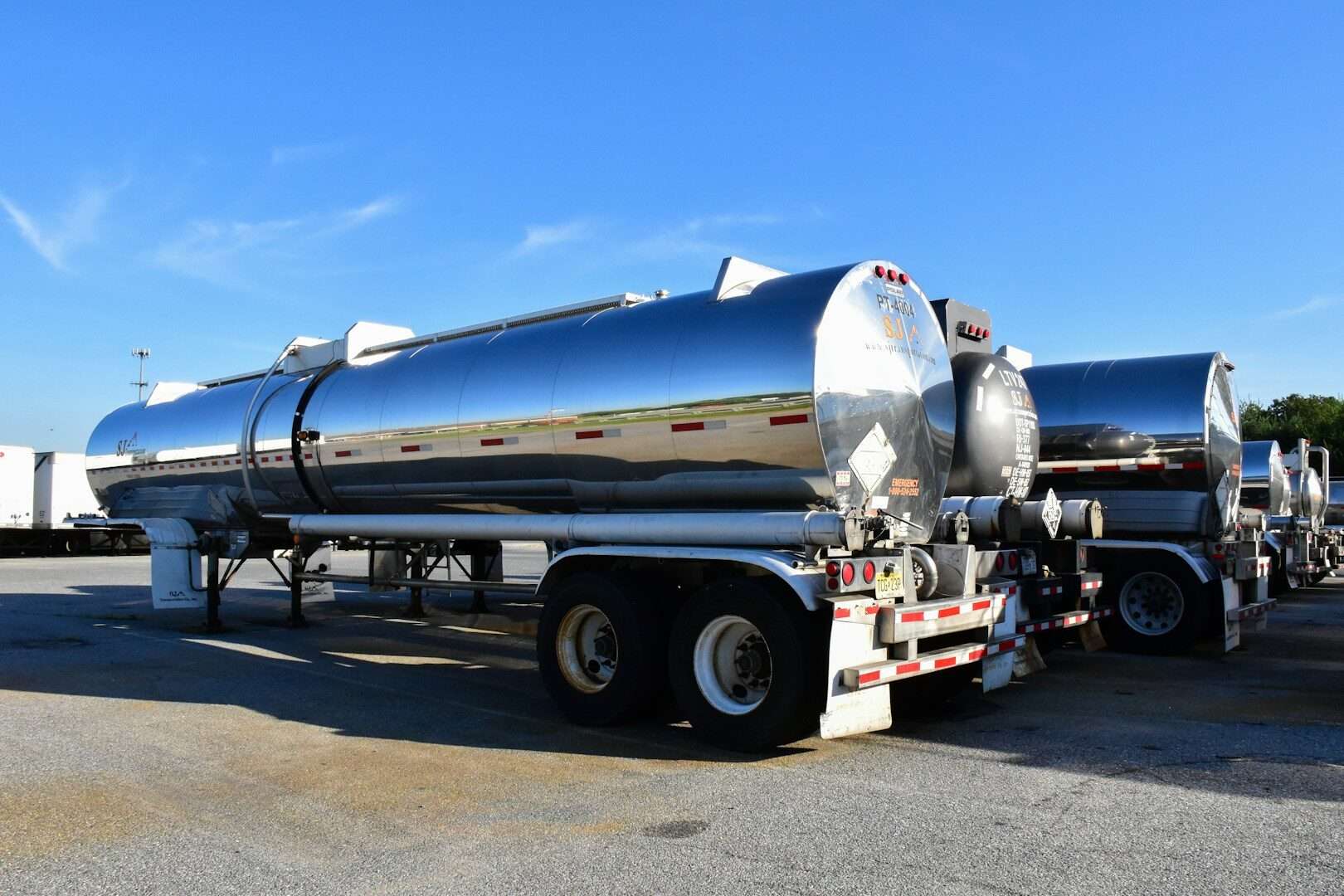
American refineries did not slow down this month. Neither did the pipelines. The part of the fuel supply chain most likely to leave your local station short of 87 octane on a Friday afternoon is the last fifty miles: one tank truck, one driver, and a federal clock telling that driver to stop.
On September 16, the U.S. Department of Transportation moved the clock.
Transportation Secretary Sean P. Duffy announced that the Federal Motor Carrier Safety Administration would temporarily loosen hours-of-service limits for truck drivers hauling gasoline and diesel. The waiver was issued that day and runs 90 days, which puts its expiration in the middle of December. Covered drivers may operate up to 16 hours within a 24-hour window, provided they take their required rest breaks. Only carriers and drivers in good standing qualify; a conditional safety rating or an active out-of-service order disqualifies you. Carriers must report any incidents to FMCSA within two business days.
Read the announcement and you would think this is a story about truck drivers. It isn’t. It is a story about the shortest lever the federal government has over the price of gasoline. Washington cannot conjure refining capacity in 90 days. It can rewrite a duty-status rule in an afternoon.
What the waiver actually moves
Start with the baseline, because the baseline is what makes the change legible. Under the standard rules for property-carrying drivers, a trucker gets 11 hours of driving inside a 14-hour on-duty window, following 10 consecutive hours off duty, with a 30-minute break required after eight cumulative hours behind the wheel. The 14-hour window governs most working days, and it keeps running whether the truck is moving or parked at a loading rack.
The waiver swaps that frame for a wider one: as many as 16 hours of operation measured against a 24-hour day. For a fuel hauler, that is rarely one heroic interstate run. Tank work is short-cycle work, terminal to station and back again, and the binding constraint is usually the clock rather than the odometer. Widen the window by two hours and a driver who used to park with product still on the trailer can make one more drop.
What the announcement does not do is explain how those 16 hours interact with the 30-minute break or the 10-hour reset, beyond instructing drivers to take “required rest breaks.” Compliance departments will want that in writing before they redraw a single dispatch board.
The 16-hour day was already legal. The excuse is what changed.
Sixteen hours is not a number invented for this waiver. It is already the outer edge of the rulebook. The hours-of-service final rule that took effect in September 2020 lets a driver stretch the 14-hour window by up to two additional hours when adverse driving conditions appear. Fourteen plus two is sixteen. Any dispatcher in America could already build a legal 16-hour window when an ice storm justified it.
So the ceiling did not move. The justification did.
The adverse-conditions exception exists for something a driver runs into and cannot forecast: fog, ice, a closed mountain pass. This waiver applies the same outer limit to an economic condition instead, in this case short-term pressure in a commodity market. That is a precedent with a long tail. Once tight fuel logistics count as grounds for extending duty time, it becomes much harder to explain why propane in January, grain at harvest, or parcel freight in the three weeks before Christmas do not deserve identical treatment. Every industry with a seasonal crunch now has a template and a citation.
A conditional safety rating just got expensive
The eligibility screen is the most underrated line in the entire announcement, and it is the one with money attached. Relief flows only to carriers and drivers in good standing. Hold a conditional safety rating and you are excluded. Sit under an active out-of-service order and you are excluded.
Picture two tank truck operators bidding on the same fuel jobber’s contract in November. One is rated satisfactory. The other picked up a conditional rating in an audit two years ago and never finished the paperwork to clear it. For the next 90 days, the first company can legally pull more hours out of every driver and every truck it owns. In a business priced by the load and the mile, that is not a compliance footnote. That is capacity, and capacity is revenue.
This is regulation by tier, and it is quietly becoming the agency’s favorite instrument. FMCSA holds the safety data. It can grant operational privileges to carriers whose records look clean and withhold them from carriers whose records do not, with no rulemaking, no new statute, and very little to litigate. Fleets that have treated their federal safety profile as a filing-cabinet chore are learning that it carries a market price. The agency showed the same reflex last month when it pulled more than a hundred truck driver training providers off the federal registry.
The safety decision now happens at hour 15, in the dark
The waiver’s safety architecture rests on one expectation: a driver who feels fatigued is supposed to find a safe place and rest. On paper, that is entirely reasonable. In practice, it relocates the judgment from a bright federal line to a single person, late at night, alone, inside a pay structure that rewards motion over rest.
There is a reason hours-of-service was written as a hard number instead of a guideline. A hard number does not ask an exhausted human being to grade their own impairment. Fatigue is uniquely bad at recognizing itself.
Which makes the two-business-day incident reporting requirement the most consequential guardrail in the package, and probably not for the reason it was drafted. It creates a dated federal record tied specifically to waiver operations. Anyone who has watched commercial trucking litigation knows where that leads. After a serious crash, the first questions will be whether the carrier was running under the waiver, what its safety rating was on the day of the load, and whether that incident report was filed on time. Carriers should assume all three answers become evidence. Insurers underwriting tank fleets should assume the same and price the next renewal accordingly.
What is left once you forget the numbers
The waiver lapses in mid-December. Whether pump prices notice is doubtful. Ninety days of duty-hour flexibility is a rounding error next to crude, refining margins, and the plumbing of regional pipelines. Georgia drivers got a clean lesson in that hierarchy this summer, when their price spike turned out to be a pipeline story rather than a Persian Gulf story.
The better question is whether the waiver ends at all. Federal hours relief has a habit of renewal, and FMCSA’s own emergency declarations page often reads less like a list of new issuances than a list of extensions.
This waiver also did not arrive alone. FMCSA spent 2026 recruiting drivers for hours-of-service pilot programs under the department’s Pro-Trucker Package: expanded sleeper berth splits, and a split duty period that would let a driver pause the 14-hour window for up to three hours a day. Every one of those projects pushes in the same direction. Duty time becomes elastic. Taken by itself, the fuel waiver looks like a supply chain patch. Taken in sequence, it looks like the 2020 rulebook being reopened one exception at a time.
Hours-of-service was written as a fatigue rule. It is now being used as an energy policy instrument. That shift happened without a rulemaking, without a comment period, and, for most of the people sharing an interstate at midnight in December, without notice.