
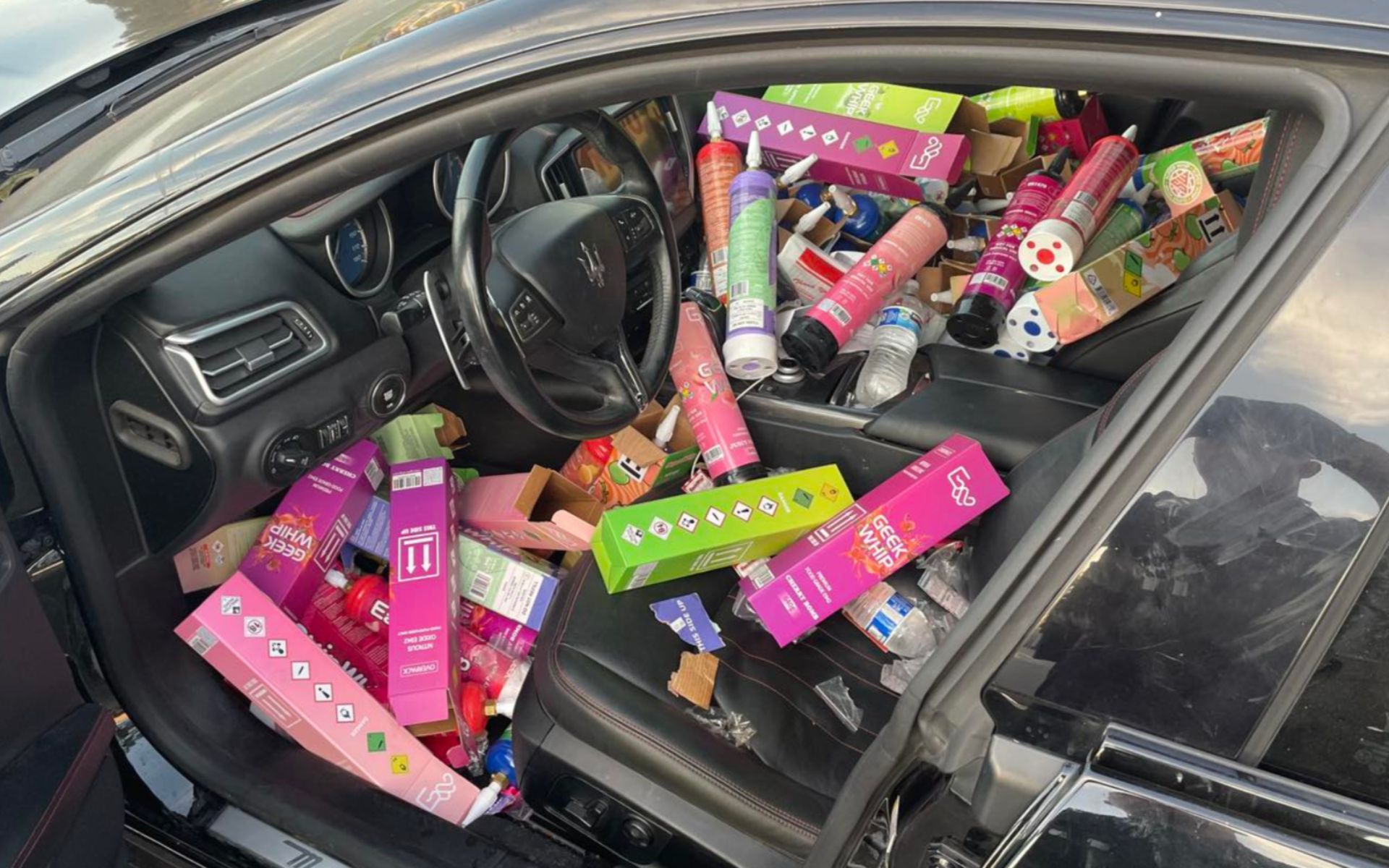
Three pages. That is the entire length of the bill that would end retail nitrous oxide sales in the United States. Inside those three pages sits a carefully built list of the people Congress decided to spare: dentists, doctors and pharmacists; food manufacturers and commercial kitchens; accredited research labs; and the aerosol can of whipped cream in your refrigerator door.
Nobody who races a car made the list.
That omission, not the nitrous oxide ban itself, is the part worth your attention. The only thing currently standing between the performance aftermarket and a federal prohibition on the gas it sells by the pound is a definition Congress wrote in 1972 and has not seriously revisited since.
What the bill actually does
H.R. 7945, the Nitrous Oxide Safety Act of 2026, was introduced in March by Rep. Kevin Mullin and sent to the House Energy and Commerce Committee. On September 16 the committee folded it into a sixteen-bill markup and advanced it on a recorded vote with no member voting against it. The committee’s own markup record lists no amendment offered to the bill, so the text that moved is the text as introduced.
The mechanism is short and blunt. One hundred eighty days after enactment, any consumer product containing nitrous oxide becomes a banned hazardous product under section 8 of the Consumer Product Safety Act. Under that law’s prohibited-acts section, that makes it unlawful to sell, offer for sale, manufacture for sale, distribute in commerce, or import the product.
Notice what that list leaves out: possession and use. This is a commerce statute, not a contraband statute. A ten-pound bottle strapped into a hatchback would not become illegal. The counter where you get it filled is the pressure point. Hold onto that distinction, because it is the entire ballgame.
The exemptions are precise. They are just not about cars.
Read the carve-outs closely and you find real drafting skill. Medical and dental use is protected, defined by the license of the person dispensing it. Food production is protected, and the bill bothers to spell out that a commercial kitchen means a restaurant, a caterer or another food-prep business. Research and development is protected for universities, companies, nonprofits and government labs.
Then comes the interesting one. The ban does not reach a consumer product in which nitrous oxide is sold as part of a food and used to push that food out of a pressurized container. That is a can of aerosol whipped cream, where the gas and the cream share one vessel. A bare charger with no cream in it is not that. Somebody threaded a needle between the dessert aisle and the smoke shop.
They were thinking hard about dairy. They were not thinking about engines at all.
Why your kit probably survives, and why “probably” should bother you
Here is the accident that protects the performance world. The Consumer Product Safety Act only reaches consumer products, and its own definition of that term specifically excludes motor vehicles and motor vehicle equipment. It does that by pointing at federal vehicle safety law, which defines motor vehicle equipment to include any part sold to improve a component of a vehicle, or as an accessory or addition to one.
A plate kit, a pair of solenoids, braided stainless lines, a bottle with a high-flow valve. That is motor vehicle equipment on any plain reading. It was never a consumer product in the first place, so a statute banning nitrous-containing consumer products does not obviously touch it.
The gas is where it gets uncomfortable. Ten pounds of automotive nitrous sold across a counter is a consumable chemical, bought by a consumer, for recreation. That is nearly word for word the language the Act uses to describe what it does cover. Is bulk nitrous a vehicle part, or is it the thing a vehicle part consumes? Nobody has needed an answer before, because nobody has ever tried to ban it.
There is a second wrinkle, and it runs backwards from what you would expect. Federal law defines a motor vehicle as something built primarily for use on public streets and highways. A dedicated race car is not one. So as this bill is drafted, the closer a car sits to pure competition use, the weaker its claim to the exclusion that shelters street parts. Read that twice.
The part nobody in this debate has mentioned
The racing industry solved the inhalant problem decades before Congress noticed it existed.
Holley’s NOS brand, which has been in this business since the late 1970s, states in its own technical documentation that it sells only automotive grade gas, dosed with sulfur dioxide at 100 parts per million, and that the additive is there specifically to deter substance abuse. The same document notes there is no performance benefit to medical grade gas at all. The industry deliberately spoiled its own product to make it unpleasant to breathe, gave up nothing in horsepower doing it, and has shipped it that way for a generation.
H.R. 7945 draws no distinction between gas engineered to be unbreathable and gas flavored to be inhaled. Chemically they are the same molecule, so you can see how the drafting got there. Practically, one of them carries a forty-year abuse-deterrent record and the other is a colorful tank behind a vape counter, and the bill has no way to tell them apart.
Process is the quiet casualty
Normally a product gets banned like this. The Consumer Product Safety Commission finds that it presents an unreasonable risk of injury, finds that no feasible safety standard would adequately fix the problem, and only then promulgates a rule through full rulemaking, with a public docket and a comment period. That architecture is slow on purpose.
Legislating the ban directly skips every step of it. No docket. No comment period. No forum in which a nitrous manufacturer, an independent speed shop or a sanctioning body can file the single sentence that would settle the question. And the fuse is 180 days, which is not much time for a supply chain to learn what it is still allowed to sell.
Congress has worked out that it can declare a category of consumer product hazardous by statute and leave the expert agency out of the conversation entirely. Enthusiasts should care about that tool regardless of what is in the bottle this time. We have watched Washington reach into the engine bay before, whether that was the EPA leaning on performance parts sellers or the swing in the other direction when the White House told EPA to ease off DIY repair. The lesson runs the same way both times. The aftermarket does well when its exemption is written down, and badly when it is merely assumed.
Follow the consumable, not the hardware
If you want the commercial stakes, stop looking at kits and look at refills. NOS rates a 125-horsepower plate system on a ten-pound bottle at roughly seven to ten full quarter-mile passes. Turn it up to 250 and you are down to three to five. A bracket racer’s season is not one purchase. It is a stack of them.
That is why a retail sales ban would bite harder than it looks. Every kit already on a shelf could stay perfectly legal and serious nitrous use would still wither, because the business runs on a refill network of independent speed shops and gas distributors. Cut the counter out and the hardware becomes jewelry.
There is an ownership-cost wrinkle here that most street users have never considered. A nitrous bottle is not a tank, it is a DOT specification cylinder, and the aluminum ones commonly used carry a five-year requalification interval under federal hazmat rules. The date stamp on the neck is why a refill shop can turn you away. Which is another way of saying the retail channel was already the compliance chokepoint for this product long before anybody drafted a ban.
Why racers bother with it at all
A short detour, because the engineering explains the economics. Nitrous oxide is roughly 36 percent oxygen by weight. In the chamber it breaks down near 572 degrees Fahrenheit and hands that oxygen over, which lets the engine burn more fuel. The leftover nitrogen buffers the rate of cylinder pressure rise. The phase change on injection pulls intake charge temperature down by 60 to 75 degrees.
In other words, you are carrying your own oxidizer and your own intercooler in a bottle. That is why it is still the cheapest horsepower per dollar in the catalog, and why the plumbing is aerospace grade. Bottle pressure is targeted around 900 to 950 psi, and system pressure routinely runs past 1,000.
One footnote nobody in this fight has raised. The EPA puts nitrous oxide’s hundred-year global warming potential at 273 times carbon dioxide. Every purge at the starting line is, technically, a small climate event. Nobody is legislating on that basis. It is simply true.
What to remember
None of this argues the abuse problem is imaginary. It plainly is not, and its enforcement edge has been turning up in car stories for a while, from the Orange County driver arrested with nearly 90 canisters in his car to the broader appetite for vehicle-based penalties on display in things like South Carolina’s street takeover law. A bill aimed at flavored tanks in convenience stores is a defensible bill.
It is also a bill that would be trivially easy to fix. Twenty words would do it. Nothing in this section applies to nitrous oxide sold for use in an internal combustion engine. That sentence costs the public health argument nothing, because the gas in question is already dosed to punish anyone who tries to breathe it.
As of this writing, the Consumer Product Safety Commission has published no guidance on how it would read the bill, and I could locate no public position from the specialty equipment industry’s trade association on H.R. 7945. Whether the House adds a motorsports carve-out on the floor remains unconfirmed. What is not in doubt is where the language stands today.
Racing’s protection in this bill is not written in the bill. It lives in a cross-reference from 1972 that points at a renumbered section of a different statute about highway safety. Cross-references are the easiest thing in Washington to amend and the second easiest to forget. The people who write the exemption list decide who gets to keep playing, and everyone left off it finds out later.