
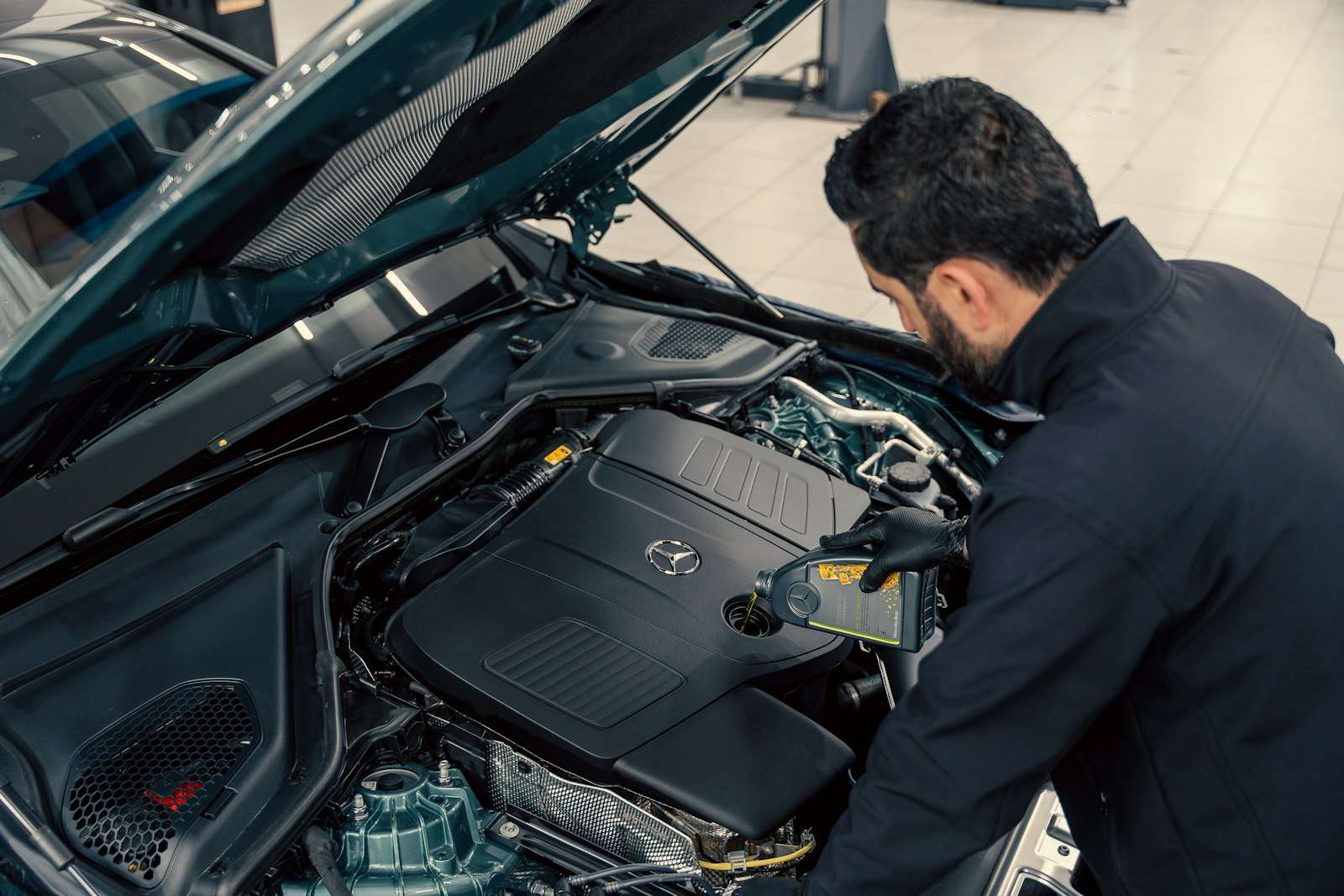
The least glamorous room at a car dealership is the one paying for everything else. Not the showroom with the polished floors and the new-car smell. The service drive, with its waiting-room coffee, its oil-stained lifts and its steady stream of customers who need something fixed.
That is why a low-key fireside chat in Southern California erased more than $20 a share from AutoNation in a single trading session.
On Sept. 17, AutoNation Chief Financial Officer Tom Szlosek sat down with investors at Morgan Stanley’s 14th Annual Laguna Conference, in a session the company billed as a discussion of strategy, financial performance and current trends. AutoNation shares closed that day at $174.88, down 10.5% from $195.37 the day before. Sonic Automotive fell about 9%, and Lithia Motors dropped about 5%.
Investor accounts of the session centered on four cautions: parts-and-service growth running softer than expected heading into third-quarter results, pressure on new-vehicle profit, a sharp drop in electric-vehicle demand and affordability strain reaching all the way down to routine maintenance. The remarks came in a webcast conversation, not a formal guidance update, and AutoNation has not put a revised forecast in writing.
The comment that rattled the market was not about how many cars AutoNation is selling. It was about how many it is fixing. That tells you almost everything about how a modern franchised dealership actually makes money.
The showroom is the lobby. The service drive is the business.
AutoNation’s own second-quarter 2026 results, filed with the Securities and Exchange Commission, show the math. Of the $1.23 billion in gross profit the company earned from April through June, $607.1 million, or about 49%, came from parts and service. New vehicles contributed $150.6 million, roughly 12%.
Read that again. The department that fixes cars produced about four times the gross profit of the department that sells new ones.
The rest of the picture fills in quickly. Finance and insurance, the office where loans, service contracts and add-on products get sold, generated $357.6 million. Used vehicles brought in $115.1 million. And new-car margins keep shrinking: AutoNation’s gross profit per new vehicle fell 14.5% year over year to $2,381.
That mix is the entire investment case for publicly traded dealer groups. New-vehicle sales rise and fall with the economy. Service is supposed to be the ballast. Cars wear out whether or not interest rates are friendly, and a car under factory warranty or an open safety recall goes back to a franchised dealer, because that is where the automaker pays for the repair.
When the ballast starts to shift, investors notice fast.
The warning was already hiding in the numbers
Here is the part that got less attention. AutoNation called its second quarter a record for after-sales gross profit, and CEO Mike Manley highlighted it in the July results release. The record is real. It is also a smaller word than it sounds.
After-sales revenue grew 3.4% from a year earlier. Gross profit in that segment grew just 1.4%, and the margin slipped 90 basis points to 48.1%. The company said customer-pay work, the jobs owners pay for out of their own pockets, grew 7%. Since the department as a whole grew at less than half that rate, everything else inside it, including warranty repairs, wholesale parts sales and internal reconditioning of trade-ins, had to be growing far more slowly or shrinking.
Now put those figures next to federal inflation data.
The Bureau of Labor Statistics’ August Consumer Price Index shows prices for motor vehicle maintenance and servicing up 7.9% from a year earlier. The broader maintenance-and-repair category rose 5.2%. Overall consumer prices rose 3.4%. New-vehicle prices rose just 0.6%, and car insurance, after years of painful increases, actually fell 5.1%.
That is not a perfect comparison. The CPI tracks prices at every kind of shop nationwide, not AutoNation’s invoices, and the calendar periods do not line up exactly. But the direction is hard to miss. When the going rate for an oil change and tire rotation climbs faster than a dealer’s service revenue, the dealer is not winning more business. It is charging more for roughly the same amount of work, or less.
That is the real story inside AutoNation’s warning. Service is not collapsing. But a good share of the growth dealers have been booking in the service lane has been built on price, and price is exactly what a stretched customer eventually pushes back on.
Why maintenance is the last thing people cut, until it isn’t
Maintenance has always been sticky spending because the alternative is frightening. Skip a car payment and you get a letter. Skip a cooling-system repair and you get a tow truck.
But there is a pressure valve most owners never think of as a spending decision: the interval. Nobody cancels an oil change. They push it back 2,000 miles. They decline the cabin filter, the brake-fluid flush and the alignment on the multipoint inspection sheet. They buy tires at a warehouse club. Each choice is tiny. Multiply it across a customer base the size of AutoNation’s, and it shows up on an earnings call.
The Cox Automotive Dealer Sentiment Index for the third quarter, based on a survey of 929 dealers conducted July 22 through Aug. 5, fits that picture. Dealers rated current market conditions at 41, well below the long-term third-quarter average of 48, while the index measuring cost pressure hit 71. Franchised dealers reported the sharpest deterioration. One Toyota dealer in the survey blamed high interest rates and rising prices for pushing people to hang on to their cars longer.
Which exposes an irony built into the franchised dealer model.
Older cars should be great for dealers. They aren’t, necessarily.
The average light vehicle on U.S. roads reached a record 12.8 years old in 2025, according to S&P Global Mobility. On paper, an aging fleet is a gift to the service department. Old cars need more work.
In practice, a 12-year-old car is long past its factory warranty, and its owner has no obligation to take it back to the brand’s dealer. The older a car gets, the harder its owner shops on price, and the independent shop down the street, the parts store and the driveway all become competition. Dealers hold a natural advantage on young cars covered by warranties and recalls. That advantage erodes with every birthday.
So when shoppers put off replacing their cars, a franchised dealer can lose twice: once on the new-car sale that never happens, and again on the years of high-margin warranty-era service that sale would have locked in.
A dealership can survive a year when people stop buying cars. It was never built for a year when people start rationing repairs.
The Fed and the EV hangover
The timing did not help. One day before AutoNation’s appearance, the Federal Reserve raised its benchmark rate by a quarter point, to a range of 3.75% to 4%, in a unanimous 12-0 vote, saying inflation “remains elevated.” It was the Fed’s first increase since July 2023, according to the central bank’s record of rate changes. We looked at what that means for trade-ins in our latest check on used-car values.
Higher rates squeeze a dealer from both directions. Shoppers pay more to finance a car, and the dealer typically pays more to carry inventory, because the floorplan loans that fund cars sitting on the lot are generally tied to short-term rates.
The EV warning has a clear backstory, too. The federal clean vehicle tax credit of up to $7,500 is not available for vehicles acquired after Sept. 30, 2025, according to the Internal Revenue Service. That means this year’s third quarter is being measured against the final months when EV shoppers had a deadline pushing them into showrooms. A drop against that comparison was predictable.
There is a quiet twist for the service department. Battery-electric vehicles skip oil changes, spark plugs and many of the fluid services that fill a dealer’s service schedule, as the U.S. Department of Energy notes. Every buyer who chooses a gasoline car instead is a future stream of maintenance visits. Weak EV demand hurts dealers that invested in chargers and training today. Over the long run, it may be the one headwind on this list that helps the service bay.
This is not a company in trouble. It is a model under strain.
None of this makes AutoNation a distressed business. It earned $182.1 million in second-quarter net income, and its in-house lender, AutoNation Finance, has grown its loan portfolio past $2.7 billion. In the first half of 2026, the company spent $457 million repurchasing 2.3 million of its own shares at an average price of $200.59. With the stock trading in the mid-$160s this week, those purchases show how quickly sentiment around the whole sector turned.
The pressure is showing up in overhead, too. Selling, general and administrative expenses consumed 69.6% of AutoNation’s gross profit in the second quarter, up from 67.0% a year earlier. When the most dependable profit line slows while costs creep higher, there is less room for anything else to go wrong.
AutoNation’s third-quarter report will show whether the Laguna comments were a warning shot or a preview. Either way, the lesson for anyone who owns, buys or sells cars is the same: the showroom gets the attention, but the service lane pays the rent. If owners have started stretching that lane’s visits, dealers will have to fight for them with sharper prices, more service specials and harder pitches for prepaid maintenance plans at the sales desk.
Have you started stretching service intervals or moving your car from the dealer to an independent shop to save money? What made you switch, or what keeps you going back to the dealer?