
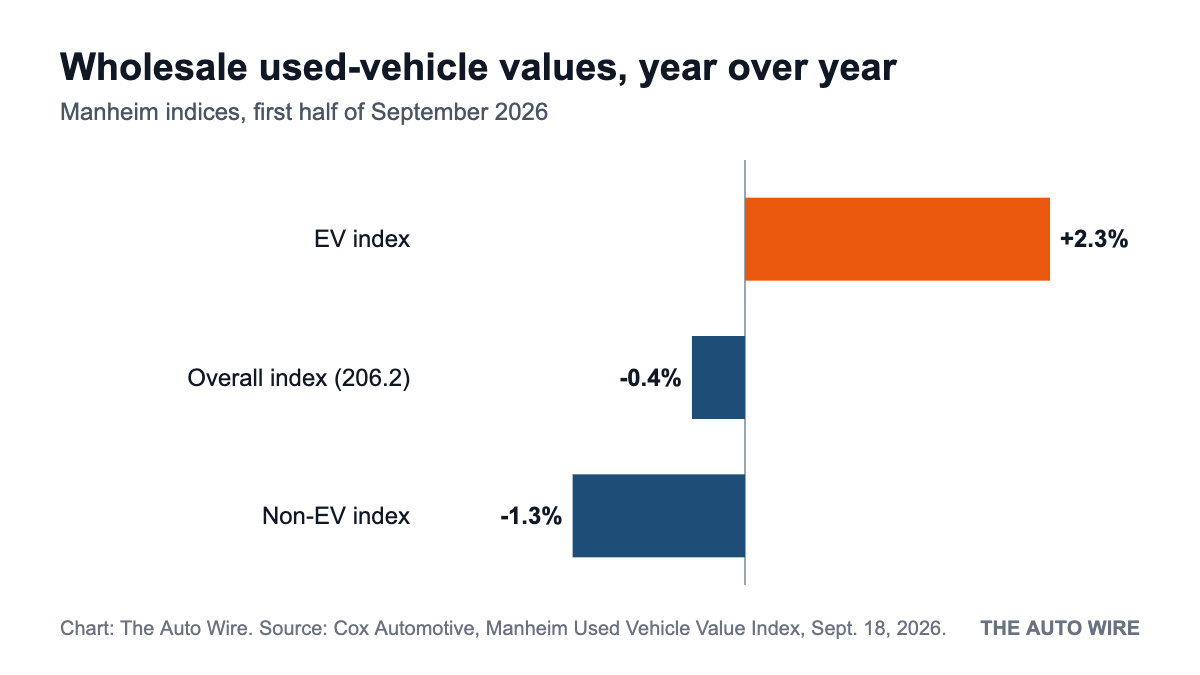
The number is 206.2. That’s where the Manheim Used Vehicle Value Index landed in the first half of September, down 1% from August and 0.4% below where it sat a year ago, according to Cox Automotive’s mid-month report published Sept. 18. It is the first year-over-year decline in used car values the index has shown in 2026.
Read quickly, that sounds like the relief used-car shoppers have been waiting on. It mostly isn’t. The headline figure is small, it measures a price most buyers never see, and it hides a much bigger split underneath: gas-burning trucks and SUVs are losing value at auction while used electric vehicles are gaining it. That split, not the 0.4%, is the story.
What the used car values index actually measures
The Manheim index tracks wholesale prices, meaning what dealers pay for used vehicles at auction, adjusted for the mix of vehicles sold and for normal seasonal swings. It is not the number on a windshield sticker.
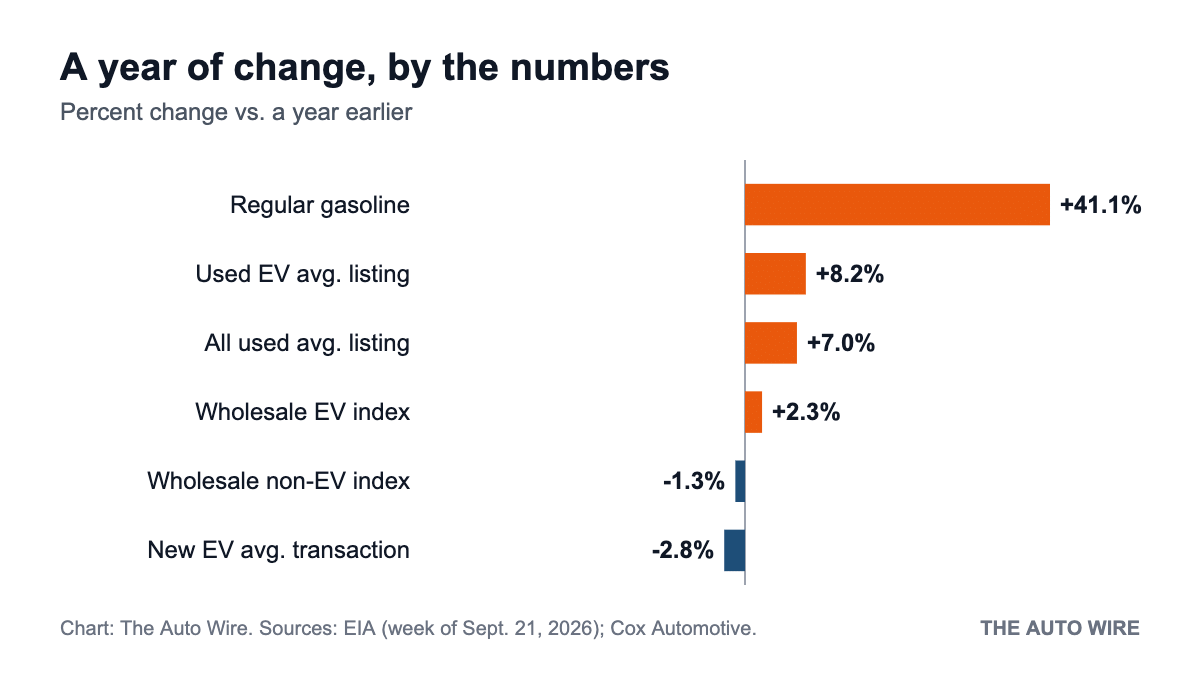
The retail side is telling a different story. Cox’s August used-inventory report put the average used-vehicle listing price at $27,239, up 7% from a year earlier and the highest monthly average since December 2022. So a 0.4% wholesale dip set against a 7% retail climb is not a price cut. At best, it’s the first sign that the pressure dealers have been passing along is starting to ease at the source.
That matters because wholesale tends to move first. Dealers price their lots off what they paid, so a softer auction market shows up on retail stickers later, not immediately. We’ve been tracking how long those old pressures linger, including how the 2021 chip shortage is still showing up in used-car prices.
The split: used EV values up, gas-car values down
Here is the part the headline number flattens. Cox also breaks out an EV index and a non-EV index. In the first half of September, the EV index was up 2.3% year over year. The non-EV index was down 1.3%. By segment, compact cars and EVs were the only groups showing year-over-year gains; pickups, SUVs and midsize cars were all negative.
Other signals in the report point the same way. Wholesale days’ supply rose to 27.8 days as of Sept. 15, 2.4 days more than a year ago, which means more cars are sitting at auction. The sales conversion rate, the share of vehicles offered at auction that actually sell, averaged 55.8%, down 1.4 points from last year. Dealers are bidding more carefully, and they’re being pickier about what they bid on.
Why now: $4.48 gas and the first Fed hike since 2023
Two things changed the math for buyers at almost the same moment.
First, fuel. The U.S. Energy Information Administration’s weekly survey put regular gasoline at $4.478 a gallon for the week of Sept. 21, up $1.305 from a year earlier. That’s roughly a 41% increase. Diesel was $6.529, up $2.78. Cox’s analysts tied the shift toward compact cars and EVs directly to gas prices climbing “amid renewed unrest in the Middle East.”

Second, borrowing. On Sept. 16, the Federal Reserve raised its benchmark rate by a quarter point to a range of 3.75% to 4.00%, its first increase in more than three years, citing inflation that “remains elevated.” Auto loan rates don’t move in lockstep with the Fed, but they follow its direction. When the monthly payment on a used truck goes up at the same time its fuel bill does, some shoppers step down a size, and wholesale prices for big vehicles feel it.
It’s worth remembering that fuel is still a smaller slice of ownership cost than most people assume. AAA’s latest numbers showed that even with gas prices up sharply, an electric sedan still cost more to own than a gas one once depreciation was counted. But buyers react to what they see at the pump every week, and the auction data shows they’re reacting now.
The EV twist: new EVs got cheaper, used ones got pricier
Cox’s August EV Market Monitor shows the two EV markets heading in opposite directions:
- New EVs: average transaction price of $54,754, down 2.8% from a year ago, with incentives averaging 12% of the price, about $6,594 per vehicle. New EV sales were 78,895, down 46.9% year over year. Last August’s total was inflated by buyers racing the Sept. 30, 2025, end of the federal EV tax credit.
- Used EVs: average listing price of $37,441, up 8.2% from a year ago. Used EV sales hit 44,350, up 14.7% year over year and up 25.9% from July.
Put those together and something shifts that neither report spells out. Using Cox’s figures, the gap between the average new EV transaction and the average used EV listing is now about $17,300. Working backward from the year-over-year changes, that gap was roughly $21,700 last August. The discount for going used on an EV has shrunk by about $4,400 in a year.
One caveat: a transaction price is what buyers actually paid, and a listing price is what sellers are asking, so this is a directional comparison, not an exact one. The direction is still clear. Used EVs are getting less cheap relative to new ones, not more.
What falling used car values mean for drivers and buyers
If you’re trading in a pickup or a large SUV: the trend is working against you. Trade-in offers are built off wholesale values, and those segments are the ones sliding. Get more than one written offer, including from buyers who aren’t selling you your next car, so you know what the vehicle is actually worth this month.
If you’re shopping for a used truck or SUV: this is where the wholesale dip could eventually help. Dealers who are paying less at auction and watching units sit longer have more reason to negotiate. Because retail lags wholesale, don’t expect sticker prices to drop overnight, but a dealer with aging inventory has less room to hold firm.
If you’re shopping for a used EV: cross-shop new. With new EV incentives averaging about $6,600 and used EV prices rising, the numbers on a leftover new model may land closer than you’d expect. If you do buy used, ask for a battery health report before you sign.
If you’re financing anything: the Fed hike matters more than the 0.4%. A small drop in a vehicle’s value can be wiped out by a slightly higher interest rate over a five- or six-year loan. We broke down how that plays out on the new side when new-car prices topped $50,000 again, and the same logic applies to used loans.
If you’re on a tight budget: this headline probably won’t reach you. Cox counted only 29 days’ supply of used vehicles under $15,000 in August, with that inventory down 25.9% from a year earlier. Those cars now make up 15.1% of available inventory, down from 20.6%. The cheapest end of the market is still short on cars, which is why three-year-old used cars under $20,000 have become so hard to find.
What it means for the industry
For dealers, the risk is timing. Anyone who stocked up on trucks and SUVs when used car values were higher this summer is now holding inventory that’s worth less at wholesale than it was, while retail buyers are more rate-sensitive than they were in August. That’s a recipe for thinner used-vehicle margins this fall.
For automakers, used EV demand is a useful signal while new EV sales are down nearly half from a tax-credit-inflated year ago. Buyers are clearly willing to own an EV. At the right price, many of them are choosing a used one. For the auction and remarketing business, which has been consolidating fast (see Copart’s $1.9 billion ACV deal), a market where some segments rise while others fall puts a premium on accurate condition data and pricing.
A final caution: this is a mid-month reading. The full September index arrives in early October, and one half-month doesn’t make a trend. But if gas stays above $4 and rates keep climbing, the gap in used car values between gas-guzzlers and fuel-sippers is likely to keep widening, and trade-in offers will follow.
Would $4.48 gas change what you drive next? Are you holding on to a truck or SUV, trading down to something smaller, or finally considering a used EV? Share what’s shaping your next move.