
For years, GM’s OnStar Smart Driver feature turned driving data into a grade for the person behind the wheel, and GM’s marketing went out of its way to keep the grades low-stakes. With a score of 88, the company explained, “you might consider yourself a B+ driver.” And unlike a high school grade, it added, “your Smart Driver score isn’t permanent.”
Montana’s attorney general says those scores had a second life. In a 31-page complaint filed Oct. 16, the state alleges that GM sold trip-level driving data to data brokers. GM contractually required at least two of them to turn it into a “Driving Score” for each customer and sell access to insurers, who, the state says, used those scores to raise premiums, drop coverage, or deny it.
The B+ line is quoted in the state’s own filing, as an example of how GM played down the significance of a bad score.
What Montana filed
Attorney General Austin Knudsen sued General Motors LLC and its subsidiary OnStar LLC in Montana’s First Judicial District Court in Lewis and Clark County under the state’s Unfair Trade Practices and Consumer Protection Act. The complaint’s opening paragraph accuses GM of turning the automobile, “a perennial symbol of American freedom and autonomy,” into “Big Brother on wheels.”
These are allegations. GM has not answered the complaint in court, and nothing in it has been proven. GM had not issued a public response to the Montana suit as of Monday, Oct. 19.
The state says the data came from more than 14 million GM vehicles, “many of which” were driven by Montanans. The complaint does not say how many Montana drivers were affected.
“Before you take ownership of your vehicle”
Most of the complaint is about one moment: the end of a car purchase, when the paperwork is signed and the buyer wants to go home.
According to the filing, a dealership employee would log into GM’s onboarding system, enter the vehicle’s VIN, set up or find the customer’s OnStar account, and then turn the screen toward the buyer. The screen told the customer to “complete the next few steps” before taking ownership of the vehicle and offered a “Get started” button. The state alleges that neither GM nor the dealer told buyers this step was optional.
The next screen, the complaint says, held a 29-page “User Terms for Connected Vehicle Services,” an 18-page “General Motors U.S. Connected Services Privacy Statement,” two links to AT&T terms and policies, a vehicle ownership acknowledgment, and two checkboxes: “I accept” and “I decline.” The state says most buyers probably saw only the first paragraph of each document without scrolling. Its broader allegation is that reading every word would not have helped, because none of the documents disclosed that GM sold driving data or that the data would reach insurers.
The state alleges that salespeople had reasons to get buyers through the process. The complaint says GM paid dealership staff bonuses or commissions for enrollments. It also says a salesperson risked a charge-back for failing to put a customer-signed copy of the OnStar terms into the vehicle’s sales packet.
The warning for something you never had
Buyers who checked “I decline” were not done. The complaint includes screenshots of a warning telling them they were about to disable OnStar and Connected Services, and that declining “will result in deactivation of all services,” including Automatic Crash Response and Emergency Services.
The state’s objection is about timing. At that point, it says, the customer had not yet been enrolled in anything. The warning described turning off services that were never on.
Buyers who still declined got a second screen. According to the complaint, it announced that all services on the vehicle “have been deactivated” and prompted them to go back and accept the OnStar terms. People who left the lot without enrolling, the state says, then received repeated emails inviting them to start a trial.
Where the GM driving data went, according to Montana
The complaint lists 36 categories of GM driving data, including GPS coordinates, seat-belt status, hard-braking and hard-acceleration events, and odometer readings. Two consecutive entries in that list are “speed over 80 miles per hour” and “speed under 80 miles per hour.”
Montana says GM developed the risk “factors” the brokers used to score drivers. According to the complaint, those factors included late-night driving, sharp turns, hard braking, hard acceleration, seat-belt status, and driving over 80 mph.
The state lays out the deals in order:
- Verisk Analytics, 2015. The complaint says GM received a multimillion-dollar lump-sum payment, then ongoing “royalty payments” as Verisk sold insurers licenses to its Telematics Data Exchange. Over the life of the agreement, the state says, insurers looked up the Driving Scores of hundreds of thousands of GM customers.
- Wejo, 2018. The complaint says the British connected-car startup paid GM a share of its gross revenue from licensing the data.
- LexisNexis Risk Solutions, 2019. The complaint says LexisNexis built Driving Scores for GM customers, sold insurers access through its LexisNexis Telematics Exchange, and paid GM a revenue share.
- Jacobs Engineering Group, Jan. 3, 2024. The complaint says GM authorized Jacobs to use and license de-identified driving data in exchange for revenue-sharing payments.
The complaint also says the Verisk deal required Verisk to recruit other automakers’ data into the exchange. According to the state, Verisk signed similar agreements with American Honda in 2017 and Hyundai Motor America in 2018. The state says GM stood to earn more money from those other manufacturers’ data.
What GM has already said and settled
GM ended the broker arrangements in 2024, after The New York Times reported on them. In an April 24, 2024 statement, GM said it had cut ties with LexisNexis and Verisk, that “any data sharing with these companies ended on March 20, 2024,” and that it would discontinue Smart Driver and unenroll all customers. Montana treats that quick stop as evidence: the complaint argues it shows GM knew the conduct was deceptive, which matters because Montana’s civil fines of up to $10,000 per violation apply to willful violations.
Federal regulators have already been through this. On Jan. 14, the Federal Trade Commission finalized an order with GM and OnStar. It bars the companies for five years from disclosing drivers’ geolocation and driver-behavior data to consumer reporting agencies, and for 20 years it requires affirmative express consent before they collect, use, or share connected-vehicle data, with limited exceptions such as sharing location with emergency responders. In a January 2025 statement on the then-proposed settlement, GM said it had expanded its privacy program so customers in all 50 states can access and delete their personal information.
Other states have their own cases. Texas Attorney General Ken Paxton sued GM in August 2024, alleging that it sold data from more than 1.5 million Texans. In May, California Attorney General Rob Bonta announced a $12.75 million settlement with GM under the state’s privacy law, subject to court approval. Montana itself opened an investigation into Ford and Stellantis in April over similar data practices.
Montana is asking the court for more than a fine. The state wants GM ordered to “delete and destroy” all driving data collected before judgment, including copies held by third parties such as the brokers.
If you own or owned a GM vehicle: what to check
Smart Driver no longer exists, and GM says broker sharing stopped in March 2024. GM driving data that was already sold is a separate question. These are the steps available now:
- Ask the brokers what they have. LexisNexis Risk Solutions provides a free consumer disclosure report. Verisk has a separate driving behavior data request form. Look for trip, braking, or speed records tied to your VIN.
- Ask GM for your data, or for deletion. GM’s current privacy statement directs access, correction, and deletion requests to consumerprivacy.gm.com or 1-866-MYPRIVACY (1-866-697-7482). GM says it does not accept these requests by email.
- Check the settings in the car. On some 2019 and newer models, OnStar location services can be turned off in the infotainment system’s Privacy Settings. GM says it may still collect location in an emergency, such as a crash. For 2025 and newer models, consent for exterior camera and sensor data is managed in the Data and Privacy section of your GM account.
- Weigh a full disconnect carefully. You can drop OnStar entirely by calling 1-888-4ONSTAR (1-888-466-7827) or pressing the blue button. Unlike the warning screen described in the complaint, this choice really does turn off Automatic Crash Response and emergency calling.
- Ask your insurer. If your premium jumped or a policy was declined, ask in writing whether third-party driving or telematics data was used. Under the federal Fair Credit Reporting Act, an insurer that takes adverse action based on a consumer report generally has to tell you so and name the agency that supplied it.
For the smartphone side of the same problem, our earlier look at what car-app trackers owners can switch off covers settings that have nothing to do with OnStar.
What happens next
GM will have its chance to respond in court. Montana has demanded a jury trial and is asking for a declaration that GM broke state law, a permanent injunction, civil fines for each willful violation (plus additional fines for violations against vulnerable adults), deletion of the data, and its legal costs.
Montana’s complaint does not dispute GM’s claim that a Smart Driver score wasn’t permanent. Its argument is that the score didn’t stay in the car. GM says the score wasn’t permanent. Did anyone in the app or at the dealership ever tell you where it was going?
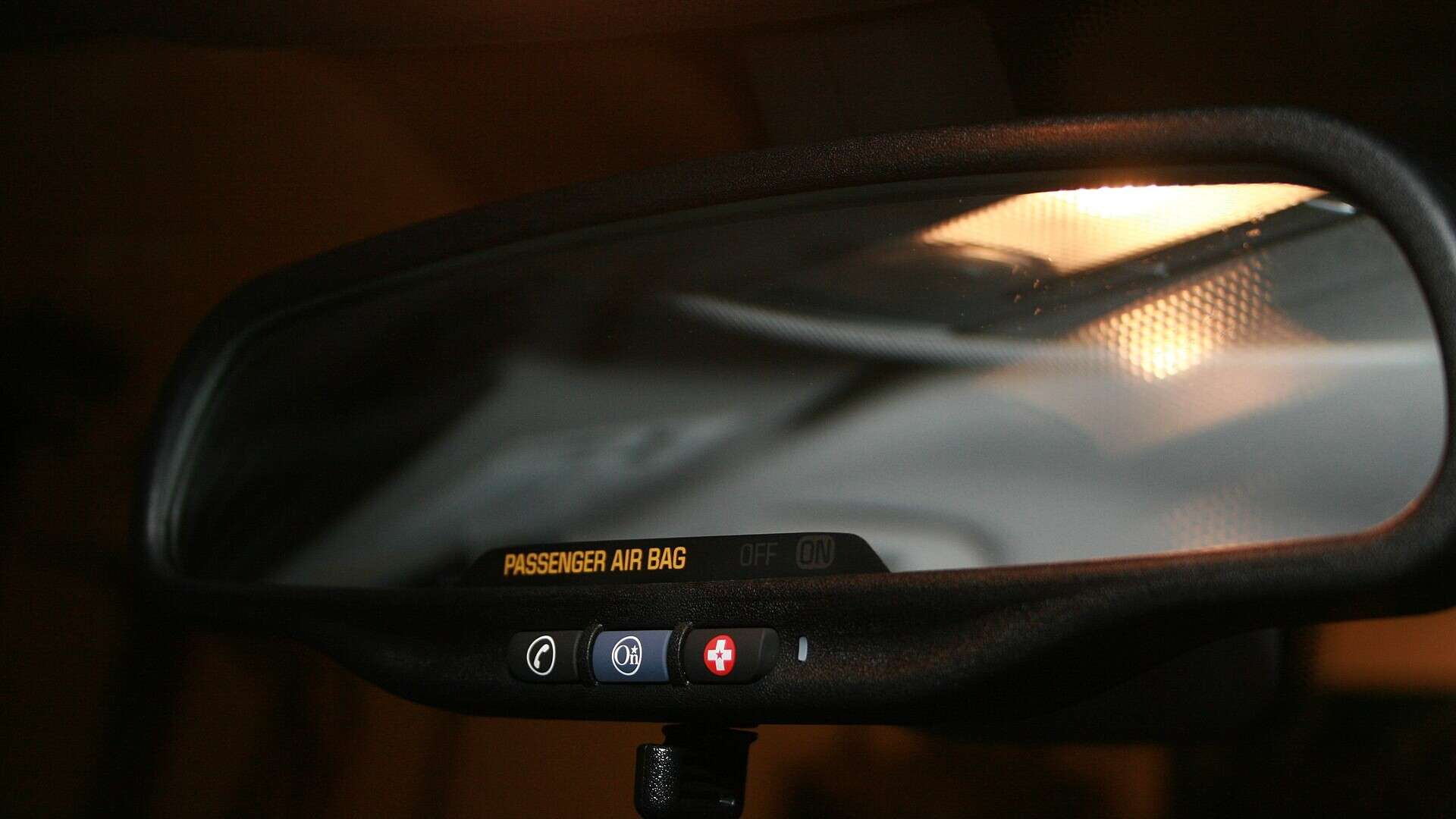
Top photo: OnStar buttons beneath a GM rearview mirror, by Tyler from Riverside, USA, via Wikimedia Commons (CC BY 2.0).
