
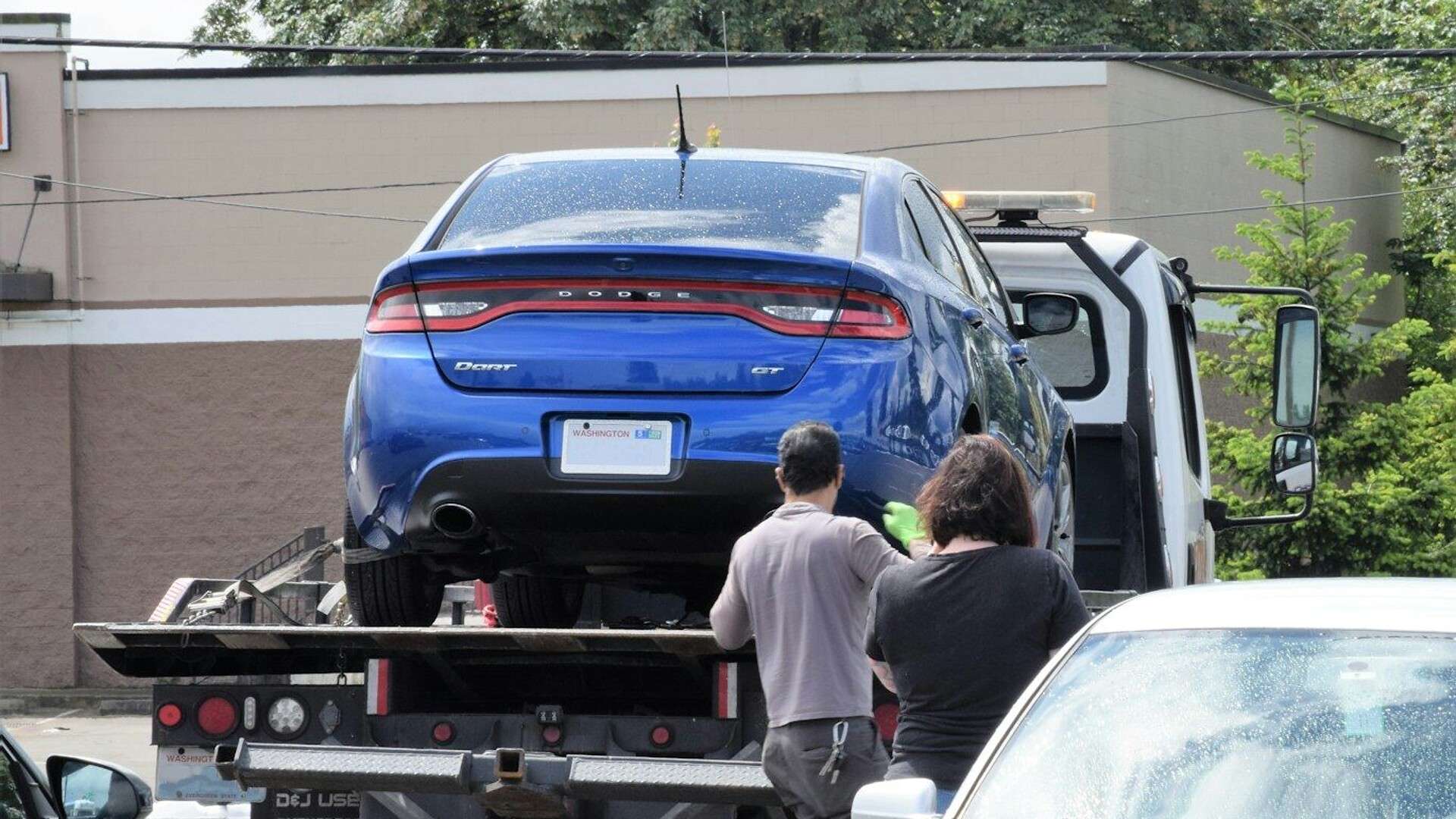
The car loan that keeps auto lenders up at night in October 2026 is not the one on the buy-here-pay-here lot.
It’s a $45,000, 72-month note on a crossover, signed in 2024 by somebody with a credit score north of 700 and a job in insurance, software or marketing. The trade-in that went into the deal was $7,000 underwater, so the new loan was bigger than the new car on day one. The payment is $1,000. Gas has been over $4 a gallon since late July. And that job sits in one of the white-collar sectors that has been quietly shrinking all year: financial activities alone has shed 129,000 jobs since May 2025, 90,000 of them at insurance carriers.
That borrower mostly isn’t in the repossession numbers yet. This story is about why they could be.
Here’s what is in the statistics. Repossessions were already running at their highest level since 2009 before this year started. The share of auto-loan dollars 90 or more days late hit a record in the spring and has barely come off it. Subprime borrowers, the usual suspects, were the ones who improved in the second quarter. The group whose late payments rose was prime and super-prime.
Good credit got them the $45,000 loan. It did not make the payment smaller, the gas cheaper or the job safer. In 2026 all three went the wrong way at once, and the lenders know it: they are now holding cars back from the repo lot on purpose, because they lose money on every one they take. The cars lenders haven’t come for yet are the number to watch.
This is the first installment of Repo Watch, a running tally of what 2026 is doing to America’s $1.7 trillion in car loans. We’ll be back every month with the numbers, the names and the next shoe.
The numbers: a 2009-level problem with the counter turned off
Start with the inconvenient fact: nobody publishes an official count of repossessions. Not the Fed, not the CFPB, not the bureaus. The last hard number anyone will put their name on is Cox Automotive’s estimate of 1.73 million vehicles repossessed in 2024, the most since 2009 and up about 43% in two years. Cox’s own forecast had 2025 at 1.82 million. For 2025 and 2026, there is no count, only estimates.
The estimates are ugly. CURepossession, the recovery-industry trade outlet, built a model on recovery-network data and Equifax delinquencies and put 2026 at roughly 3.08 million completed repossessions, within sight of the 2009 peak of about 3.2 million. That is a model, not a count, and its authors say so. We’re not going to launder it into a fact. But you don’t need it, because the pieces of the machine that do get measured all point the same way.
The auction lanes. Manheim, Cox’s wholesale arm, says repossessed vehicles hitting its auctions are at a record year to date, 36% above 2019, and that repo is the only category of inventory that has climbed back above its pre-pandemic level. Repos are now 16% of what Manheim sells, up from about 12% in 2022. The growth rate has slowed, from double digits in recent years to 9% this year. Keep that slowdown in mind; it is not good news.
The delinquency pipeline. The New York Fed’s second-quarter report puts auto balances at $1.71 trillion. The share of those dollars 90 or more days late hit a record 5.6% in the first quarter and sat at 5.5% in the second, roughly half a point higher than a year earlier. The annualized flow of loans into serious delinquency was 3.00%, up from 2.93%. In March, Cox’s own default tracker hit 3.79% annualized, the highest since early 2010, with year-to-date defaults running 9% above 2025.
The subprime index. Fitch’s 60-day subprime delinquency index, which goes back to 1994, set an all-time record of 6.90% in January. Tax refunds pulled it down in the spring; by July it was back to 6.13%. Fitch said in March it expects both prime and subprime performance to deteriorate this year versus last.
Why the slowdown isn’t good news. Repo growth isn’t slowing because fewer people are in trouble. It’s slowing because lenders have stopped sending the trucks. In April the American Recovery Association, the repo agents’ trade group, told its members in writing that accounts once assigned for repossession at 60 days past due “are now often being held at 90 days, 120 days, or longer,” as lenders work to keep consumers in their vehicles. At the Auto Finance Summit last week the message was the same: lenders are modifying and extending delinquent loans rather than taking the cars. The math explains why. Fitch’s data shows prime lenders recovering 59 cents on the dollar at auction in July and subprime lenders 38 cents, and a CFPB study found 94% of repossessed cars that were sold left the borrower still owing money. A repo is a loss for everyone, so the lender waits.
The Philadelphia Fed published a paper in April arguing the headline delinquency rate overstates how bad borrowers’ finances are, precisely because the flow of new delinquencies has been fairly stable while the stock of old ones grows as forbearance practices evolve. Fair enough. Read it the other way: the pile of loans that are badly late and not being resolved is the biggest on record, and it is being managed, not fixed. That pile is what a job loss or a $4 gas bill lands on.
The new face of the repo: good credit, no cushion
Prime borrowers are not defaulting in droves. Fitch’s prime 60-day delinquency index was 0.49% in July. Even at the bottom of the Great Recession it only touched 0.9%. If you have a 740 score and a job, the odds you lose the car this year are still small.
What has changed is the direction. That 0.49% was 0.42% a year earlier, a rise of about a sixth. Experian’s second-quarter data showed 60-day delinquencies climbing across prime and super-prime loans, to 0.7%, in the same quarter subprime improved. VantageScore flagged the same pattern last fall: near-prime and prime borrowers were the tiers where late payments were growing fastest. For years the auto-credit story was a subprime story. The subprime index is still at record territory, but the thing moving now is the tier that was supposed to be safe.
Two things changed.
Prime borrowers signed the biggest loans. You need good credit to get $44,664 financed at 7% over 70 months, which is what the average new-car buyer did last quarter. Borrowers with 720-plus scores took 54.6% of all auto originations in the second quarter. Of the new-car buyers paying $1,000 or more a month, 69% took terms of 72 months or longer. A prime file with a $1,000 payment and six years to run is not a safe loan. It is a loan with no slack in it, held by someone who has never missed a payment and has no idea how fast that can change.
The cushion is gone. Lenders are stretching to keep volume up. The New York Fed says the median credit score on a new auto loan fell to 716 from 724 in the second quarter, and originations to borrowers in the 620-to-659 band jumped 55% in a year. Cox’s dealer-finance data shows negative equity in a majority of loan applications. Fitch’s own explanation for the subprime pain, “affordability pressures weighing disproportionately on lower-income, highly leveraged borrowers,” now describes a lot of prime files too. The leverage migrated up the credit ladder.
The lenders have been saying it out loud all year, in the careful language of earnings calls. Ally, the biggest pure-play auto lender, told analysts in July that delinquencies “have remained stubbornly high,” that “gas prices are also an issue,” and, in the words of CEO Michael Rhodes, that “consumers are basically triaging on a real-time basis.” Wells Fargo grew auto originations 15% in the third quarter while its overall provision for credit losses rose to $1.03 billion from $681 million a year ago. Santander’s U.S. consumer-auto book has 13.2% of loans 30 to 89 days late. Repo Watch will be reading Ally’s third-quarter numbers closely.
And the people who actually take the cars have been saying it longer. “We’re in very low-income neighborhoods but also in very high-income neighborhoods,” an executive at a California recovery firm told reporters last fall. A Michigan repo operator described the business to CNN in February as “a target-rich environment.” Sen. Elizabeth Warren opened a probe of a dozen auto lenders in February over what her office called skyrocketing repossessions. Whatever the exact count, the trucks are not short of work.
The boat has always been full of subprime borrowers. What’s new is who is standing on the dock with a $1,000 payment, a $7,000 hole in the trade-in, a 72-month term and a job in an industry that is cutting. They don’t need to default to be in trouble. They need one bad month. 2026 is a year built out of bad months.
The payment math: how a good loan becomes a bad one
Edmunds published its third-quarter financing data on October 1. Every line that matters is a record.
- 21.2% of new-vehicle loans now carry a payment of $1,000 or more a month. A year ago it was 19.1%.
- 25.5% of new-vehicle loans run 84 months or longer. A year ago, 21.8%. Seven-year car loans have gone from a buy-here-pay-here gimmick to one in four new-car deals.
- The average new-car buyer financed $44,664 at 7.0% for 70.5 months and will pay $9,938 in interest. The average payment is $787. Down payments fell, to $5,554 from $6,021.
- Used isn’t the escape hatch it used to be: $582 a month at 10.6% over 70 months.
Then there’s the hole people are starting from. In the second quarter, 29.6% of trade-ins on new-car purchases were underwater, by an average of $6,884. Buyers who rolled that into the next loan took on a record $944 average payment and are on track to pay $16,270 in interest. Earlier in the year, one in four underwater trade-ins owed more than $10,000. “Stretching out a loan shouldn’t be a way to talk yourself into a vehicle that doesn’t make sense,” Edmunds’ Ivan Drury said with the release. A quarter of buyers did it anyway.
The car itself is the first cause. The average new vehicle sold for $50,562 in September, $52 off the all-time high. Cox estimates the 2025 tariffs added $5,000 to $8,900 to the cost of an imported vehicle and $1,600 to $2,000 to a U.S.-built one, and that sticker prices on 2026 models ran 10.4% above the 2025 models they replaced. Manufacturers and dealers ate some of that. Buyers ate about 6%.
The money is the second cause, and it just got worse. The Federal Reserve raised rates in September for the first time since 2023, to a range of 3.75% to 4.00%, because oil pushed inflation back to 3.7%. Markets put a second hike in December at roughly 75%. The 10-year Treasury, which auto rates key off, has been above 5%. Cox reported last week that the prime rate on a used-car loan hit 12.9% in October, and that lenders are already “seeing interest rates ticking up on loans booked so far in October.” Total interest on a typical used-car loan is now about $11,000, 26 cents of every payment dollar, versus about $5,600 in 2019.
The third cause is the one nobody budgets for: the asset is shrinking. Wholesale used values fell 0.6% from a year ago in September, the first annual decline since early 2025, and Cox cut its full-year forecast to essentially flat. Large trucks and SUVs, the vehicles with the biggest loans on them, lost value fastest as $4 gas sent buyers toward hybrids and compacts. A borrower who was $5,000 underwater on an F-150 in June is deeper underwater today without having done anything.
One line item moved the right way: auto insurance is down 5% from a year ago. Maintenance and repair costs are up 5.8%, and nearly half of drivers are responding by skipping it. The car that doesn’t get fixed is the next car that doesn’t get paid for.
The three accelerants
None of the above is new. Payments have been climbing since 2021. What’s new is that 2026 stacked three income shocks on top of a loan book that had no room for one.
1. The job market stopped hiring, and AI is the reason companies give
The September jobs report, released October 2, showed 29,000 jobs added. July was revised to a loss. Over the past year the economy has added about 45,000 jobs a month, and Moody’s Mark Zandi points out that outside health care the number is essentially zero: health care and social assistance added roughly 520,000 jobs in twelve months; the rest of the economy lost about 24,000. Unemployment is 4.2%, which sounds fine until you look at who’s in it. The long-term unemployed, people out of work more than six months, are 27.1% of the total, up from 23.6% a year ago. The median spell of unemployment is 11.5 weeks, near a four-and-a-half-year high.
That’s the shape of a “low-hire, low-fire” market, and for a car loan it’s the worst shape there is. Layoffs are rare, so weekly jobless claims look benign, under 200,000 for five straight weeks. But if you are the one laid off, nobody is hiring, so the gap between paychecks runs three months instead of three weeks. Two missed payments is where repossession assignments used to start. Now lenders wait for three or four.
And the layoffs that are happening have a signature. Challenger, Gray & Christmas, which has tracked announced job cuts since 1993, reports that artificial intelligence is the single most-cited reason for layoffs in 2026: 120,136 jobs through September, 21% of all announced cuts and more than double the 54,836 attributed to AI in all of 2025. Technology-sector cuts are up 54% year over year. Oracle disclosed in its annual report that AI “has resulted, and may continue to result, in reductions to our workforce” after shedding roughly 21,000 jobs. Block cut nearly half its staff; Jack Dorsey said a “significantly smaller team, using the tools we’re building, can do more.” Cloudflare called its 1,100 cuts a move to an “agentic AI-first operating model.” Salesforce credited Agentforce. Kroger told 3,000 corporate employees last week that “the way work gets done is changing across every industry.” These are not warehouse jobs. They are the jobs that carry $800 car payments.
Is AI actually causing it? Economists are split, and we’ll say so. Yale’s Budget Lab concluded in May that AI is “probably not (yet)” the reason for the labor market’s weakness and that immigration slowdowns explain more. Goldman Sachs estimates AI has trimmed payroll growth by roughly 25,000 jobs a month, real but modest. Oxford Economics suspects some companies are dressing up ordinary cost-cutting as AI strategy. Stanford researchers, on the other hand, find employment of 22-to-25-year-olds in the most AI-exposed occupations running about 19% below where it would otherwise be, with the damage coming through hiring that never happens. Fed Governor Lisa Cook said in late September there is “limited evidence” so far, and that she is “highly attentive” to the scenario where that changes. The Fed’s own Beige Book put it more plainly: firms “anticipated less job creation after increasing productivity by investing in AI.”
Your lender does not care which economist is right. The payment is due on the 15th either way, and the hiring freeze is what turns a layoff into a default. Wages, meanwhile, are growing 3.0% against 3.7% inflation. Real pay has fallen in almost every month since the war began.
2. The war put $4 gas in every budget for five months
The war between Iran and the U.S.-Israel coalition began in late February. Within weeks the Strait of Hormuz, which carries a fifth of the world’s seaborne oil, was effectively shut; Brent crude hit about $118 in late March. An April 8 ceasefire did not reopen the shipping lanes. Crude flows have partly rebuilt through ship-to-ship transfers, but refined products, diesel and jet fuel above all, are moving at less than half the pre-war rate, and renewed tanker attacks and strikes on Saudi facilities put Brent back above $105 this month.
At the pump: regular gasoline is $4.30 today against $3.04 a year ago and $2.98 before the war. The national average has been above $4 since late July. The September monthly average of $4.33 beat the old September record by 50 cents, and this is the first October on record above $4. By AAA’s count 2026 has now logged 165 days at or above $4, more than 2022. Diesel is $6.32 after a record $6.53 on September 22, up 74% in a year, which is why at least 16 trucking companies went bankrupt between late August and late September and why Spirit Airlines simply stopped flying on May 2.
Moody’s Analytics estimates the war has cost U.S. consumers about $265 billion so far, roughly $2,000 per household, of which about $1,100 is energy and another $360 is the higher interest rates the Fed imposed to fight the energy inflation. The tally grows by about $50 a week. Zandi’s framing: the war has absorbed about half of the average household’s income gains this year.
Do the car math. A driver covering 15,000 miles a year at 20 mpg is paying about $945 more for gas than a year ago, call it $79 a month. In a 17-mpg pickup it’s about $93. That’s an 8% to 9% surcharge on a $1,000 payment, levied on exactly the vehicles that are losing resale value fastest. Insurify’s June survey of car owners found 69% driving less, 46% postponing maintenance, 35% taking on debt to cope and 29% who had already missed or delayed a bill. Even the repo industry is being squeezed: its trade group warned in May that $7 diesel was pushing recovery agencies “to a breaking point.”
Relief is political and partial. Ohio, North Carolina, Indiana and Utah suspended or cut fuel taxes; the White House deferred the federal diesel excise tax through year-end and temporarily allowed dyed off-road diesel on highways. The Strategic Petroleum Reserve is down to about 283 million barrels, its lowest since 1982. The Energy Information Administration expects gas to average $3.56 in 2027 and diesel $4.49, but only if Gulf flows normalize, and the IEA says the diesel squeeze lasts well into next year. Longtime fuel-price analyst Tom Kloza expects the national average to stay above $4 through the midterms and bets on above $4 into 2027.
3. Everything else landed in the same quarter
The Fed’s September hike was the first since 2023 and came with a warning that more are likely. Consumer sentiment in the University of Michigan’s October reading fell to 46.3, lower than 99% of all readings in the survey’s history; the Conference Board’s measure is at its lowest since 2014. The personal saving rate is 4.1%. More than one in ten dollars of student debt is seriously delinquent, up from half a percent two years ago, after collections resumed and seven million borrowers were pushed off an expired repayment plan this fall. Nearly half of buy-now-pay-later users paid late in the past year, and 29% are using it for groceries.
None of those is a car-loan statistic. All of them are the same wallet.
What happens next
The next 30 days are loaded. Start with Ally’s third-quarter results: its full-year guide was for retail auto losses of 1.8% to 2.0%, and any move off that number is the first hard read on how the summer treated car loans. Edmunds’ third-quarter negative-equity report is due any day; last year’s landed October 15. The Fed meets October 27 and 28; markets have mostly moved their bets for the next hike to December, where it’s priced at roughly 75%. The October jobs report comes November 6. The New York Fed’s third-quarter debt report follows in early November. And the fourth quarter is repo season: the industry’s rule of thumb is that about 30% of the year’s repossessions happen between October and December, when the holiday budget meets the car payment.
The base case is not a collapse. It’s a plateau at the worst level since 2009. That is what the forecasters who have to sign their names say. The Fed’s own projections have unemployment at 4.1% next year and inflation back near 2%. The EIA expects Brent to fall to $84 in 2027 and gasoline to average $3.56, if Gulf flows normalize. TransUnion projects auto delinquencies climbing more slowly in 2026 than in 2025. Cox pencils in roughly 1% growth in repo volume at auction; the recovery industry’s own model says it “may be approaching a plateau, although at levels not seen since the aftermath of the financial crisis.” Fitch’s view is less kind: it expects both prime and subprime performance to deteriorate this year versus last and to weaken further in the second half. But nobody credible is forecasting 2009.
The downside case doesn’t need a recession. It needs the extensions to run out. Remember what the repo agents were told in April: accounts are being held at 90, 120 days and longer. Loan extensions are not forgiveness; they move the missed payments to the back of the loan, on a car that is worth less every month. The Philadelphia Fed’s finding that delinquent loans are staying delinquent longer is the same fact from the other side. At some point a lender decides it has extended enough, and the backlog it built converts to repossessions all at once. That is the realistic shape of a “repo wave”: not a spike in people failing, but the end of a year of lenders choosing not to count them yet.
Four things would trigger it. Diesel above $6 through the winter, which the futures market already prices through January and which the IEA says is likely. A December rate hike that drags auto rates up with a 10-year Treasury above 5%. A holiday season with no seasonal hiring: retailers have announced 62,000 seasonal jobs so far against 100,800 by this point last year, the weakest September for hiring plans since 2011, which removes the side income that bridges a lot of December car payments. And used values that keep sliding, especially on trucks, so that every voluntary surrender and every repo sale leaves a bigger deficiency balance behind.
What would make it better is also specific. A ceasefire that actually reopens Hormuz would put Brent on the EIA’s path toward $74 by late 2027 and take the Fed’s reason for hiking off the table. Insurance is already falling. Credit is, strangely, easy: Cox’s measure of auto-credit availability is at a 10-year high. The door out of a bad loan is open. It just closes when you’re 60 days late.
What Repo Watch will track. Every month, nine numbers:
- Fitch’s prime 60-day index (0.49% in July; December’s level was 0.54%, and above that is new territory for this cycle)
- Experian’s prime and super-prime 60-day rate (0.7% in Q2)
- The New York Fed’s share of auto balances 90+ days late (5.5%; the record is 5.6%)
- Manheim’s repo share of sales (16%) and repo volume growth (9%)
- Lender loss rates and guides: Ally, Capital One, Santander, CarMax
- The long-term-unemployed share (27.1%) and median duration (11.5 weeks)
- AAA’s national average against $4, and diesel against $6
- Manheim’s used-value index, with truck and SUV depreciation broken out
- Repo-industry assignment trends: the day lenders stop holding accounts at 120 days is the day this story changes
If you’re one bad month away
This is not financial advice; it’s what the data says about the order of operations. The common thread is that every option is better before the first missed payment than after it.
Call before you miss, not after. Lenders are extending and modifying loans right now to avoid taking cars back, because the repo loses them money too. A payment extension, which moves one or two payments to the end of the loan, is routine and costs you interest, not your credit. Get the terms in writing. The borrower who calls at day 10 gets the extension; the borrower who goes silent until day 90 gets the assignment.
Know your number. Pull the payoff from the lender and the car’s real value from two sources. If you’re above water, you have a clean exit: sell it. If you’re under, know by how much, because that gap doesn’t disappear when the car does. Ninety-four percent of repossessed cars that go to auction leave the borrower owing money, plus towing, storage and fees. A voluntary surrender saves the fees and nothing else; it is still a repossession on your credit and still leaves the deficiency.
Refinance while your score is still your score. Auto credit is unusually available this year, and Experian counted about 140,000 refinances in the second quarter saving an average of $83 a month. Two catches. Rates are rising, so the window is now, not after the December Fed meeting. And lowering the payment by stretching the term is how people end up in year seven of a loan on a car worth less than the balance.
Don’t buy your way out of the gas bill. Swapping an underwater truck for a hybrid to save $90 a month in fuel only works if you have equity. Buyers who rolled negative equity into a new loan this spring averaged a $944 payment. You cannot save $90 by spending $200.
Shop the insurance. Premiums are down 5% from a year ago, the first real decline in years. It is the one line in the budget that will take a phone call and give money back.
Fix the car. A deferred $400 repair becomes a $2,000 tow-and-rebuild on a car you still owe $30,000 on, in the month you can least afford either.
If the job goes, move fast. File for unemployment the same week; the median search is now 11.5 weeks, and a quarter of the unemployed have been out more than six months. Tell the lender immediately and ask specifically about hardship or unemployment deferment programs. If the car is underwater and you carry GAP coverage, understand what it does and doesn’t pay before you need it.
Know what the lender must do. State law governs notice before a repossession, notice before the sale, your right to reinstate or redeem, and how a deficiency can be collected. The CFPB’s complaint portal still works, and the complaint record still matters in a dispute. Nobody reads that paperwork until the truck has already come. Read it now.
Why this is a watch, not a story
A story runs once. This one changes every month, and most of the numbers that move it are published on a schedule that nobody outside the auto-finance industry reads: Fitch’s indices, Manheim’s mid-month check-ins, the New York Fed’s quarterly, Experian’s tier data, lender 8-Ks, AAA’s Monday price sheet, the first-Friday jobs report. We’re going to read all of it and tell you what it means for the payment in your driveway, in plain English, with the sources linked, every month until the line behind the gate starts getting shorter.
Next up: Ally’s third-quarter numbers, Edmunds’ negative-equity report, and the Fed on October 28.
If your payment started feeling heavy this year, what tipped it: gas, the job, or the loan itself?
Subscribe to The Auto Wire newsletter and Repo Watch lands in your inbox the morning the numbers do. Follow us on X at @the_auto_wire for the same-day reads. And if you’ve been through this in 2026, with a good score and a job that disappeared, we want to hear it: admin@theautowire.com. We’ll protect your name. We won’t soften the numbers.
Lead Image Photo by fr0ggy5