
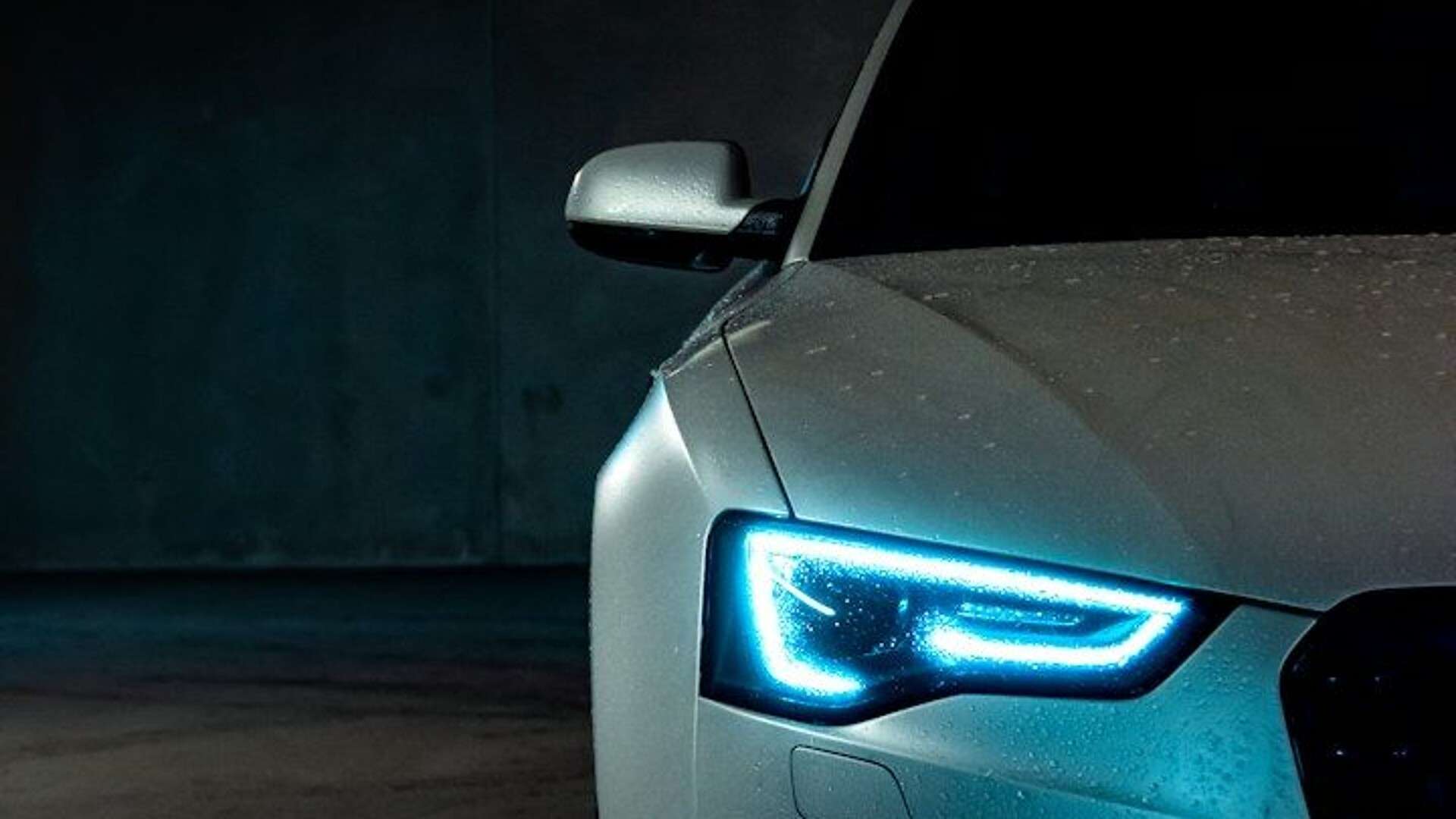
FMVSS 108 is the federal standard that dictates every lamp, reflector and blinker on a new car. It was written for vehicles with a human holding the wheel. NHTSA now wants to revise it for cars where no human is driving at all.
The agency has published a notice of proposed rulemaking, scheduled for the Federal Register on October 26. It does three things. It removes requirements that assume a driver’s hands and eyes, it creates an optional cyan marker lamp to show a vehicle is driving itself, and it updates two headlamp rules that have nothing to do with autonomy. Comments are open for 30 days on docket NHTSA-2026-1519.
The document doesn’t name Tesla, Zoox or any specific robotaxi. Even so, the main beneficiaries are clear: vehicles built without a steering wheel or pedals.
Removing the rules that assume a driver
Some current lighting rules can’t be met by a car that has no driver controls. Turn signals have to self-cancel when the steering wheel returns to center, and a car without a wheel has nothing to trigger that. Beam switching has to be operable by hand or foot. Hazard flashers have to be easy for “a person driving the vehicle” to activate.
Related Articles
- Audi Q4 E-Tron Recall: 80% Charge Limit, Fire Risk, and No Fix Yet
- Cox Says the VinSolutions Breach Is Contained, but the Legal Exposure Sits With Dealers
For automated vehicles without manual controls, NHTSA would limit those requirements to vehicles that actually have manual controls. The proposal doesn’t drop the hardware. These cars would still need a turn-signal operating unit and a beam-switching device, but the automated system would operate them. The turn-signal and high-beam telltales would also be dropped for these vehicles. A lamp-failure telltale would take their place, and it would have to be visible from every seat. That makes sense when any occupant might be the only person who notices a burned-out brake light.
NHTSA says that without these changes, manufacturers of these vehicles would simply apply for exemptions. Its argument is that rewriting the standard is cleaner than approving exemptions one by one.
The cyan lamp
The lamp NHTSA is proposing has a specific job. It would show that a vehicle is “operating without the expectation that an occupant is monitoring the roadway.” Under that definition, it’s a Level 3-and-above signal, not a light for ordinary driver-assistance systems.
The proposed specs:
- Color: Cyan, the blue-green defined in SAE J578. NHTSA argues that amber, red and white already have established meanings.
- Layout: One or two lamps each on the front, both sides and the rear, for four to eight lamps total. Each must be mounted at least 15 inches off the ground.
- Behavior: The lamps stay steady when lit. They don’t flash. NHTSA is asking for comment on whether flashing should be allowed for some signals.
- Brightness: Two sets of intensity limits, one for when headlamps are on and one for when they’re off.
- No combining: The cyan lamp can’t share a housing optically with other lamps.
NHTSA built the spec from SAE J3134 but departs from it on photometry, lamp count and optical combination. It cites Mercedes-Benz’s two-year on-road validation in California, which used five vehicles. That’s why the turquoise lamps on Drive Pilot cars may look familiar.
The lamp would be optional. NHTSA says it doesn’t have enough evidence of a safety need to require it on every automated vehicle. The proposal would ban the lamp on vehicles without automated driving capability. If this becomes final, adding cyan accent lighting to an ordinary car wouldn’t just break a state law. It would put the car out of compliance with the federal standard.
The preemption question
California already allows these lamps under Vehicle Code sections 25950 and 38750, which reference the SAE standard. NHTSA tentatively believes its final rule would preempt those sections wherever the federal version differs from J3134. It also expects to override other state color laws that would block a compliant cyan lamp. It says laws reserving blue for police wouldn’t be affected, because cyan is a different color.
Related Articles
- Opry Mills’ Security Chief Tells Nashville Regulators Repo Companies Can See Cars Enter the Mall, Then Says No Car Was Stolen There in About Two Years
- NHTSA Reviews Petition Alleging Ford’s 7.3L V8 Idles at 6 PSI of Oil Pressure, Then Got a 1,000-RPM Software Patch and No Recall
NHTSA tentatively concludes the rule generally wouldn’t block state lawsuits, but says some claims about how a fitted marker lamp performed could be impliedly preempted. A federal standard that partly shields robotaxi operators from lighting-related lawsuits is something the trial bar will likely challenge in the comment docket.
The headlamp changes
Two changes apply to every car. Integral-beam headlamps, which include most modern LED units, would be tested at their marked design voltage instead of the 12.8 volts used since the sealed-beam era, and results would be expressed in watts. LED modules have their own driver electronics, so a fixed test voltage doesn’t reflect how they actually operate. Separately, the rule requiring the low beam to sit above the high beam in vertical headlamp layouts would be removed. Mounting-height limits stay the same, but designers get more freedom with front-end styling.
What owners should take from this
Nothing changes yet. This is a proposal, and NHTSA has not put a number on its benefits or costs. If it goes final, body shops will stock cyan lamp assemblies that can’t share a housing with anything else, and a lit cyan lamp becomes a decent exhibit in a liability fight (our guess, not NHTSA’s). Don’t add cyan lights to a car that doesn’t drive itself.
A steady cyan lamp would tell you nobody in the car is expected to be watching the road. Would you merge in front of a cyan-lit car, or hang three lengths back? Tell us why.