
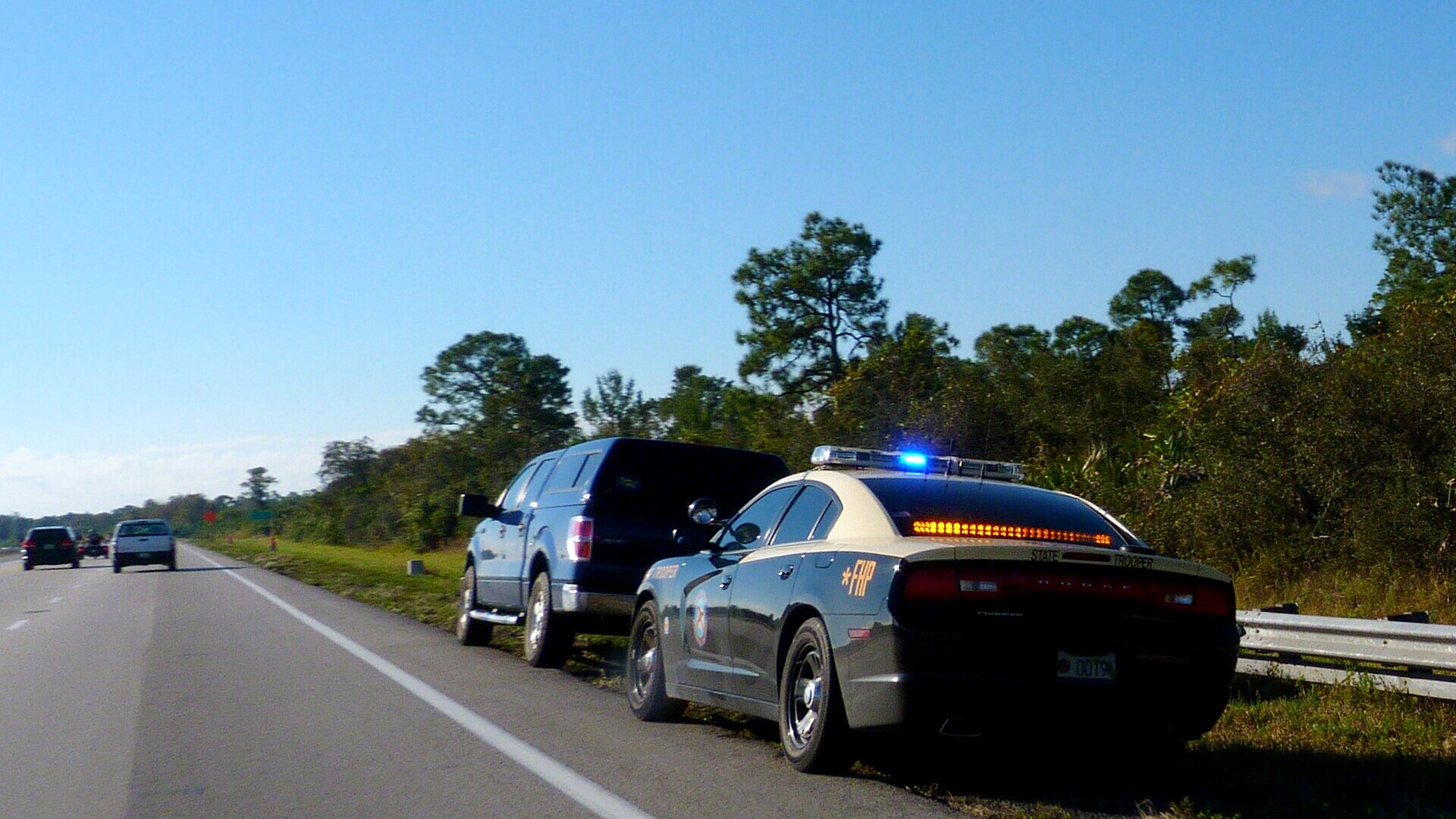
Both boys in the Chevrolet Traverse were 15. The driver had a learner’s permit and his mother’s SUV. At 3:45 a.m. on State Road 54 in New Port Richey, Pasco County, a Florida Highway Patrol trooper ended their 115-mph run with a PIT maneuver. The passenger died.
The chase began around 3:45 a.m. on July 26, when the trooper saw a Chevrolet Traverse going 74 mph in a 45 zone, according to MySuncoast’s report of FHP’s account. The driver did not stop, FHP says, and reached up to 115 mph. After the PIT, the SUV rotated onto the south shoulder, hit a utility pole and struck a tree. The driver was seriously injured. Neither boy wore a seat belt.
FHP said alcohol was in the SUV and has not said whether either boy had been drinking. The Tampa Bay Times reported that the boys took the car, which belonged to the driver’s mother, without permission after a sleepover. FHP has not identified the trooper, and the Times reported it is unclear how fast the SUV was going when the PIT was performed. The boy’s family blames the trooper, the Times reported, and has asked that the driver not be jailed.
What FHP’s pursuit policy allowed before December 2023
FHP’s pursuit rules are public as Policy 17.05, titled “Emergency Response and Pursuits.” The copy posted on the agency’s website carries an Oct. 11, 2022 revision date. Section 17.05.02 let troopers pursue only suspects they reasonably believed had committed a felony, reckless driving under section 316.192 or DUI under section 316.193, and the text says “ALL OTHER PURSUITS ARE PROHIBITED.” Section 17.05.04(D)(1) required the decision to start a chase to rest on what the driver did before the attempt to stop him, so running after the lights came on did not count by itself.
WFTV reported in January 2024 that the version effective Dec. 22, 2023 dropped that gate, so a chase can begin as soon as someone starts fleeing if troopers judge it safe and appropriate. The station quoted Dave Kerner, who heads the Florida Department of Highway Safety and Motor Vehicles, describing the revisions as a way to end pursuits quickly through the PIT. The Times reports that the current policy treats the PIT as the primary technique for ending a pursuit and lets troopers chase or ram any driver who refuses to stop, whatever the original offense.
Other Florida agencies draw tighter lines, the Times reported. Miami police limit pursuits to violent felons and allow a PIT only when deadly force is justified, the Miami-Dade Sheriff’s Office forbids PITs and front-bumper ramming, and the Palm Beach Sheriff’s Office treats forcing a stop as deadly force and a last resort.
FHP has not said which offense the Pasco trooper relied on. The public record shows a speeding stop, flight and alcohol in the car, with no violent crime reported. It does not show whether the 2022 test would have been met, and under the policy as WFTV and the Times describe it, that question no longer has to be answered before a chase starts.
What running from a trooper does to a speeding stop
Florida’s fleeing statute, section 316.1935, makes it a third-degree felony to flee a marked patrol car that has its lights and siren on. Fleeing at high speed or with wanton disregard for safety is aggravated fleeing, a second-degree felony. If it causes serious bodily injury or death, it becomes a first-degree felony with a three-year mandatory minimum prison sentence, and a conviction requires the court to revoke the driver’s license for at least one year and no more than five. Whether any of that applies to a 15-year-old is for prosecutors to decide, and as of the Times’ Nov. 2 story the Pasco County State Attorney’s Office had not received the investigation or made a charging decision.
The licensing rules the driver was breaking carry far less. Under section 322.1615, a learner’s license holder must be accompanied at all times by a licensed driver at least 21 years old sitting in the closest seat to the right, and after the first three months may drive only until 10 p.m. Breaking either rule brings the civil penalty for a moving violation under chapter 318. At 74 in a 45 at 3:45 a.m., the boy was already past both limits before he ran.
The same felony exposure showed up this month on State Road 414 near Orlando, where an FHP trooper wrote that he reached 147 mph chasing a motorcycle and WKMG-TV reported the rider was charged with fleeing and eluding at high speed, among other counts.
34 deaths since the policy changed
The Times story carries a tally: 34 people killed in FHP pursuits in the nearly three years since the agency changed its chase policy. The count comes from the Miami Herald, built from FHP pursuit data and the paper’s own records requests, and the Times story does not fully explain the method. By that count, 10 of the 34 were not involved in the chase, nearly one in three, and more than 180 innocent people were injured. At least five of the dead were teenagers.
FHP figures cited in the story show seven pursuit deaths in the three years before the change, 17 deaths in 2024 against five in 2023, and pursuits and PIT maneuvers that more than tripled.
Three decisions still pending
FHP’s internal review will measure the trooper’s actions against policy. Under the 2022 text of Policy 17.05, troop commanders review every pursuit for compliance and supervisors file a pursuit report on form HSMV 61141. FHP has not said when the Pasco review will finish. The State Attorney’s Office still has to decide whether to charge the driver, and the medical examiner has withheld the autopsy, citing the open investigation, according to the Times.
Under FHP’s 2022 rules, this chase needed a felony, reckless driving or DUI before it could start. Under today’s, running was enough. If it were your 15-year-old in that passenger seat, which rulebook would you want the trooper working from?