
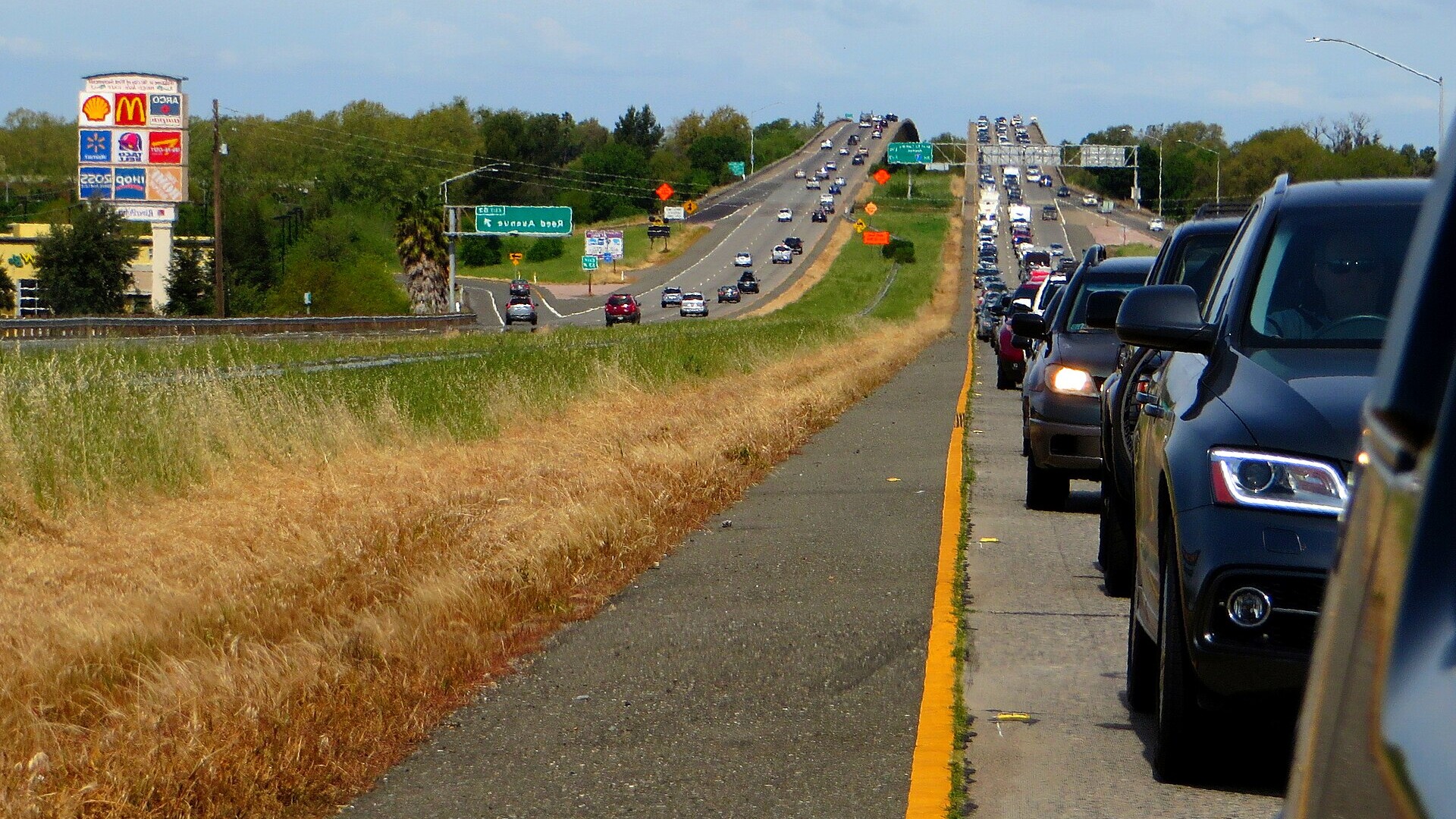
Of the 81.5 million Americans AAA expects to travel this Thanksgiving, 72.9 million will go by car, on roads paid for in part by a federal gasoline tax that Congress last raised in fiscal 1993, according to the Congressional Research Service. The Auto Wire covered the EV registration fee in the House highway bill earlier this month. That fee is a patch on a hole Congress has been filling out of the general fund since 2008, and the hole keeps getting wider.
The tax is 18.3 cents a gallon, plus 0.1 cent for the Leaking Underground Storage Tank Trust Fund, for 18.4 cents in all, CRS reports. The Highway Trust Fund’s highway account came up about $17 billion short of spending in fiscal 2025, and CBO’s June 2026 baseline, as summarized by CRS, projects that gap at $27 billion by fiscal 2036. CRS says the account balance would approach zero in fiscal 2028. The fuel taxes are also written to shrink: CRS lists the gasoline and diesel rates falling to 4.3 cents a gallon after Sept. 30, 2028, unless Congress extends them.

About $271.5 billion in transfers since 2008
The trust fund has stayed open through transfers from the Treasury’s general fund. CRS’s Table A-2 lists ten of them across nine laws, from $8.017 billion on Sept. 15, 2008, to $118 billion in the Nov. 15, 2021 infrastructure law, which included $90 billion for highways and $28 billion for transit. CRS does not print a total. Adding the table’s amounts gives about $271.5 billion, The Auto Wire’s arithmetic.
December 11 is the next deadline
The 2021 law’s highway authorizations were set to expire on Sept. 30, 2026. Congress extended them to Dec. 11, 2026, under P.L. 119-103, CRS says. That date is 15 days after Thanksgiving. The House bill, the BUILD America 250 Act (H.R. 8870), was introduced May 19 by Rep. Sam Graves. It would authorize an annual average of $75 billion in trust fund contract authority and $3 billion from the general fund, subject to appropriation, over five fiscal years, and it drops the multiyear advance appropriations the 2021 law used. CRS says it would raise assured annual highway funding by about 7%, to $73 billion in fiscal 2027 and $78 billion by fiscal 2031.
CBO projects the fiscal 2031 gap at $27 billion with the bill in place, up from $23 billion on current trends, according to CRS. The registration-fee proposal CRS describes would charge $130 a year on electric vehicles, rising to $150 by fiscal 2032, and $35 on plug-in hybrids, rising to $50 by fiscal 2031. CBO estimates those fees would raise about $17 billion over fiscal 2026 through 2036, against a projected $265 billion highway account gap for the period.
The Auto Wire’s reading of CRS’s table is that Congress has treated the trust fund’s gap as a recurring bill to be paid from general revenue, and the House bill still leaves a $27 billion gap in fiscal 2031 in CBO’s projection. Whichever version passes, the next decision on how to pay for roads arrives Dec. 11, with a second tax decision due in 2028.
Dec. 11 first, then 2028
Whether Congress passes a reauthorization, another short extension or nothing by Dec. 11, and whether the 2028 expiration of the fuel taxes gets attached to it.
The federal gas tax has sat at 18.4 cents since fiscal 1993. If you had a vote before Dec. 11, how many more cents a gallon would you sign off on, if any?