
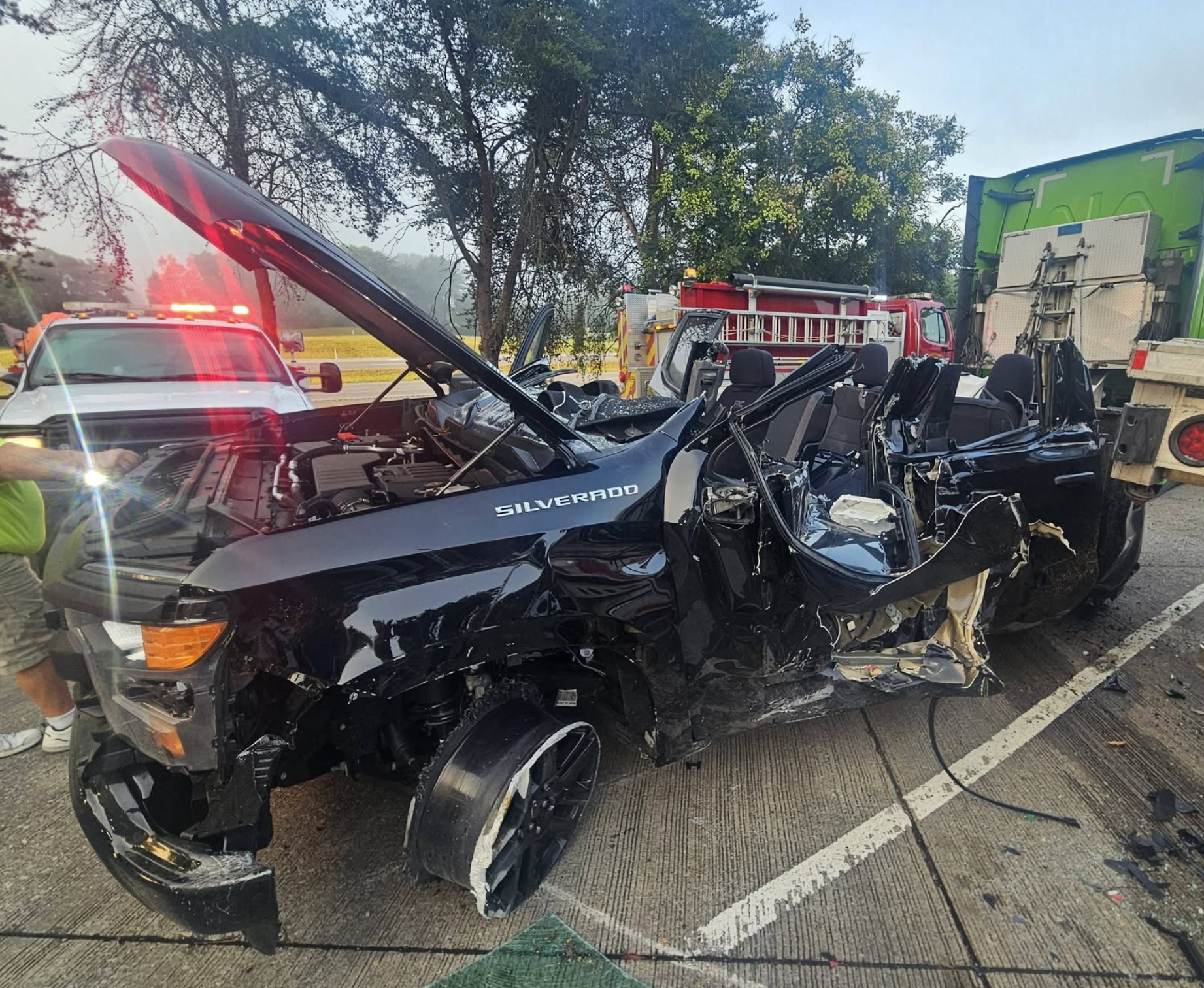
There’s a particular kind of wreck that makes crumple zones, airbags, and five-star ratings almost irrelevant, and a fleeing driver in Smith County, Tennessee found it early Friday morning. According to the volunteer rescue squad that pulled him out, the crew had to strip a Chevrolet Silverado down to free the man trapped inside — cutting off the roof, prying away a lot of sheet metal, and then using a heavy pneumatic lifting system to raise the semi-trailer off his legs. Read that last part again. The trailer was on him.
Related Articles
- A Stolen Carvana Hauler, 13 Charges, and No Bond: Inside the Bay County Highway Chase
- The 3,000-Mile Oil Change Is Dead. Here’s the Number That Actually Matters
Crews were dispatched to the westbound side of Interstate 40 near the Buffalo Valley Rest Area, around mile marker 267, shortly before 5 a.m. The rescue squad’s account, drawn from what officers on scene told them, is that the driver was being pursued, left the rest area, and hit the back of a parked flatbed semi. He was hospitalized. There’s no word yet on who he is, what started the chase, or what he’ll be charged with. What’s worth digging into is the crash itself, because it’s a textbook example of the one truck-versus-car scenario that engineers can’t fully save you from.
Underride is why the roof had to come off
When your vehicle hits a wall, a tree, or another car, the front structure does its job: the bumper beam, frame rails, and engine bay collapse in a choreographed sequence, absorbing energy before it reaches you. That entire system is calibrated to meet an obstacle roughly at bumper height. A trailer deck isn’t at bumper height. It sits up around four feet, right at your windshield line.
So when a passenger vehicle — even a tall body-on-frame pickup like a Silverado — hits the rear of a trailer, the front end can slide underneath. The frame rails and crumple structure pass harmlessly below the deck while the trailer’s edge shears straight into the greenhouse: windshield, A-pillars, roof. This is called underride, and when the trailer reaches the cabin it becomes “passenger compartment intrusion,” which is the polite engineering term for the truck coming into the space where your head is. That the rescue crew’s first move was removing the roof, and that the trailer ended up resting on the driver’s lower body, tells you the Silverado went well under. His crash structure and his airbags were, in the moment that mattered, bypassed entirely.
The guardrail that’s supposed to stop this — and its limits
Trailers do carry a defense against exactly this: the rear impact guard, that steel bar hanging off the back of every semi. It’s federally required. Under NHTSA’s standards — FMVSS 223 for the guard itself and FMVSS 224 for the trailers that must carry one — any trailer or semitrailer rated at 10,000 pounds or more has to have a guard configured low and wide, strong enough to catch a car and keep it from sliding under.
Here’s the catch enthusiasts should know: those guards are engineered for low-speed protection. The 2022 final rule upgraded the standard’s design target all the way up to a blistering 35 mph, from the previous 30. That’s not a typo. The guards are validated to protect occupants of a car striking the rear at around highway entrance speed, not highway speed — and certainly not pursuit speed. The rule itself explains they’re meant to work alongside your seatbelt and airbags within that envelope. Blow past it and you’re back to physics with no referee. There’s also still no federal mandate for side underride guards; that remains stuck in research and advisory-committee limbo.
Related Articles
- The Auto Wire Week in Review: VW’s Job-Cut Bombshell, a Wave of Recalls, and the Wildest Police Chases
- This 1971 Chevy Pickup Was Stolen for Eight Months. It Was Sitting in a Garage the Whole Time
Flatbeds add their own wrinkle. Of all trailer types, a bare flatbed is among the hardest to see at night — no tall box wrapped in reflective tape, just a thin horizontal deck sitting in the dark. Parked at a rest area at 4:43 a.m., to a driver who wasn’t looking because he was busy fleeing, it may as well have been invisible until it was in the windshield.
The part the insurer won’t love
If you’re wondering who pays for all this: probably not the suspect’s insurer, and possibly no one on the civil side. Most auto policies carve out coverage for injuries or damage sustained while intentionally fleeing law enforcement or committing a felony, which means the driver’s own medical bills and the trucker’s smashed flatbed may fall outside his coverage entirely. The motor carrier will likely lean on its own physical-damage coverage to fix the trailer, then try to subrogate — chase the at-fault driver for the money — which, against someone who just got arrested off an interstate, is optimistic. Realistically, the truck owner’s best shot at recovery is criminal restitution ordered as part of sentencing.
The practical takeaway has nothing to do with running from the cops, which I trust you already weren’t planning. It’s this: no rating on your window sticker is earned against a stationary object at windshield height. Closing speed on a slow or stopped truck — especially a low, dark flatbed near an on-ramp at night — is one of the few things that can defeat a modern vehicle’s entire safety design. Leave the following distance. The bar on the back of that trailer is doing less than you think.