
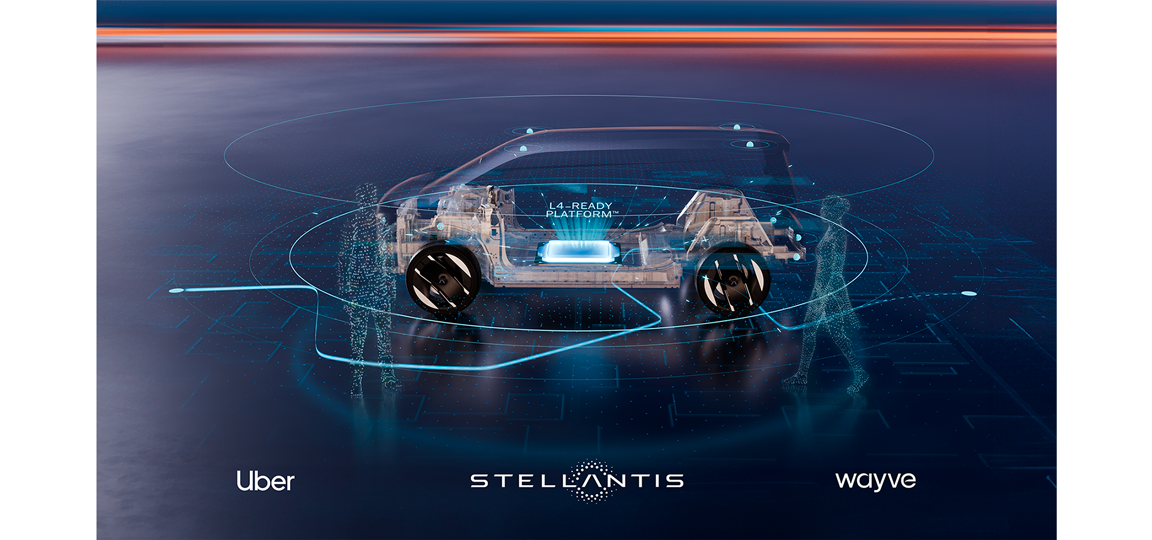
Here’s a fun exercise: read the Stellantis, Wayve, and Uber robotaxi announcement, then try to find a single thing in it you could put on a calendar. A launch date. A city. A vehicle. A price. A fleet size. Anything. You won’t, because there isn’t one. What the three companies actually announced on June 17 is that they’ve agreed to “jointly explore” building and deploying Level 4 robotaxis “at a global scale.” That’s the whole commitment. It’s an agreement to think about it together, dressed up with enough trademark symbols to make it sound like a product.
That doesn’t mean it’s meaningless—but understanding what’s real here versus what’s aspiration requires unpacking a few things the press release very deliberately blurs.
Start with what “Level 4” actually means, because the marketing around autonomy is a swamp. The SAE grades run 0 through 5. Level 2 is what your current adaptive-cruise-plus-lane-centering system is: the car assists, you supervise, and if it plows into a stopped fire truck, that’s legally on you. Level 4 is the real deal—the vehicle handles every part of driving within a defined area and set of conditions, with no expectation that a human will grab the wheel. No steering-wheel babysitter required. Note that Stellantis and Wayve’s existing production deal, signed in May, is for something they call “L2++,” which is a made-up marketing tier, not an SAE grade. It’s souped-up Level 2. The driver is still responsible. The jump from that shipping product to true driverless L4 is not a software update; it’s a different universe of liability and engineering.
Related Articles
- How to Buy a Used Car Without Getting Taken for a Ride
- How ‘American-Made’ Went From Ford and Chevy to Tesla, Honda, and Jeep
Which is exactly why Stellantis’s contribution is a purpose-built “L4-Ready Platform” and not just a Chrysler with cameras bolted on. A car that drives with nobody aboard can’t have a single point of failure. If the primary braking circuit dies, there’s no human foot to hit the pedal, so the platform needs redundant braking, redundant steering, redundant power, and redundant compute—two of everything that could kill someone if it quit. That redundancy is the genuinely hard, expensive part of driverless hardware, and it’s the part software companies can’t wish into existence. It’s the legitimate reason an automaker belongs in this deal at all.
Wayve’s piece is the more interesting technical bet. The London company builds what it calls embodied AI—an end-to-end neural network that learns to drive from data, rather than the modular, rules-plus-HD-maps approach Waymo pioneered. Wayve’s pitch is that its system doesn’t need a city painstakingly pre-mapped centimeter by centimeter before a car can operate there, which in theory means you can drop it into a new market without re-engineering the whole stack. That’s the “cost-effective expansion” the release is gesturing at. The catch nobody in the announcement mentions: end-to-end learned systems are notoriously hard to validate and explain. When a hand-coded system makes a mistake, you can trace the logic. When a giant neural net does something weird, “the model decided to” is not a sentence regulators or crash investigators love. Wayve knows this—it’s built side projects like a language-explanation layer to make the black box narrate itself—but “trust the learned driver” remains the central unproven proposition of the whole camp.
Uber’s role is the easy one and the honest one: it owns the app and the riders. It doesn’t build cars or write driving software. It’s the storefront.
Now the part that makes this announcement genuinely amusing if you’ve been paying attention. Stellantis has done this before—with the competition. Back in 2016, the company that’s now Stellantis (then FCA) became Waymo’s first automaker partner, handing over Chrysler Pacifica Hybrid minivans that became the backbone of Waymo’s early robotaxi fleet—the first vehicles to carry the public in a driverless commercial service. In 2020, FCA even named Waymo its exclusive Level 4 partner. So the automaker now teaming up with Waymo’s rival Wayve has, in a very real sense, already built more revenue-generating robotaxi hardware than almost anyone. It just did it for someone else’s software. This deal is Stellantis quietly diversifying its autonomy bets rather than starting from zero.
What’s actually running today—as opposed to being “explored”—is the stuff that predates this announcement. Wayve and Uber already have a deal to put autonomous rides on the Uber app in London and Tokyo plus ten other cities, with a public waitlist already open in London. And Wayve is flush: it raised $1.5 billion in its last funding round, which buys a lot of runway to keep training models. Those are concrete. The three-way L4 robotaxi program stapled on top is the speculative layer.
Related Articles
- A Tarp Blinded This Driver at Highway Speed — Here’s the Masterclass in Not Panicking
- Inside the 63-Person Ring That Shipped Stolen Luxury Cars From New Jersey to West Africa
For you, the person reading this because you like cars, here’s the practical translation. Nothing about this changes what shows up at a dealership. You will not be buying a driverless Stellantis product out of this partnership; L4 robotaxis are fleet assets, owned and operated by the companies, summoned through an app. The most consequential shift buried in “Level 4” is legal, not mechanical: once a car is genuinely driving itself, liability moves from the person in the seat to the maker and operator of the system. That’s a product-liability regime, and it’s why every one of these announcements is smothered in redundancy talk and “safety” language—the companies are the ones on the hook now, not the rider. For passengers that’s arguably a good deal. For the corporate lawyers, it’s the entire ballgame, and it’s the real reason a decade of these partnerships keeps forming, dissolving, and reforming while the number of cities where you can actually hail a driverless car grows agonizingly slowly.
Treat this one as a letter of intent with a publicist. The pieces are credible and the players are serious. But until there’s a date, a car, and a city attached, “jointly explore” is doing an enormous amount of work in that sentence.
Images Via: Stellantis