
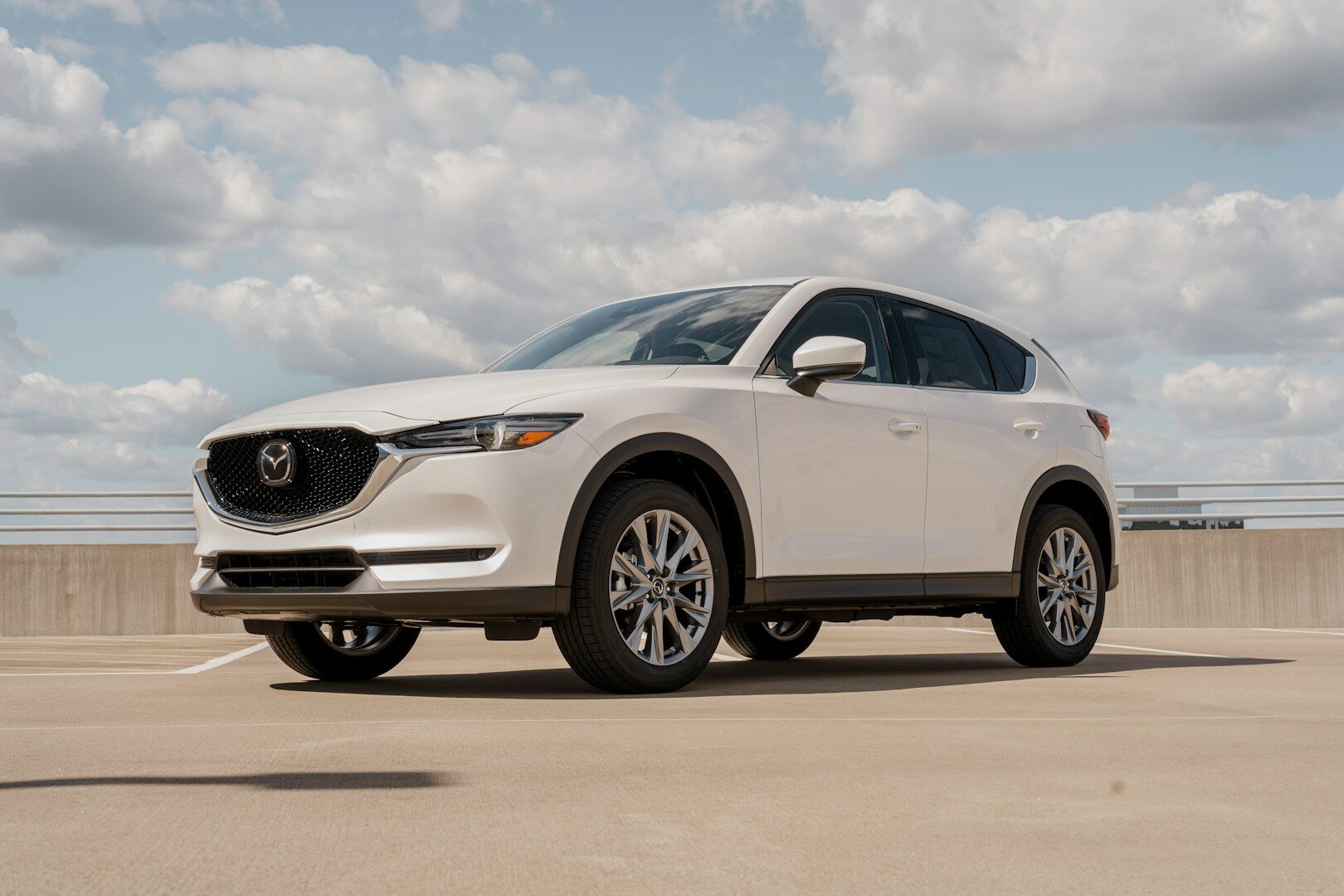
Somewhere at an IIHS test facility last year, a Mazda CX-5 was aimed at a motorcycle-shaped target and told to stop itself before impact. Most of the time, it simply didn’t try. Run the test six times, at three speeds, from centered and offset angles, and five of six trials ended the same way: the automatic braking never engaged at all, so there was nothing left to measure. The sixth run produced a one-mph reduction in closing speed. Against a stopped car, the numbers weren’t much better. At 37 and 43 mph, the outgoing CX-5 hit the target every time, its computer only trimming a fraction of the impact speed beforehand.
Garage-worthy EDC gear, on sale this week.
That front crash prevention system earned a Poor rating, the lowest grade the Insurance Institute for Highway Safety hands out, and it’s the reason the old CX-5 never qualified for a safety award of any kind.
This week, IIHS named the redesigned 2026 CX-5 a Top Safety Pick+, its highest distinction. Run that identical test battery against the new model and the results reverse completely: six-for-six against the motorcycle target, six-for-six against the car, collision avoided logged at every single speed IIHS tested. A Poor became a Good in one model generation.
That flip is the real story here, not the trophy. Automakers earn safety awards constantly; it’s a fairly routine event in this business. What isn’t routine is watching a system rated dead last get rebuilt into one of the best in its class inside a single redesign cycle. And a few clicks deeper into IIHS’s own published data sits a second detail that matters just as much to anyone actually cross-shopping this vehicle: the headlights that helped the CX-5 earn its plus aren’t the headlights most people buying one are actually going to get.
Why the Old System Failed a Motorcycle So Badly
IIHS didn’t toughen its grading arbitrarily. The evaluation that tripped up the old CX-5, what the agency calls front crash prevention vehicle-to-vehicle 2.0, is a newer test, introduced specifically to expose this kind of blind spot. Earlier automatic emergency braking systems were validated mostly against slow-moving or stationary cars, because that’s the crash type with the deepest well of regulatory data behind it. A motorcycle is a different problem for a radar-and-camera system: a narrower profile, a different closing geometry, and a real risk that hardware tuned to recognize a sedan-shaped object simply won’t register a rider at all. Real-world data on motorcyclist fatalities is exactly why IIHS built two-wheeled targets into this test.
The old CX-5’s sensor suite wasn’t designed with that scenario in mind, and its results show a system that mostly never woke up rather than one that tried and fell short.
IIHS also made its pedestrian test meaningfully harder this year by adding nighttime runs to an evaluation that used to check daylight performance only, a tougher ask for any camera working with less contrast and less light. The old CX-5 was never even scored under the new version. The redesigned model was, and it passed, avoiding a crossing child in daylight and both a crossing and a walking adult at night on either high or low beams.
A Hardware Problem, Not a Software One
None of this arrived through an over-the-air patch. Automakers typically save their biggest driver-assistance jumps for full redesign cycles rather than mid-life refreshes, because the radar and camera hardware behind this kind of braking is tied to where the bumper beam sits, how the wiring harness is routed, and what the windshield mount can structurally support. Retrofitting that into an existing platform rarely pencils out; it’s cheaper to wait for the next generation and build the sensor suite in from the start. That’s the quieter implication behind the CX-5’s jump from Poor to Good: Mazda didn’t patch a bug, it replaced the hardware underneath it, which is also why a leap like this tends to show up exactly when a model gets fully redesigned and not a day sooner.
It’s also worth knowing if you’re shopping the used market. A 2025 CX-5 carrying a Poor rating in front crash prevention isn’t a paperwork technicality. It’s a documented, repeated failure to avoid a stationary vehicle at speeds most people drive on an average commute.
The Headlight Detail Nobody’s Going to Notice at the Dealership
To qualify for any 2026 IIHS award, a vehicle needs “acceptable- or good-rated headlights across all trim levels” — every configuration a shopper might actually drive off the lot, not just the one in the press photos. The CX-5 clears that bar. Clearing the bar and having the best equipment, though, are two different things.
IIHS tested two separate headlight setups on the 2026 CX-5. The Premium Plus trim, the most expensive one in the lineup, gets curve-adaptive LED projector headlights with high-beam assist, rated Good. Every other trim, the 2.5 S, S Select, S Preferred, and S Premium, four of the five configurations Mazda sells, and almost certainly the four that will make up most CX-5s on the road, share a non-adaptive system rated merely Acceptable, with IIHS’s own notes describing inadequate visibility in some nighttime curve scenarios.
Headlight technology has come a long way since the mechanical pop-up units that once defined an entire generation of sports cars, and curve-adaptive LED projectors are a genuinely useful safety feature. But a Top Safety Pick+ badge describes the best equipment a nameplate is capable of offering, not the equipment sitting on the lot in your trim and color. It’s a distinction Mazda’s marketing page isn’t going to volunteer, and it’s not the only headlight story making news this year: Ford spent part of 2026 recalling tens of thousands of Explorers over a completely different failure mode, bending headlights that could blind oncoming drivers instead of helping the driver see. Different problem, same underlying lesson: headlight performance is no longer a minor spec.
Not Every Automaker Cleared the Bar
IIHS released ratings for nine 2026 models in this same round, and the split is a reminder that none of this happens on autopilot. The Audi A6, BMW X1, and Subaru Crosstrek Hybrid joined the CX-5 as Top Safety Pick+ winners. Five other models tested alongside them, including the Cadillac CT5, didn’t qualify for anything at all; the CT5 posted a Poor side-structure rating and Poor headlights, and wasn’t even rated on the small-overlap front test. IIHS has ratcheted its criteria upward almost every year lately: an updated moderate-overlap test in 2024, the tougher vehicle-to-vehicle evaluation in 2025, nighttime pedestrian testing added this year. It’s the same instinct behind IIHS’s newest teen-driver vehicle list, which gates its recommendations on a hard weight cutoff rather than good intentions. The agency is increasingly willing to let a single unmet variable disqualify an otherwise competent car.
Why Any of This Should Matter to You
A Top Safety Pick+ badge isn’t just bragging rights for a brand’s marketing department. Insurers use exactly this kind of crash-avoidance data to help price risk, and the same category of sensor and crash data that helped the CX-5 earn this rating is the kind insurers are increasingly asking automakers to hand over directly. State Farm’s new arrangement to pull crash data straight from Toyota and Lexus vehicles is the clearest recent example of where that road leads. The car that avoids the crash in an IIHS lab is also, increasingly, the car generating the data that determines what you pay to insure it.
Buy a CX-5 for the crash-avoidance hardware, and you’re buying something real and dramatically improved over last year’s model. Buy the base trim for the sticker price, and you’re also buying the Acceptable headlights, not the Good ones, a distinction that exists only in IIHS’s database and nowhere on the window sticker.
A safety rating tells you the best a manufacturer proved it could build in a given generation. It doesn’t tell you which version of that car is going to end up in your driveway.