
Every stolen car eventually needs new paperwork. That’s the part of auto theft nobody thinks about until they’re the one holding a “clean” title on a car that was never legally theirs to buy.
Arlington County, Virginia police say a Maryland police officer spent more than a year helping supply exactly that kind of paperwork. Not by forging documents at a desk, but allegedly by using the kind of institutional access most of us assume exists to catch car thieves, not enable them.
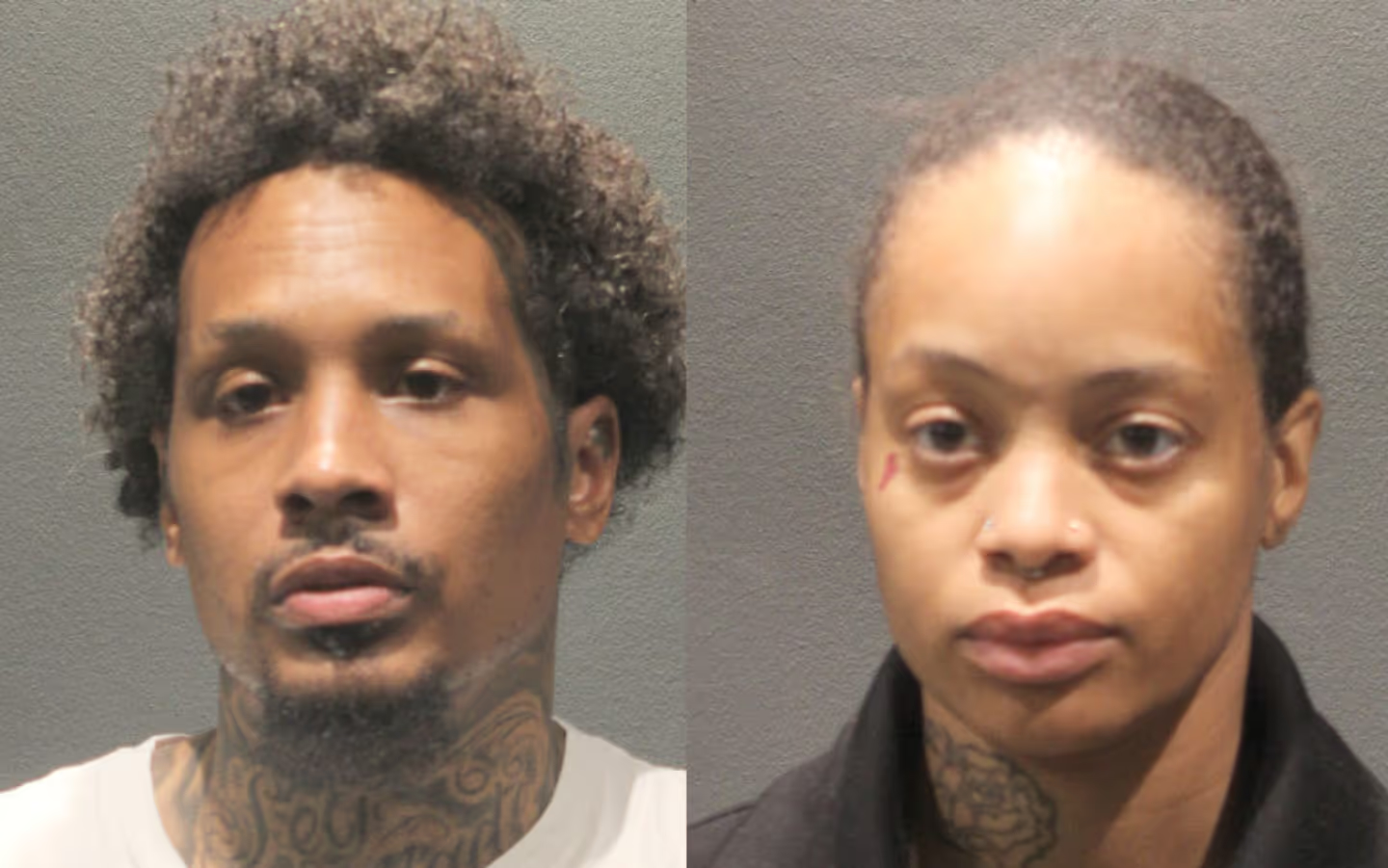
According to a July 28 release from the Arlington County Police Department, officers arrested Sierra Alston, 33, and Renaldo Gaines, 35, both of Washington, D.C., following an investigation that started almost by accident. On March 18, 2025, an officer conducting extra patrols inside a parking garage in the 800 block of Army Navy Drive noticed an unoccupied car that looked out of place. A closer look revealed the vehicle had been reported stolen out of Nevada and was displaying an altered vehicle identification number. When Alston and Gaines returned to the car, officers detained them.
What followed was more than a year of investigation into something bigger than one hot car in a garage. Investigators allege the pair conspired to steal vehicles, acquire already-stolen ones, and alter the VINs to disguise them from detection. At the time, Alston was a sworn police officer in Maryland, and police say she used law enforcement resources to help Gaines pull it off. Arrest warrants followed in July 2026, and the two were taken into custody in Washington, D.C. on July 23 with help from the U.S. Marshals Service.
Gaines faces six charges, including grand larceny of an auto and possession of a vehicle with an altered VIN. Alston faces two counts of conspiracy to commit a felony and unauthorized use of a vehicle, a noticeably lighter charge sheet for the person police say supplied the access that made the whole operation possible.
That gap matters more than it looks.
This isn’t really a story about two people stealing cars in Northern Virginia. It’s a story about an assumption baked into every clean title report, every dealership trade-in appraisal, and every private-party used car sale in America: that the person checking a VIN against law enforcement records has no reason to lie about what they find.
Here’s what most car buyers don’t know about VIN cloning, and it’s worth understanding because it isn’t what it sounds like. Thieves don’t need to physically pry a VIN plate off another car. They copy the number from a legitimately titled vehicle of the same make, model, and year, often one registered far away, which is why a car stolen out of Nevada surfaced in a Virginia parking garage, and stamp or affix that borrowed number onto the stolen car. Run a title check on that VIN and it comes back spotless, because the report is pulling the history of the honest car sitting in someone else’s driveway a couple of time zones away, not the one a buyer is about to hand over cash for.
That con only works because of how much weight a 17-character string carries. NHTSA has required a standardized 17-character VIN on every vehicle sold in the United States since the 1981 model year, specifically so one number could track a car through manufacturing, sales, insurance claims, and law enforcement databases for its entire life. The whole system works because everyone downstream, DMVs, insurers, dealers, buyers, trusts that number without question. Cloning doesn’t defeat that system through some clever technical exploit. It just tells the system a convincing lie.
Which brings us to the actual story here. A stolen car running a cloned VIN can usually be caught by cross-referencing it against a handful of databases: the National Crime Information Center, state DMV records, insurance total-loss registries. Those databases are the safety net. Police say this scheme lasted more than a year not because of a gap in that safety net, but because one of the people allegedly running it had a badge that let her look through it whenever she wanted.
Here’s the detail that should bother anyone who follows how these cases actually get prosecuted. Gaines, the civilian, is charged with grand larceny, receiving stolen goods, and possessing a vehicle with an altered serial number: the charges that come with physically taking and disguising a car. Alston, the officer police say enabled the whole scheme, faces conspiracy and unauthorized use of a vehicle. Virginia’s criminal code, like most states’, was never really written for an officer allegedly running plates or pulling records to help a theft ring. That kind of insider misuse tends to get folded into whatever generic charge happens to fit, which is a quieter problem than the theft itself and a far harder one to legislate away. It’s a dynamic Auto Wire has seen before in a Toronto re-VIN case where the charges collapsed just as fast as they were filed.
There’s an irony worth sitting with, too. None of this got caught by a fraud algorithm, a flagged national title record, or an automated database cross-check. It got caught because a beat officer walked through a parking garage and noticed a car that didn’t belong. The most sophisticated VIN-cloning schemes in the country keep getting undone the same unglamorous way: somebody paying attention to what looks wrong.
This case isn’t an outlier, either. Auto Wire has tracked a steady run of VIN-cloning rings moving stolen vehicles across state and international lines, dealership insiders using their own access to defeat the very security systems built to stop them, and buyers left holding thousands of dollars in debt on cars they never legally owned once the fraud unraveled. Even the tools designed to catch cloned vehicles and cloned plates have blind spots law enforcement is still catching up to.
For anyone shopping for a used car, the practical lesson isn’t paranoia. It’s redundancy. Confirm that the VIN stamped on the dashboard matches the one on the door jamb sticker and the title. Look for mismatched rivets, overspray, or a plate that looks newer than the car around it. And remember that a cloned VIN, almost by definition, produces a clean history report. That’s the entire point of borrowing someone else’s number instead of trying to hide the car’s own.
A clean title report doesn’t prove a car is honest. It proves that nobody with the right kind of access has lied about it yet. That’s the sentence worth remembering long after the names Alston and Gaines fade from the news cycle, because the next VIN-cloning ring won’t need a criminal mastermind. It will just need someone on the inside willing to look the other way, or better yet, look it up.
Image via Arlington Police Department