
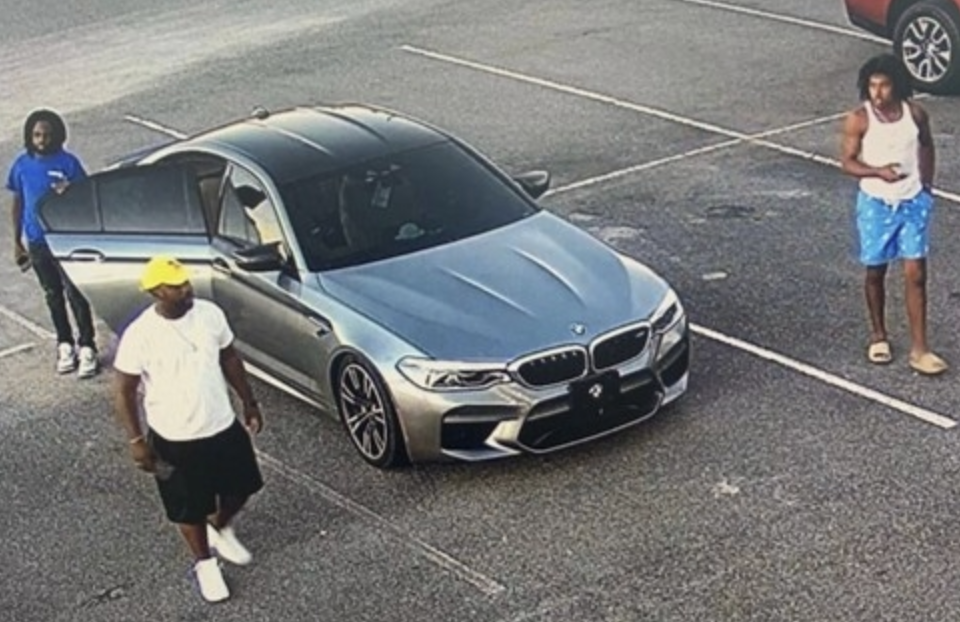
Five people are now serving federal time for a car theft operation that ran from 2021 to 2023 and hit dealership lots in fifteen states, and the thing worth sitting with is how little technology was involved. Nobody cracked an immobilizer. Nobody built a CAN injection tool. They walked in the front door, shook hands, and left with the keys.
Hosea Fernandez Hampton, 27, of Charlotte was sentenced to 97 months in federal prison plus three years of supervised release, according to the U.S. Attorney’s Office for the Western District of North Carolina. He’d pleaded guilty to conspiracy to transport, possess and sell stolen vehicles in interstate commerce, plus possession of a stolen motor vehicle. His four co-defendants were sentenced earlier: Dewanne Lamar White got 108 months, Kevin Ja’Coryen James Fields 96, Reginald Eugene Hill 60, and Garyka Vaughn Bost a year and a day. Prosecutors describe the ring as taking more than 100 high-end cars overall, with at least 82 vehicles worth nearly $5.9 million stolen during Hampton’s stretch in the conspiracy. That’s an average haul of roughly $72,000 per car — Bentleys, Porsches, Land Rovers, BMWs, Cadillacs and Mercedes, plus expensive metal from Chevrolet, Dodge and Ford.
The fob swap is a paperwork attack, not a hack
Here’s the part every dealer principal should have printed and taped to the key cabinet. According to the government, the crew posed as shoppers, went through the motions of a test drive or an inspection, and swapped the vehicle’s key fob for a lookalike. Later, they came back and used the real fob to drive the car away.
Think about what that actually defeats. A modern smart key isn’t a mechanical device — it’s a transponder holding a cryptographic credential paired to one specific vehicle’s immobilizer, using rolling codes so a captured transmission can’t simply be replayed. That system is genuinely hard to beat electronically, which is why so much modern theft targets relay amplification and diagnostic-port key programming rather than the crypto itself.
But an immobilizer doesn’t care who holds the authorized key. It only cares that the authorized key is present. Swap the real fob for a dead lookalike and the security architecture is untouched and completely irrelevant — the credential has simply changed pockets. The counterfeit goes back in the key cabinet or the lockbox, where it will look correct to every human who glances at it, and a BMW display key or a Mercedes fob is visually near-identical across dozens of cars on the same lot.
Related Articles
- He Allegedly Stole and Torched a Chevy Suburban. His Loyalty Card Turned Him In First.
- Pep Boys Sold to Mavis for $700M — But Icahn Kept the Real Estate
The vulnerability being exploited isn’t in the vehicle. It’s in the dealership’s inventory control, and specifically in the gap between “the key tag says the fob is here” and “someone actually verified this fob starts this car.” Any store that can’t answer the second question by close of business is exposed. The other methods described by prosecutors — smash-and-grabs to reach key storage, forcing lockboxes — are cruder versions of the same insight: on a dealer lot, the key is the whole security system.
Sanitizing a stolen car, and the federal statutes that punish it
Getting the car off the lot is the easy part. Keeping it is where organized crews separate themselves from opportunists, and the government says this one did three things.
First, they pulled the GPS and tracking hardware. Worth understanding that there are usually two separate systems in play: the factory telematics control unit that powers services like emergency call and remote location, and whatever aftermarket lot-management tracker the dealer bolted in to find cars on a crowded back lot. Both have to go, and yanking a telematics module on a modern car is not a clean operation — it typically kills automatic crash notification, leaves a dead SOS button, and stores a stack of communication fault codes that any competent scan tool will read out years later.
Second, fictitious dealer tags or stolen plates went on. This is the underrated move. Automated license plate readers are how an enormous share of stolen vehicles get located, and an ALPR hit works by matching a plate against a hotlist. A dealer tag is essentially a plate that no system expects to correspond to a specific VIN, which makes a stolen car functionally invisible on an interstate run.
Third, they replaced the authentic VINs. Federal law treats that as its own crime: 18 U.S.C. 511 makes knowingly removing, tampering with or altering a vehicle or part identification number a five-year felony, and trafficking in vehicles with altered VINs carries a ten-year maximum under Section 2321.
Cloning a VIN is harder than it sounds, because the number appears in more places than the dash plate you can see through the windshield. There’s the federal certification label in the door jamb, stamped locations on structural components, and — critically — NHTSA’s parts-marking requirement. Under 49 CFR 541, manufacturers of covered passenger car lines must mark major parts with the identifying number, in target areas registered with the agency. Change the dash tag and the door sticker and you still have a fender, hood, doors and deck lid quietly carrying the original car’s identity. That’s not a nostalgia rule from 1984; it’s how investigators unwind exactly this kind of case.
The buyer at the end of the chain gets nothing
The stolen cars went back to Charlotte and were sold locally, well below market value. If you were the person who got a $90,000 Land Rover for $40,000 in cash and thought you’d simply outnegotiated a motivated seller, the law has bad news.
A thief holds void title. Under UCC 2-403, a purchaser acquires only the title the transferor had power to transfer — and while someone with voidable title (a fraudster who tricked an owner into handing the car over) can pass good title to an innocent buyer, a straight thief can’t. When the car is identified, it goes back to the dealer or its insurer, the buyer eats the loss, and no auto policy in existence reimburses you for the purchase price of a car you never legally owned. You become an unsecured creditor of a federal defendant, which is a polite way of saying you’ve donated the money.
The federal tool built to stop this is NMVTIS, created under the Anti Car Theft Act of 1992 and run by the Justice Department. State titling agencies query it before issuing title, which is the single best chokepoint for catching a cloned VIN. It’s also available to consumers for a few dollars through approved providers, and it’s not the same thing as the commercial history report you’re used to seeing.
Related Articles
- A Georgia Crime Center Supervisor Got Busted Using Flock to Track Her Partner’s Car. She’s Also the Least Interesting Part of This Story.
- Porsche Just Raised Its Layoff Total to 8,900. The Growth Rate Is the Real Warning Sign
Practical version: if a luxury car is priced dramatically below market, verify that the dash VIN, the door-jamb certification label and any visible parts markings all agree, run the number through NMVTIS before money moves, and treat a nonfunctional SOS button or an obviously disturbed telematics area as a hard stop rather than a quirk.
Context, and the sentence math
The conspiracy’s 2021-to-2023 window sits exactly on top of the national theft peak. NICB counted 1,020,729 vehicles reported stolen in 2023, up from 1,008,756 in 2022. Thefts have fallen hard since — 850,708 in 2024 and 659,880 in 2025, a multi-decade low. That decline is real, but it’s driven largely by patched software vulnerabilities on the mass-market models that fueled the surge. It says essentially nothing about crews who steal a Bentley by asking to see it.
One last wrinkle. Hampton is described as a leader of the scheme, and he drew 97 months — eleven fewer than White. The government also documented him fleeing police at speed and being stopped in Flagler, Florida in a stolen 2018 BMW M5 taken from a Wilmington dealership, with a pile of key fobs and a Glock 19X under the driver’s seat. Federal sentencing turns on guideline calculations, loss amounts, criminal history and cooperation, not on who wore the crown. The photograph the government released of that traffic-stop haul — a spread of fobs beside a handgun — is a fairly complete summary of the business model.
Images Via: United States Attorney’s Office Western District of North Carolina