
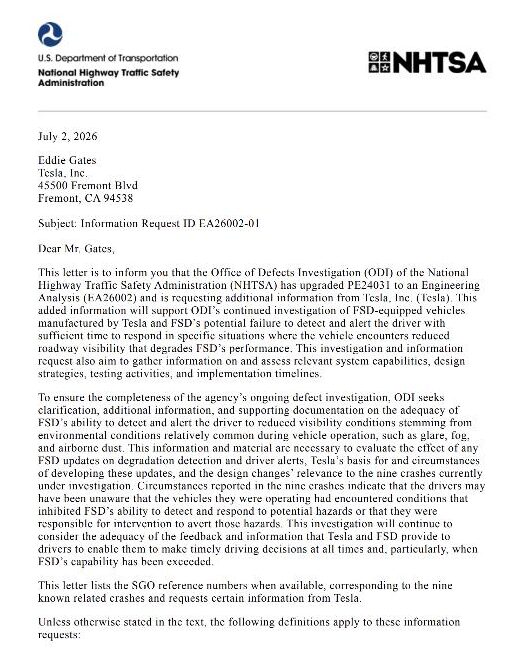
NHTSA didn’t ask Tesla to fix a sensor this month. It didn’t ask for a recall, a software patch, or a single physical change to any vehicle. It asked Tesla to defend its own FSD marketing, line by line. That’s a different kind of federal letter than automakers are used to getting, and it says more about where this fight is headed than anything happening under the hood of a Model 3.
The request landed as part of an expanded investigation into nine crashes involving Full Self-Driving in fog, glare, and blowing dust. Buried inside that technical inquiry is a 17-page document that reads less like an engineering questionnaire and more like a deposition. It walks through specific phrases pulled from Tesla’s website, its official X account, and Elon Musk’s own posts, then asks the company to explain, one line at a time, whether the words match the product. Among the phrases singled out: FSD Supervised described as “effectively point-to-point autonomous transport in your own car,” a claim that the system “can drive in whiteout conditions,” and a Musk post asserting “Tesla FSD can operate in all conditions.” The agency also flagged Tesla-published videos showing occupants making espresso, dancing, and reclining their seats while FSD Supervised drove, along with a Musk reply touching on texting behind the wheel. Tesla has until August 12, 2026, to answer.
Here’s the detail that gets lost every time this story resurfaces. Full Self-Driving, name and all, is legally a Level 2 driver-assist system. Same regulatory category as adaptive cruise control paired with lane centering. Not autonomous. Not close. Tesla’s own owner’s documentation requires hands available and eyes on the road the entire time it’s engaged. So when a federal regulator asks whether a video of someone brewing espresso while “FSD Supervised” drives reflects the system’s intended use, it isn’t a gotcha question. It’s pointing at the gap between a product name built on the phrase “self-driving” and a legal classification that demands constant supervision. Most buyers never learn that gap exists until it matters.
This isn’t really a story about a widened crash probe. It’s a story about a regulator building a paper trail. The technical half of the investigation, how FSD detects degraded visibility and whether it warns drivers in time, is already underway. What’s new is the other half: a federal agency methodically compiling a company’s marketing copy, official social posts, and promotional videos into a single document, then asking that company to reconcile its own words with the physical limits of the product. NHTSA is asking a car company to explain its own ad copy the way a plaintiff’s attorney would.
The timing makes this stranger, not more predictable. This administration’s NHTSA has spent 2026 loosening the rules around autonomous vehicles, not tightening them: revised pedal requirements for AVs, a public call for developers to unleash American innovation, and in May, a Tesla Model Y became the first vehicle to pass the agency’s new ADAS evaluation. This is not an agency spoiling for a fight with the driverless-car industry. Which is exactly what makes its persistence on Tesla’s messaging worth noticing. Marketing claims are one of the few levers a safety regulator can still pull without wading into the political fight over restricting the technology itself. If NHTSA isn’t going to slow FSD’s rollout, it can still make Tesla answer for how it talks about FSD’s limits.
That distinction carries weight well beyond a federal filing cabinet. We recently covered the NTSB’s findings on a fatal Tesla crash in Katy, Texas, where 71-year-old Martha Avila died after a Model 3 tore through her living room wall at more than 70 mph on a street posted for 30. FSD Supervised had been active minutes earlier; the driver then floored the accelerator, which disengaged the system and handed full authority back to him, exactly as designed. Tesla’s own vice president of Autopilot software publicly blamed the driver within weeks of the crash, and the NTSB’s preliminary findings later backed that account. Tesla’s position in cases like this rests on one argument: the software got out of the way, so the person behind the wheel is responsible. NHTSA’s new information request sits awkwardly next to that argument. A company can’t simultaneously market a product as capable of driving itself through a whiteout and argue in a courtroom that the driver alone bears responsibility for what happens when attention lapses. Tesla may have already handed future plaintiffs that contradiction, in a video, dancing.
Reduced visibility isn’t a problem unique to Tesla, either. A Zoox robotaxi drove into a wall of smoke at a Las Vegas fire scene in June, stalled short of the fire crew, and needed a remote human operator to back it out, an episode that triggered a 105-vehicle recall while Zoox rewrote its software to treat smoke as an obstacle instead of empty air. Cameras, radar, and lidar all struggle with fog, smoke, and blowing snow in different ways, and every company selling driver assistance or autonomy has had to decide how honestly to describe that limitation. Zoox’s answer was a recall notice and a fix. Tesla’s answer, so far, has been lifestyle footage. That’s the actual difference this investigation is circling.
Nothing here grounds a single Tesla or forces a recall notice into anyone’s mailbox. That was never the point. NHTSA isn’t investigating a bug. It’s building a deposition, and the most damaging witness Tesla faces in the next round of FSD litigation may not be an engineer or a crash reconstruction. It may be Tesla’s own marketing department, and the CEO’s account on X.