
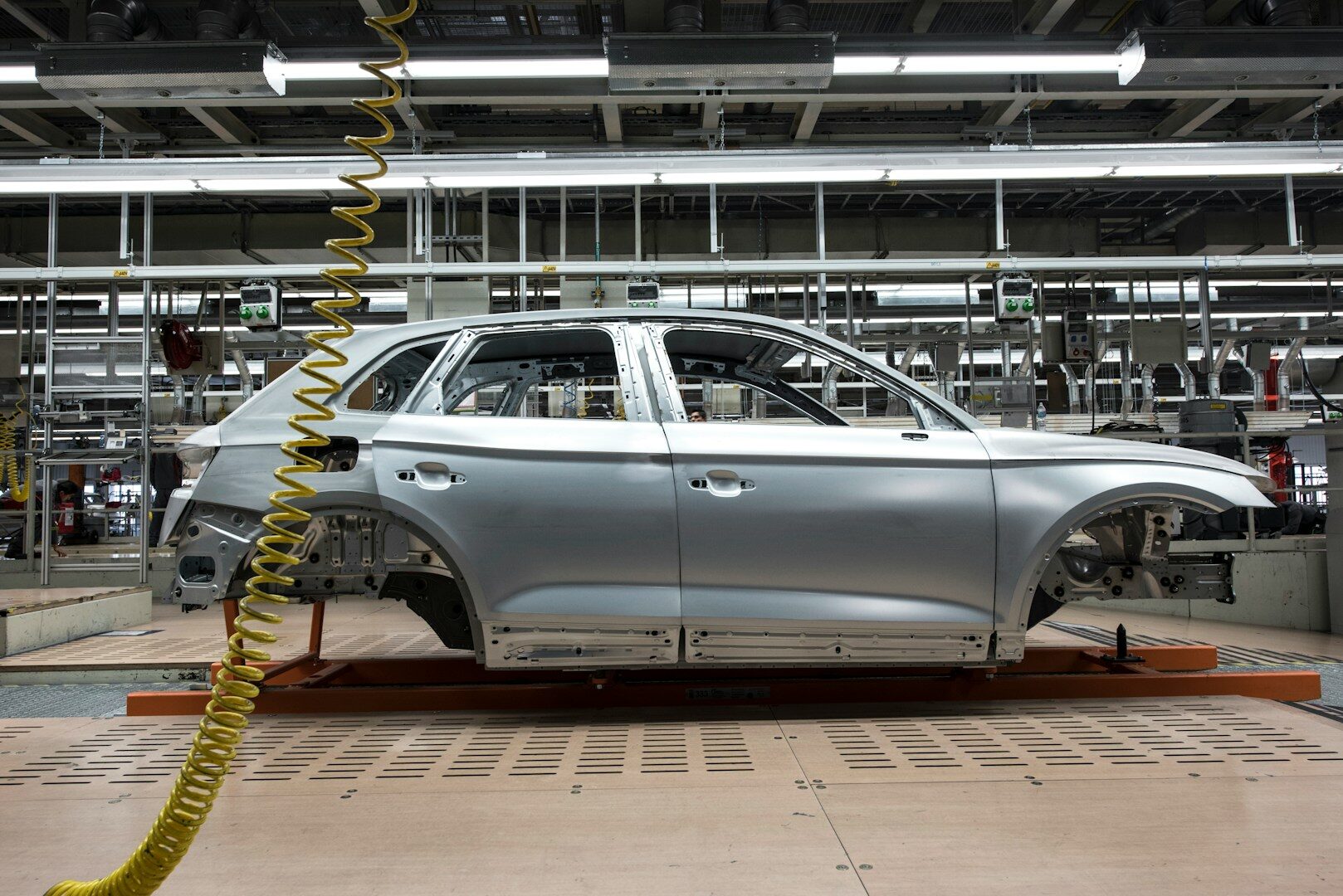
Toyota builds its most profitable SUVs in a corner of Japan that keeps shaking itself apart.
That’s not the headline anyone else is running this week. The headline is simpler: a 7.1-magnitude earthquake tore through southwestern Japan, killing at least 13 people, toppling buildings, buckling roads, and cutting power across the region. Toyota extended a shutdown of Lexus production at its export plant through the end of the week. Nissan suspended output at its own factory nearby. Those are the facts, and Automotive News had them first.
The more interesting story isn’t that an earthquake stopped two car plants. It’s that this is the second time in a decade an earthquake in this exact region has done precisely that, to precisely these companies, and neither one has moved.
Here’s what almost nobody outside Japan’s auto beat remembers: in April 2016, two earthquakes hit Kumamoto Prefecture, in the same southwestern Kyushu region Toyota and Nissan build in today. The first measured 6.2. The second, less than two days later, hit 7.0. Toyota didn’t just lose its Kyushu output that week. It shut down every vehicle assembly plant it operated in Japan, 26 production lines in all, because a single supplier, Aisin Seiki, had a Kyushu factory that made body parts and couldn’t ship anything for days.
That detail matters more than this week’s death toll or how many days a paint shop sits idle. Toyota’s famous production system doesn’t have a plan B. It isn’t supposed to.
Toyota invented the kanban system, the “just-in-time” method that keeps only a few hours of parts inventory on hand at any given assembly plant, ordering exactly what’s needed exactly when it’s needed and nothing more. It is, by a wide margin, the most studied and copied manufacturing philosophy in industrial history. Business schools teach it as the reason Toyota became the most valuable automaker on Earth. What they teach less often is the tradeoff. A system with almost no slack has almost no cushion. When a road buckles or a supplier’s roof caves in, there’s no stockpile sitting in a warehouse to bridge the gap. The line simply stops.
That’s not a flaw Toyota stumbled into. It’s a bet the company has made, over and over, for half a century: that the savings from lean inventory outweigh the cost of the disruptions lean inventory guarantees eventually. Most years, the bet pays off. Every few years, in exactly this stretch of southwestern Japan, it doesn’t.
Kyushu isn’t a random place to build cars, either. Toyota’s Kyushu plant is where the company builds the RX and NX, the two best-selling Lexus models in the United States and two of the most profitable vehicles Toyota makes anywhere. Nissan’s Kyushu factory exports engines and vehicles worldwide. The region was chosen decades ago for cheap land, a deep-water port for export shipping, and a skilled labor pool built up around the automakers’ own supplier networks, the same logic that clustered Detroit around the Great Lakes and Germany’s auto industry around the Rhine. Manufacturing follows infrastructure and expertise, not risk maps. Japan’s risk map happens to be almost entirely red. The country sits on the Pacific Ring of Fire and records roughly 1,500 earthquakes a year strong enough to feel.
None of this is news to Toyota’s own risk managers. Automakers and their suppliers carry what’s called contingent business interruption insurance specifically to cover the scenario playing out in Kyushu right now: a covered loss not because your own factory was damaged, but because someone else’s was. What gets less attention is what happens to that coverage after each event. Premiums climb, deductibles widen, and insurers get pickier about which Japanese facilities they’re willing to underwrite at all. That’s a cost that never shows up in a press release. It shows up in a sticker price instead.
The bigger lesson goes beyond Toyota. In 2011, the Tohoku earthquake and tsunami didn’t just kill tens of thousands of people. It also flooded a single Renesas Electronics chip plant in Naka, more than 500 miles from Kyushu. That one factory made microcontrollers used in roughly a third of the world’s cars. Its shutdown didn’t slow production for a week. It rippled through global auto manufacturing for the better part of a year, forcing plants from Kentucky to Germany to idle for want of a chip smaller than a fingernail. If a single-source parts strategy can do that from 500 miles away, a live earthquake zone housing two full assembly plants isn’t a hypothetical risk. It’s a recurring one.
Toyota has spent the past few years quietly hedging elsewhere. Its new RAV4 hybrid line just came online in Kentucky, and its $3.6 billion San Antonio expansion is built around the idea that America should build more of what America buys. That diversification is happening against a backdrop of real financial pain, too; Toyota, Honda, and Nissan have already absorbed roughly $28 billion in tariff-related costs this year. Building outside Japan helps with all of that. It does not fix Kyushu.
The efficiency that makes Toyota one of the most profitable car companies on the planet is the same efficiency that makes it vulnerable every time the ground moves in the one corner of Japan it can’t relocate. Nobody in Nagoya is going to say that out loud this week. The earthquake will make headlines for a few days, the shutdown will end, Lexus dealers will get their inventory eventually, and the story will quietly close.
It will also, almost certainly, happen again. It already has, in the same place, to the same companies, once before. Toyota rebuilt the plant. It never rebuilt the plan.