
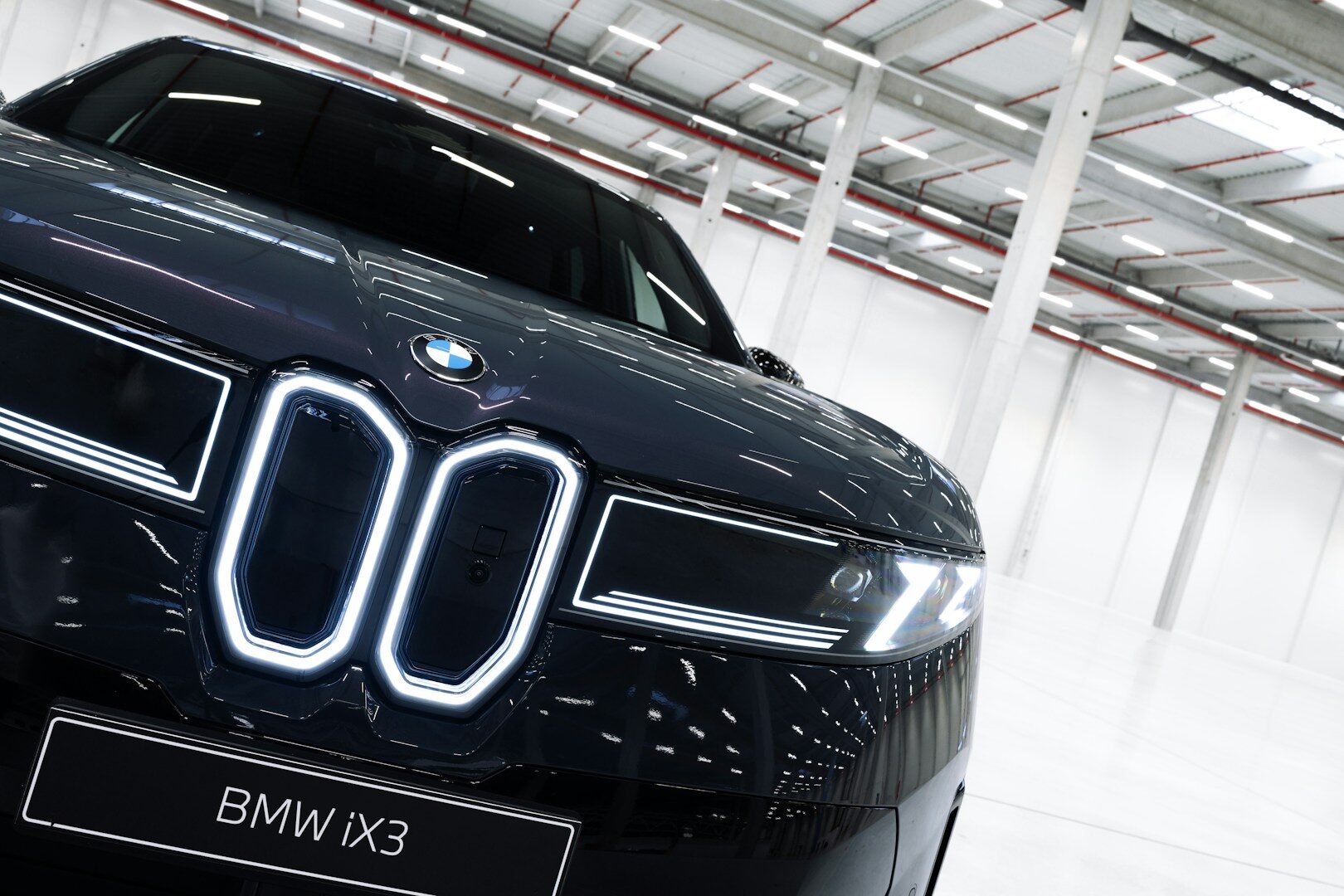
BMW confirmed this week that its plant in San Luis Potosí, Mexico will start building the Neue Klasse i3 sedan and iX3 crossover in 2027, backed by a dedicated high-voltage battery hall. That’s the press release. Buried a few lines into BMW’s own briefing to Mexican reporters is the detail that actually matters: those batteries will arrive already built, shipped in from Europe, with some cells coming from Chinese suppliers.
Read quickly, that sounds like a supply-chain footnote. It isn’t. It’s the whole story.
BMW is not just opening an EV line in Mexico. It’s opening one in the middle of a live renegotiation over exactly what counts as North American enough to dodge a tariff bill, and the single most expensive part of the car it plans to build there doesn’t clear that bar yet.
What BMW Actually Confirmed
The details, relayed through interviews with the Mexican outlets Excelsior and El Financiero, are straightforward enough. San Luis Potosí will add the i3 and iX3 to a lineup that already includes the 3 Series, 2 Series Coupé, and M2, funded by the €800 million expansion BMW announced back in 2023. Plant president Klaus von Moltke framed it as a long-term bet on Mexico rather than a reaction to short-term politics, and noted the site was designed from day one to export well beyond the United States, to China, North Africa, the Middle East, and the European Union, where battery-electric vehicles already make up roughly 60 percent of new sales. We broke down the tariff math behind that strategy here, and it hasn’t gotten friendlier since.
The Line BMW Buried
Here’s the sentence that should have been the headline. Von Moltke told El Financiero that BMW is examining whether to localize battery cell production in Mexico, and that the decision is “closely related to all trade agreement requirements.” Translated out of executive-speak: the batteries going into a Mexican-built BMW currently don’t count as Mexican, American, or Canadian. They count as European, and partly Chinese. Under the trade rules that determine whether this car crosses the border duty-free, that distinction matters more than where the doors get bolted on.
Why Batteries Don’t Get To Hide In The Average
Most people assume a car’s origin is one big average, a blend of steel, glass, wiring, and labor that adds up to a percentage. Under USMCA, it isn’t, not for every part. A handful of what the agreement calls core parts, including the engine, transmission, body, chassis, and, crucially, the advanced battery in an EV, each have to independently clear their own regional value threshold, currently as high as 75 percent. That rule barely existed under NAFTA, because NAFTA was written in 1994, when a mass-market electric vehicle was still a science project. USMCA’s drafters added battery tracing specifically to stop automakers from building a compliant shell of a car in North America while quietly importing its most valuable component from somewhere else. BMW’s current plan looks close to exactly that scenario, just not on purpose.
A Battery Hall Isn’t A Cell Factory
It’s worth being precise about what BMW’s money actually buys in San Luis Potosí. The bulk of that €800 million budget went toward a massive new building dedicated to high-voltage battery assembly. Assembly is the operative word. That hall bolts finished cells into modules and modules into packs; it doesn’t grow the cells themselves. Cell manufacturing, the actual electrochemistry, is a separate and far more capital-intensive business, which is exactly why BMW is still sourcing cells from Europe and China while a nine-figure Mexican battery hall sits ready to receive them. A plant can be finished years before its supply chain is.
Terrible Timing, By The Calendar
BMW is making this bet at an unusually exposed moment. The United States, Mexico, and Canada just finished USMCA’s first mandatory six-year review on July 1, and Washington declined to renew the agreement in its current form, something we covered here. Origin rules for the auto sector, the exact math that decides whether a Mexican-built EV clears the border duty-free or eats a 25 percent tariff, are being actively renegotiated in bilateral talks running through this summer. BMW is locking in a battery supply chain years before it knows what the finish line looks like.
Who Wins, Who’s Exposed
Mexico wins regardless of how the cell question resolves; the jobs, the investment, and the export volume land there either way. BMW wins optionality, a plant that can sell into Europe, China, and the Middle East if the American math stays ugly. The exposed party is anyone counting on a tariff-clean, Mexican-built BMW EV on the original timeline. Every quarter BMW spends “examining” cell localization is another quarter those cars keep clearing customs on someone else’s terms, not BMW’s.
The industry loves to talk about where a car is assembled. Customs officials only care about where its most expensive part was actually made. Right now, the honest answer for BMW’s new Mexican EVs is: not yet here.
“Buried a few lines into BMW’s own briefing to Mexican reporters is the detail that actually matters: those batteries will arrive already built, shipped in from Europe, with some cells coming from Chinese suppliers.” Misleading, as we learn further down in the article. The *batteries* aren’t being shipped from Europe–one component, the *cells*, are. BMW makes the batteries, but not the cells; yes, the cells are the most expensive part of the battery, but they’re far from its entirety, as battery management systems are a major part of the assembly. BMW is making a point of assembling the weighty batteries (itself a pretty capital-intensive process) near the plants, especially for the Nueue Klasse cars that integrate the batteries into the chassis. I’d add that CATL, BMW’s major cell supplier, has a plant adjacent to the plant in Hungary where BMW currently makes the iX3, and could do the same in SLP should demand justify.