
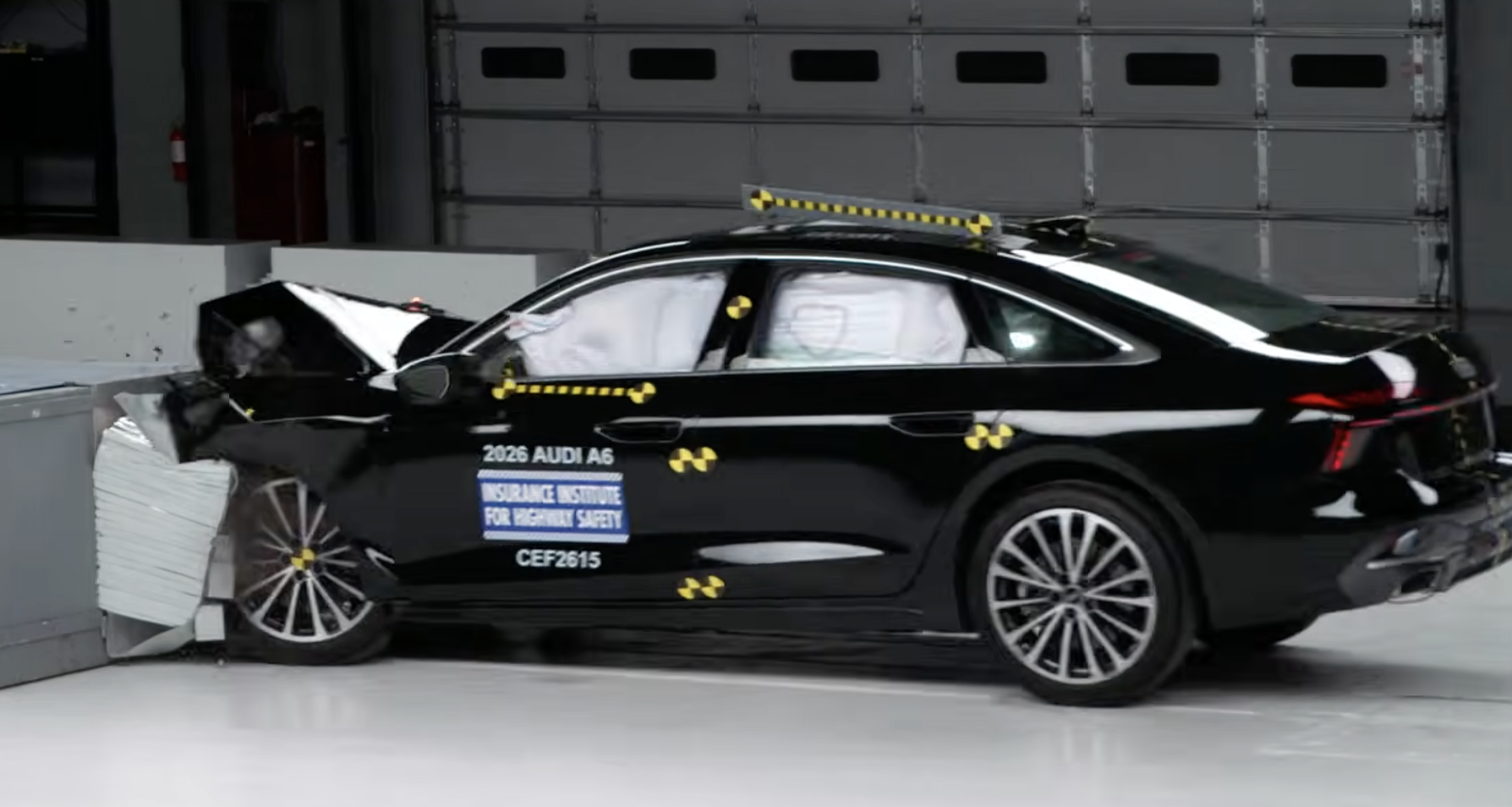
The ninth-generation A6 landed a Top Safety Pick+ from the Insurance Institute for Highway Safety on July 9, one of four 2026 models to clear the bar in a nine-vehicle batch. That’s the headline Audi’s PR department wants, and it’s earned. But the trophy is a pass/fail summary of a rating sheet with a lot more texture, and the full A6 file contains one result that ought to change how you spec the car.
Buy the cheapest A6 and you get good headlights. Spend more and you don’t.
The pay-more-see-less problem
IIHS rated two lighting variants. The base Premium trim runs plain LED projectors: overall rating good, with low beams throwing 124.7 meters down the right edge of the straightaway. Premium Plus and Prestige get Audi’s Matrix-design LED units — the ones with 48 individually controllable segments per side hidden behind a hexagon-perforated stainless-steel screen — and they rate only acceptable, with low-beam reach on that same straightaway right edge collapsing to 79.5 meters.
That’s a 45-meter deficit. At 60 mph you cover 45 meters in about 1.7 seconds. IIHS also flagged the upgraded lights as inadequate on the gradual left curve, where the cheap ones were rated good in all four curve tests.
Related Articles
- Waymo and Uber Are Breaking Up Again, and This Time It’s About Who Vacuums the Back Seat
- Philly Recovered 30 Stolen Hondas In A Month. The Arrest Count Is Still Zero, And That’s The Real Story
The base light isn’t perfect — it tripped the glare threshold by 5 percent on one curve, a penalty the expensive units avoided entirely. But the trade is lopsided: the Premium’s beam pattern buys a lot of distance for a little glare. Neither variant is curve-adaptive, which is worth knowing if you assumed the segmented digital hardware was steering light around corners. In the U.S. spec, it isn’t.
Mechanically, this is the predictable cost of styling ambition. A perforated decorative screen sitting in the light path and a housing packaged around 48 addressable DRL segments leave the actual low-beam projector working with less real estate and less clean aperture. You are paying for a light show and giving back road illumination.
The ownership math is worse than the rating suggests. A 48-segment matrix headlamp assembly is a control-module-bearing part, not a sealed bulb housing, and Prestige cars add second-generation digital OLED taillights with 198 segments per side. A parking-lot tap that would total a halogen lamp on a 2005 A6 now touches four-figure components that need coding after replacement. Insurers price that in through claim severity, which is exactly the kind of thing that shows up later in your renewal and never gets explained to you.
Where the crash data actually softened
Three sub-ratings came back acceptable rather than good, and the pattern is interesting.
Two are in the updated moderate overlap front test — the 40-mph, 40-percent-offset barrier hit that IIHS revised in 2022 to put a second dummy, sized as a small woman or 12-year-old, in the seat behind the driver. The A6’s rear occupant took acceptable marks for head/neck and for restraints and kinematics, with 2.1 kN of neck tension and 4.2 kN of shoulder belt tension. Its chest index came in at 34, and there was no recorded head contact during forward excursion.
Context matters here. IIHS built this test after finding that in newer vehicles, belted second-row occupants now face higher fatal-injury risk than those up front — not because back seats got worse, but because front seats got dramatically better with adaptive airbags and advanced belts that rarely migrate rearward. The Institute has been explicit that its belt-tension metric makes a good rating very difficult without rear pretensioners and force limiters. The A6 clearly has decent rear restraint hardware — it scored good overall — but the numbers say Audi is running closer to the ceiling back there than up front, where every driver measurement came back good.
The third acceptable is driver torso in the side test. That evaluation swings a 4,200-pound moving deformable barrier into the driver’s flank at 37 mph, and — a detail that gets garbled constantly — the driver dummy is a SID-IIs, the small-female/12-year-old size, not an average male. The A6 recorded 35 mm maximum rib deflection, a 4.44 m/s deflection rate and a viscous criterion of 0.98. Structure rated good, with the B-pillar stopping 23.5 cm short of the driver’s seat centerline.
For comparison, the 2026 BMW 5 Series kept its B-pillar 33.5 cm clear in the same test. The Audi holds together, but it lets the barrier get ten centimeters closer to the seat, and the thorax numbers reflect a smaller occupant taking more of the load than the airbag and door structure ideally allow.
Related Articles
- Waymo’s Robotaxis Are Racking Up Austin Parking Tickets Because Free Curb Space Beats a Real Garage
- A Rental Car Theft Ring Shipped Stolen SUVs to Ghana for a Year. The Weak Link Wasn’t the Car.
One more thing the rating sheet quietly reveals: the small overlap and side ratings were assigned by IIHS based on tests run by Volkswagen/Audi. The moderate overlap test carries no such note — it appears to have been run in Ruckersville. The three soft sub-scores are concentrated in the tests where the rear seat and a smaller-stature dummy are doing the talking.
What’s genuinely excellent
Active Front Assist is standard and it swept the vehicle-to-vehicle 2.0 evaluation: collision avoided in all six passenger-car runs and all six motorcycle runs, at 31, 37 and 43 mph, centered and offset. Detecting a motorcycle’s narrow radar and camera signature at 43 mph is a real engineering achievement, and it’s where the Cadillac CT5 in this same batch scored poor.
Pedestrian performance is equally strong, with avoidance in nearly every scenario and a 22-mph speed reduction in the one low-beam case it couldn’t fully avoid. Seat belt reminders rated good, which stands out because Audi has been shipping marginal and poor reminder systems across the lineup — the A3 sedan managed a poor in this same round. LATCH rated good, though only two of three rear positions have complete anchor hardware.
The segment picture
The A6’s real advantage isn’t its own sub-scores — it’s what the neighbors look like. The 2026 5 Series has no rating at all in the updated moderate overlap test and none in vehicle-to-vehicle 2.0, which mathematically excludes it from an award. The E-Class rates marginal in moderate overlap. IIHS classifies the A6 as a large luxury car, incidentally, even though Audi markets it as mid-size — a distinction that matters, because frontal-crash ratings are only comparable among vehicles of similar weight.
Practical takeaway for anyone shopping: the safest A6 on paper is the $64,100 Premium. If you want the Premium Plus or Prestige content, understand you’re accepting a lighting downgrade and more expensive front-end repairs to get it. Ask the dealer to show you the window sticker’s lighting line before you sign, and if you spend real time on unlit two-lane roads, weigh that 45 meters against a head-up display.
Images Via: IIHS on Youtube