
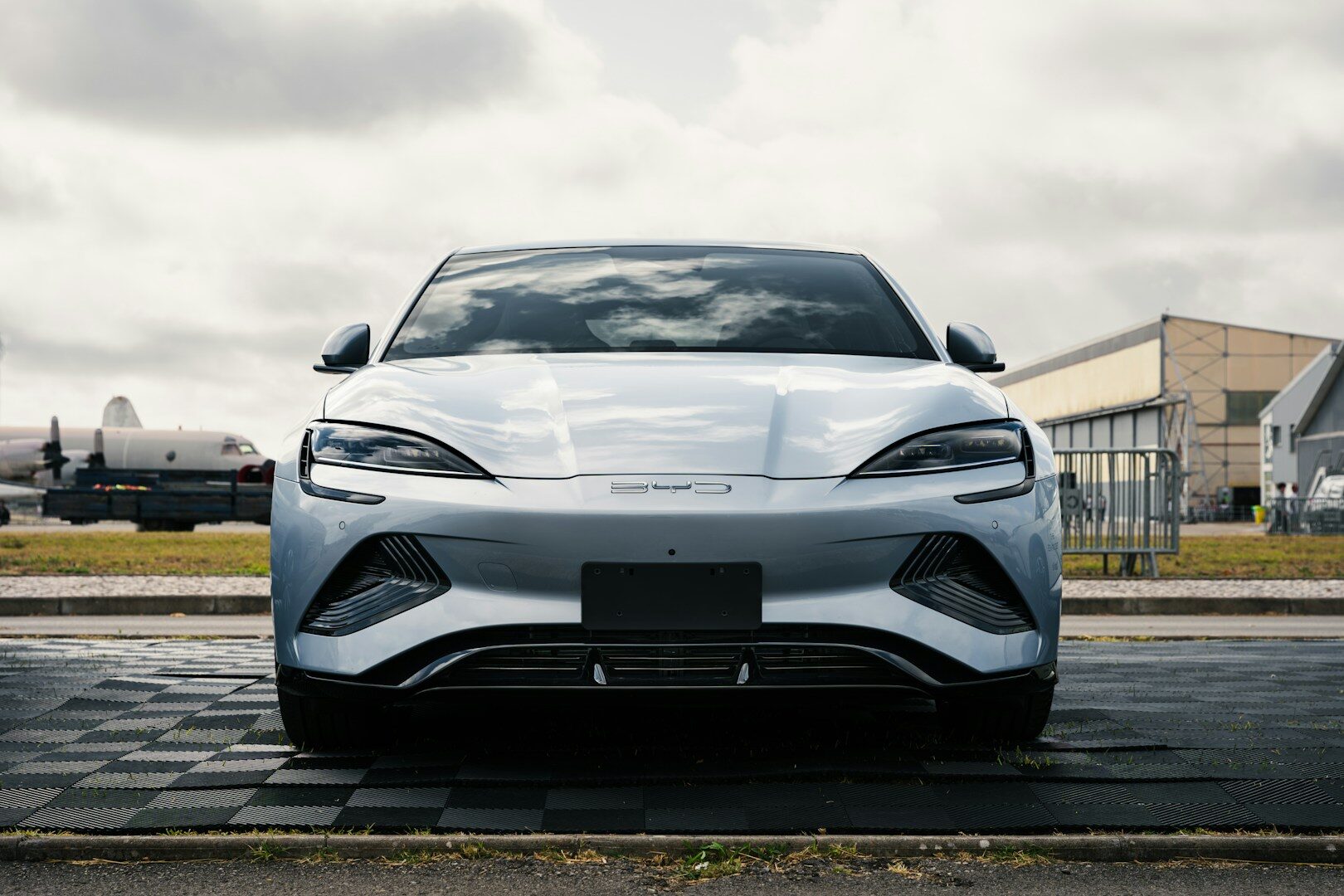
Melexis signing a purchase agreement with BYD is, on its face, the least exciting automotive story of the week. A Belgian chip designer and a Chinese carmaker put pen to paper. Nobody’s 0-60 time changed.
Stay with it, though, because the boring version of this story explains a lot about how your next EV gets built, who decides what’s inside it, and why a €0.50 part occasionally shuts down a factory.
What “direct supplier” actually means
Melexis announced on August 25 that it has signed a Master Purchase Agreement with BYD, moving it into BYD’s global procurement ecosystem as a direct supplier. Melexis frames this as formalizing a relationship that already existed, and its VP of China Strategy, Dieter Verstreken, calls it a natural evolution of a multi-year collaboration.
Here’s the part the release doesn’t spell out. Until now, Melexis chips almost certainly reached BYD vehicles the way most semiconductors reach most cars: indirectly. A Tier-1 supplier builds a motor control module, a battery junction box, a pedal assembly. That Tier-1 chooses and buys the chips inside it. The automaker buys the finished module and has, historically, only a vague idea what silicon is in the box.
Related Articles
- Right to Repair Just Won in Congress. Don’t Celebrate Yet.
- Hyundai May Push Its Georgia Factory to 800,000 Cars a Year — Here’s the Real Math
A direct supply agreement flips that. The carmaker specifies the chip, negotiates its own price, and takes responsibility for securing supply — then the Tier-1 builds around what the OEM has nominated. In procurement language this is a directed buy, and it became fashionable for a very specific reason: during the 2021–22 semiconductor crunch, automakers discovered they couldn’t see past their own Tier-1s. They were losing production lines over parts they had never ordered, from suppliers they had no contract with, and they had no standing to demand allocation.
The trade-off is real. The OEM gains visibility, pricing leverage and priority when supply gets tight. It also inherits inventory risk and a procurement headache measured in thousands of individual part numbers. That BYD thinks this is worth doing for sensor ICs tells you those parts have become strategically important rather than incidental.
What Melexis actually puts in cars
This isn’t a company that makes infotainment processors. Melexis builds analog and mixed-signal sensing and driver chips: current sensor ICs, magnetic and inductive position sensors, temperature and pressure sensors, LED drivers, fan and pump drivers, pre-drivers, transceivers. The BYD agreement covers powertrain, thermal management, lighting, braking, steering and battery applications, plus industrial and robotics parts.
Take the traction motor. To run a permanent-magnet motor efficiently, the inverter needs to know exactly where the rotor is, thousands of times per second. Traditionally that’s a wound resolver or a Hall-effect sensor. The problem in an EV is that you’re trying to make a magnetic measurement while sitting inches from 400-amp busbars and switching inverters that throw enormous stray magnetic fields. A Hall sensor in that environment can be lied to.
That’s why Melexis pushes inductive position sensing, which uses coupled coils rather than magnets and is inherently immune to stray fields. The company’s MLX90510 resolver is rated to 240,000 electrical rpm — a number that only makes sense once you realize modern EV motors spin past 20,000 mechanical rpm and multiply by pole pairs.
The MLX90513 pedal-and-steering sensor is specified at ±0.1 percent full-scale accuracy and ASIL C compliance. That last bit matters more than the accuracy figure. ASIL is the risk-classification scale in ISO 26262, running A through D, and a component’s rating determines how much redundancy and diagnostic coverage the whole system needs around it. Buying an ASIL C sensor rather than an unrated one is the difference between a brake-by-wire system that can be certified and one that can’t.
And the newer MLX90514 reads two sets of coils simultaneously so a single chip can report steering angle and torque at once — exactly what steer-by-wire needs, and exactly the kind of part that’s suddenly in demand as by-wire chassis systems move from concept to showroom.
Why the most vertically integrated carmaker on earth still buys chips
BYD is famous for making everything itself. It builds its own cells, its own motors, and through BYD Semiconductor, its own power devices — IGBTs and silicon carbide switches. So why buy sensors from Belgium?
Because power semiconductors and mixed-signal sensor ICs are barely the same industry. A power device fab optimizes for handling hundreds of amps and hundreds of volts without melting. A sensor IC is a precision analog design problem: you’re measuring microvolts of signal in an electrically filthy environment, then compensating for temperature drift, package stress and manufacturing variation with on-chip trimming. The intellectual property is in decades of characterization data, not in the process node.
Vertical integration has limits, and this is one of them. It’s the same reason automakers that cast their own engine blocks still buy oxygen sensors.
What it means if you own or service one of these things
Practically, the sensor content in a modern EV is a mixed blessing.
The good news: contactless sensing has killed off a whole category of failure. The old throttle position sensor was a potentiometer with a physical wiper dragging across a resistive track, and it wore out. Magnetic and inductive sensors have nothing touching anything. Intermittent pedal faults from worn contacts are largely a legacy problem now.
The less good news: none of these parts are serviceable. A chip soldered inside a sealed module means you replace the module, and modules are priced like modules. Add to that the count — an EV has vastly more electric pumps, valves, actuators and thermal sensors than a combustion car, because heat pumps, battery conditioning loops and cabin climate all need independent control. Every one of those is a node that can throw a code.
For anyone worried about their range readout: current sensor accuracy is the reason your state-of-charge number is trustworthy or isn’t. Battery management systems estimate remaining capacity partly by coulomb counting — integrating current in and out over time. Small measurement errors compound. If a car’s range estimate wanders, the sensing chain is a likely culprit.
Related Articles
- Why New Car Prices Climbed to $49,855 — It Wasn’t Really the Sticker
- Mazda Patented a Fix for the Rotary Engine’s Dirtiest Secret. The RX-7 Crowd Should Pump the Brakes
On the insurance side, none of this helps. Higher electronic content per vehicle means higher parts cost per collision, and safety-rated sensing in brake and steering assemblies generally means replacement rather than repair after any impact that touches those systems. That’s part of why EV repair severity keeps climbing even when the crash damage looks modest.
The scale, and the politics
Worth keeping perspective on who signed this. Melexis posted Q1 2026 sales of €202.1 million and employs around 2,000 people across 12 countries, having been founded in Belgium in 1989. Its second quarter came in at €217.3 million. That’s a specialist, not a titan — a company that has grown by owning niches the giants find too small.
There’s also an uncomfortable subtext nobody in the release is going to acknowledge. This is a European semiconductor firm deepening direct commercial ties with a Chinese automaker at exactly the moment Europe is arguing with itself about Chinese EV imports. The chips will go into vehicles, some of which will be sold back into Europe. Both facts are true at once, and both are the ordinary condition of the modern car business.
The takeaway for buyers is small but real: when a Chinese-built EV lands in a Western market carrying European sensor silicon under a direct supply contract, the long-term parts and support picture is a bit steadier than it would be with an opaque all-domestic bill of materials. It’s not a reason to buy anything. It is a reason to stop assuming you know where a car comes from based on the badge.