
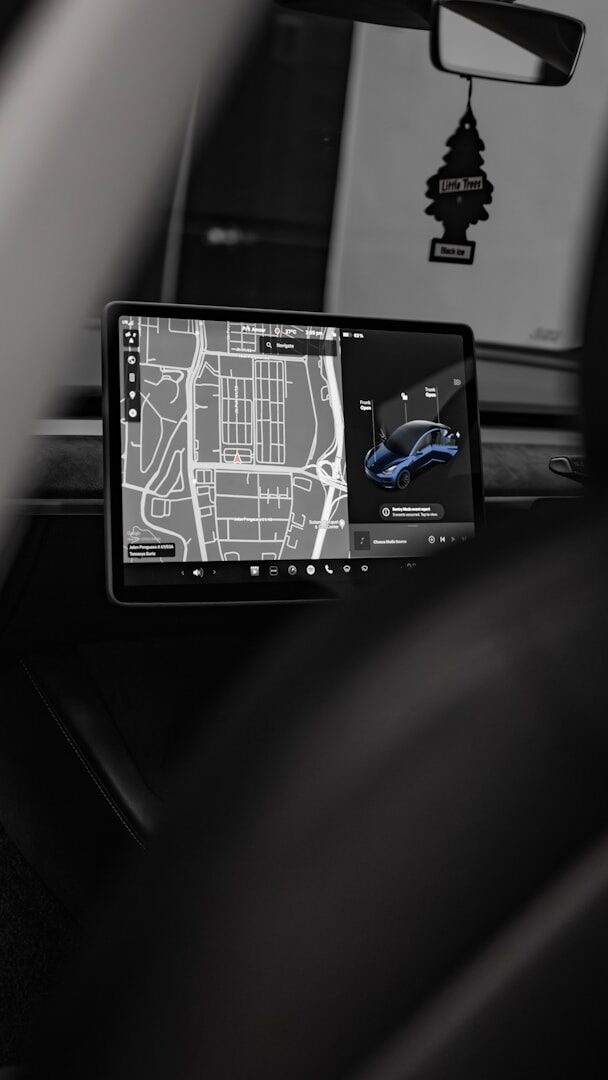
Tesla’s Summer Update did something the company has been circling for a year: it let Grok touch the car. Tesla’s release notes for 2026.26 put it plainly, saying the assistant can now make phone calls, play music, adjust climate, and search the Controls panel. Tesla’s support page goes a bit further, listing navigation, calls, music search, temperature, and opening the glove box, and noting Grok remains in Beta.
That’s a real upgrade over a chatbot that could book a destination and tell you a joke. It is not, however, an AI with its hands on your car. Worth understanding the difference, because the constraints on this thing are more interesting than the feature list.
Your car’s voice assistant has a usage cap
Start with the strangest detail, one Tesla states on its own Grok support page: Grok in the car is rate-limited. If you’re signed into a Grok account, your in-car usage counts against that account’s limits. If you’re not signed in, usage is capped and the car will eventually tell you to sign in to keep going.
Sit with that. The interface you use to set cabin temperature can run out. No prior automotive voice system worked this way, because no prior system was a third-party LLM billed by consumption. Tesla also says limits may change over time, which means the amount of talking your car will tolerate is a business decision someone else can revise.
Related Articles
- An Iowa Dealer Allegedly Financed the Same Cars Twice — Stellantis Just Won $5.5 Million By Default
- GM’s Wireless Update Failed So Badly, Dealers Now Have to Fix These 7 SUVs By Hand Before Selling Them
That’s a genuinely new category of ownership dependency. Your seat heater doesn’t expire. Your voice shortcut to it might.
Nothing works without a data pipe
Grok requires Premium Connectivity or a stable Wi-Fi connection, per Tesla’s own requirements. There is no on-device fallback. The audio leaves the car, gets processed by SpaceXAI — the entity xAI became after SpaceX absorbed it, and the name Tesla now uses in its own documentation — and the response comes back.
The practical consequence: every place your LTE dies, Grok dies. Mountain passes, deep parking structures, rural stretches of the Mountain West, the tunnel you take every day. In those spots you fall back to Tesla’s legacy voice commands, which are local, rigid, and unchanged by this update.
So the honest description of what happened is that Tesla added a cloud convenience layer on top of the existing control stack, not a replacement for it. Legacy commands still exist precisely because the new ones can’t be trusted to be there.
What “hardware control” actually means
The glovebox is the interesting item on that list, because it’s the only true actuator. Everything else — climate setpoints, media, phone calls, settings search — is software already sitting behind the touchscreen. Grok isn’t reaching onto the vehicle bus. It’s parsing your sentence into an intent and handing that intent to the same subsystems the UI has always called.
That architecture matters for how you should think about failure. When a voice request doesn’t happen, there are now three distinct places it can break: speech recognition, intent parsing in the cloud, or command execution in the car. Two of those live outside your vehicle and leave no trace a technician can pull. Tesla’s diagnostic tooling can show you what the car did. It can’t show you what a remote model thought you meant.
If you’re the kind of owner who logs faults, that’s a real change to how you document a complaint. “It didn’t turn the heat on” is now potentially a connectivity issue, a model issue, or a car issue.
The hardware line in the sand
Grok requires an AMD-based infotainment processor and software 2025.26 or later. Tesla says availability may expand via over-the-air updates, and also that it’s subject to change or end at any time.
Read that as written. Intel-MCU cars — a large slice of Model S, 3, X, and Y from roughly 2018 through early 2023 — are not getting this by software. Silicon is not a firmware problem. Tesla built its whole brand on the promise that your car improves after you buy it, and this is one of the clearest examples yet of that promise hitting a physical ceiling.
For used buyers, the infotainment processor is now a spec worth checking before you sign. It lives under Controls > Software > Additional Vehicle Information. Two otherwise identical Model 3s can differ here, and the gap between them widens with every update.
The regulatory part nobody mentions
Here’s what makes the safety conversation odd. NHTSA’s driver distraction guidelines, finalized in April 2013, cover visual-manual interfaces in original-equipment devices. They’re explicitly nonbinding and voluntary. NHTSA laid out a three-phase plan back then; Phase 3 was supposed to extend the guidelines to auditory-vocal interfaces. It was never issued.
Which means an LLM that operates cabin systems by conversation sits in a federal blank space. There’s no standard, not even a voluntary one, defining how demanding a voice interaction in a car may be.
And “hands-free” has never meant “attention-free.” Research funded by the AAA Foundation and conducted at the University of Utah found that unsafe levels of mental distraction persisted for as long as 27 seconds after a driver finished a voice task on the worst systems tested, and at least 15 seconds on the best. At 25 mph, 27 seconds is roughly three football fields of impaired attention after you stop talking.
Related Articles
- Honda and Nissan’s Merger Collapsed — So They’re Quietly Merging Their Computers Instead
- Hyundai’s American-Built Global Pickup Has One Big Problem: Nobody Knows Where It’s Actually Being Built
That study looked at rigid command systems. A conversational assistant that invites follow-up questions, holds context, and has a personality setting called Unhinged is not obviously less demanding. It might be less frustrating, which lowers workload, or it might keep you talking longer, which raises it. Nobody has published the answer.
What’s coming, and what to do about it
Musk set expectations for the next step on X in June, responding to an owner who wanted to direct the car the way you’d direct a rideshare driver. His reply: “This functionality will be there in about 3 months or so.” That points at fall 2026 for voice input reaching Full Self-Driving’s planning layer — the first time speech would influence how the car actually drives rather than what it plays.
Until then, the sensible owner posture is straightforward. Verify your infotainment processor before buying used. Understand that Premium Connectivity is now load-bearing for a feature set Tesla markets as standard equipment. Learn the legacy voice commands anyway, because they’re the ones that work in a dead zone. And check your Grok privacy settings — Tesla says conversations are anonymous to it and that your contacts stay in the car rather than going to SpaceXAI, but location features require you to opt into precise location sharing.
Grok controlling your Tesla is a good headline. Grok asking you to sign in before it will turn on your seat heater is the part you’ll actually remember.