
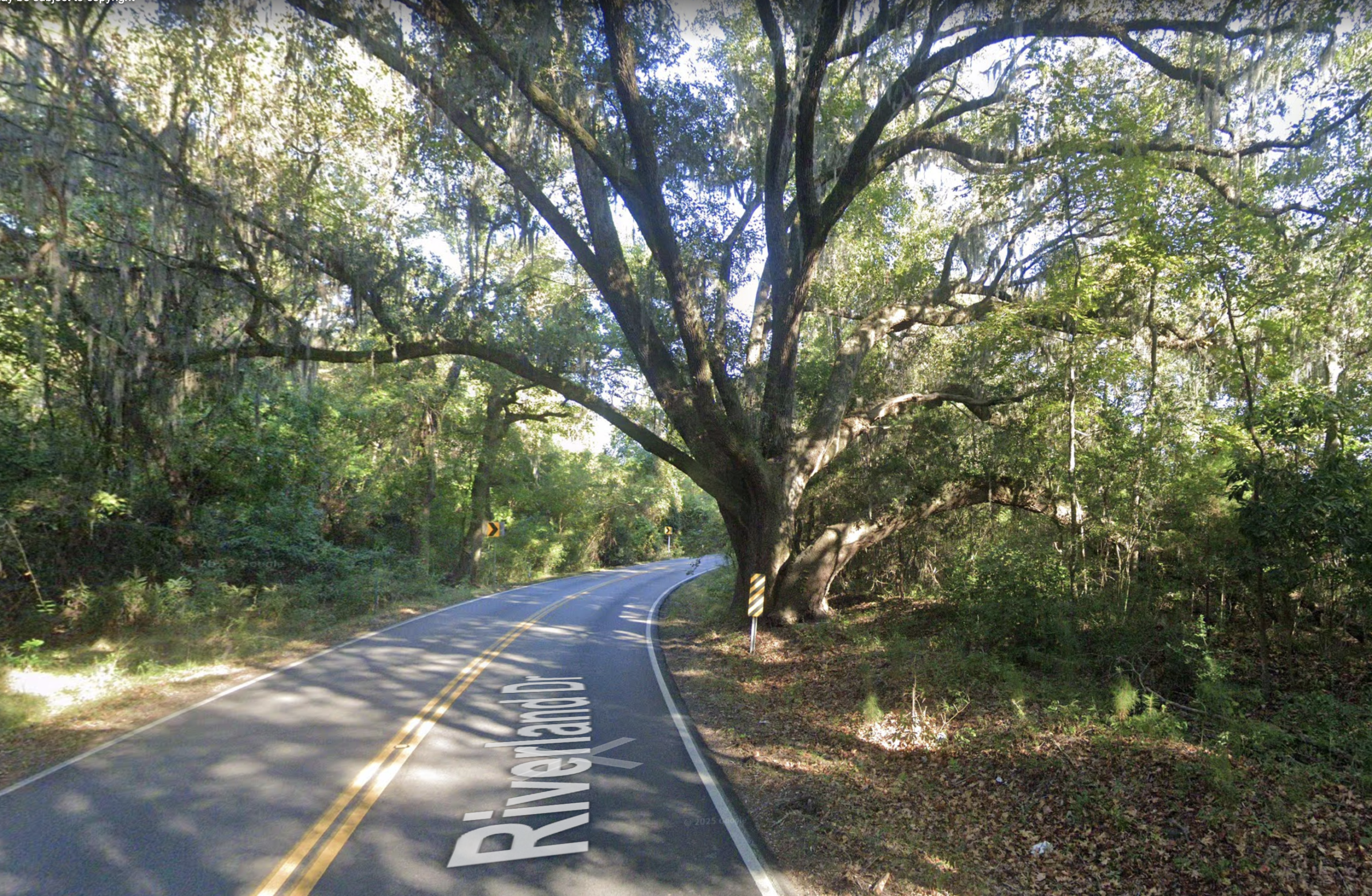
Long before the early morning of November 18, 2023, people on James Island, South Carolina had already given a stretch of Riverland Drive two separate nicknames. The tight bend leading up to a massive grand oak was known locally as “dead man’s curve.” The tree itself had been called “the Widowmaker” for years, tied to a documented history of wrecks that predated the crash that eventually made it famous nationwide.
Just before 1:30 a.m. that morning, a 2010 Cadillac SRX carrying five friends home from a birthday celebration left the roadway on that curve. According to The Post and Courier, the SUV had been traveling as fast as 95 mph in a posted 40 mph zone before the driver, Brittney Roper, then 26, braked hard enough to slow to somewhere between 79 and 88 mph at impact. It wasn’t enough. None of the four passengers were wearing seatbelts. Earl Hamilton Jr., 29; his brother James Hamilton, 27; Tyler Barron, 29; and Mitchell Watson, 26, all died. Roper survived, tearing a carotid artery and requiring leg surgery. A toxicology test later showed a blood alcohol concentration of 0.09% and the presence of THC. She was charged with four counts of reckless homicide and four counts of felony DUI resulting in death, and was granted bond in mid-2024 on the condition she wear an alcohol-monitoring ankle bracelet.
That’s the tragedy, and it is still working its way through a South Carolina courtroom. It is not, by itself, much of an automotive story. What makes this worth a closer look is what happened next, because it says more about how this country actually handles known road hazards than any single crash report could.
Two of the victims’ families, the estates of Earl and James Hamilton, sued the City of Charleston and the South Carolina Department of Transportation, arguing both agencies knew Riverland Drive’s oak tree was dangerous and failed to do anything about it. In June 2026, the lawsuit ended in a settlement. According to Live 5 News, the two estates will split between $70,000 and $82,000, paid by the city and SCDOT. Both agencies deny liability, and the case remains subject to appeal.
Sit with that figure for a second: $70,000 to $82,000, combined, for two deaths, from two government bodies accused of ignoring a documented, named hazard for years. That isn’t evidence of a weak case. It’s closer to the ceiling.
South Carolina’s Tort Claims Act caps what any state or local government entity can be forced to pay over a single incident, no matter how many people die or how clearly negligent the agency turns out to be. Under Section 15-78-120 of the state code, damages are limited to $300,000 per person and $600,000 total for a single occurrence, regardless of how many agencies were involved. Four people died in one crash on one night. Even a full liability verdict against the city and SCDOT for all four deaths could not have exceeded $600,000 combined, before accounting for how much fault a court assigns to a driver going more than double the speed limit while impaired. State lawmakers have had a bill sitting in committee since 2023 to raise those caps to $500,000 per person and $1 million per occurrence. It still hasn’t passed. When a legislature’s own proposed fix is to make government negligence more expensive, that’s a fairly direct admission of how cheap it currently is.
None of that is really about this specific tree. It’s about the fact that a wrongful death claim against a government agency in South Carolina was never built to make a family whole. It’s built to put a finding on the record, because the payout was capped before the lawsuit was ever filed.
The second thing this case reveals has nothing to do with dollars. It’s about how much the federal government already knows about roadside trees, and how little that knowledge changes on the ground.
The Federal Highway Administration has been warning about this exact scenario for at least two decades. Per FHWA safety guidance, trees are the single most commonly struck objects in serious roadside crashes nationwide, and vehicle collisions with trees kill more than 4,000 people and injure over 100,000 more every year in the United States. The agency’s recommended fix is what engineers call clear zone management: keep fixed objects like trees a safe distance from the travel lane, or shield the ones that can’t be moved with guardrail. It’s the same forgiving-roadside logic behind breakaway signposts and crash cushions, the idea that leaving the road shouldn’t automatically mean someone dies if the roadside is designed to absorb the mistake instead of punishing it.
FHWA’s own materials also flag exactly why that fix so rarely happens in practice, noting that efforts to remove hazardous trees are often met with strenuous local objections. That’s precisely what unfolded on James Island. Even as neighbors circulated petitions and packed council meetings demanding the Widowmaker come down, other residents worried about losing a piece of the neighborhood’s identity, the same tension FHWA has documented nationally for more than twenty years, playing out on one residential street.
None of this excuses what Roper is accused of. Ninety-five miles an hour in a 40 mph zone, with a blood alcohol content over the legal limit and THC in her system, is reckless by any reasonable definition, and the criminal case against her exists because her decisions were the immediate cause of four deaths. But a driver’s recklessness and a government’s negligence aren’t mutually exclusive findings. A road authority can know about a named, documented hazard, do nothing about it for years, and still watch a drunk, speeding driver absorb almost all of the public blame, while paying out a fraction of what four lives were worth under a formula state lawmakers wrote decades ago and haven’t gotten around to updating.
This publication has run into that same gap between individual punishment and systemic fixes before, whether it’s Florida only recently starting to treat triple-digit speeding on public roads like the serious offense it is, or the loophole that lets drivers with suspended licenses keep driving with little real deterrent. Meanwhile, most driver’s education programs still spend more classroom hours on parallel parking than on recognizing the kind of hazard that had a nickname for years before it ever killed anyone. The pattern holds here too: it’s much easier to prosecute the person behind the wheel after a tragedy than to fix the thing sitting next to the road that made the tragedy so lethal in the first place.
The Widowmaker tree earned its name honestly, one collision at a time, long before Brittney Roper ever got behind the wheel that night. The real story isn’t the tree, or even the settlement. It’s that an entire community can repeat a warning out loud for years, and the law still won’t treat that warning as knowledge until it’s written into a police report.