
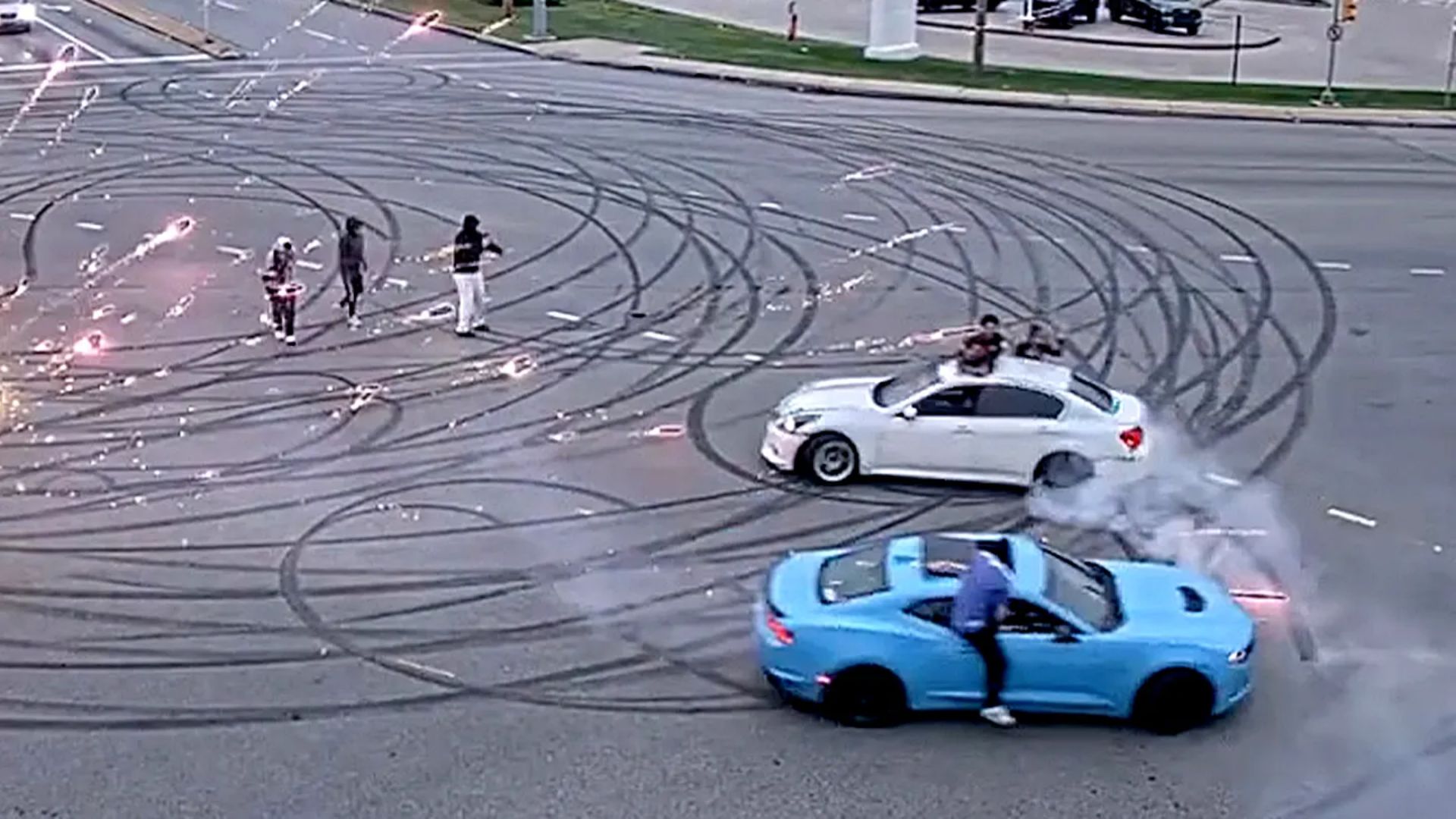
More than 80 people — 80 adults and an unspecified number of juveniles — were arrested outside Greenville, South Carolina, over the weekend after a crowd swarmed a stoplight intersection to watch a car spin donuts inside a human circle. That’s the headline every outlet is running with. It’s the wrong one.
The real story is what almost none of those 80-plus people were actually doing. Most weren’t driving. Most weren’t organizing anything. They were standing in a circle, filming a stranger’s car on their phones. Under a South Carolina law that isn’t even four months old, that’s enough. Standing in the circle now carries real legal exposure — and depending on whose car got someone there, it can cost that person a vehicle they never drove that night.
According to the Greenville County Sheriff’s Office, the takeover happened just before midnight on September 5th at the intersection of Locust Hill Road and Fairview Road — a stoplight near a church, a daycare, and a cemetery, not an abandoned industrial lot. The sheriff’s office shared video of the scene: a white car doing donuts inside a ring of spectators, smoke pouring off the tires, at least one person standing in the center of the circle as the car spun around them. By the time deputies finished processing the scene, they had made more than 80 arrests, impounded 38 vehicles, and recovered 10 firearms.
Ten guns is the detail worth sitting with. A street takeover used to get described, generously, as a car meet that got out of hand — tire smoke, bad decisions, a bored crowd. Add ten firearms to that crowd and it stops being a car culture story and becomes a public safety story that happens to involve cars.
Every one of those 80-plus people was charged with the exact same offense: aiding and abetting a street takeover, a crime that didn’t exist in South Carolina until this spring. The governor signed the Roadway Protection and Safety Act into law on May 15th. The vote to get it there wasn’t close — 109-1 in the House, 46-0 in the Senate — which tells you how little patience is left, across the political spectrum, for exactly this kind of chaos.
Here’s the part that should surprise you. The law creates three tiers of offender — participant, organizer, and aider or abettor — and grades the punishment accordingly. A driver caught doing donuts faces up to a year in jail and a $500 fine on a first offense. An organizer faces the same. An aider or abettor — the legal bucket that swallowed essentially the entire crowd in Greenville — faces a maximum of 30 days and a $100 fine. Deputies didn’t round up 80 street racers. They rounded up 80 people who, under the letter of the law, are barely more culpable than jaywalkers.
The fines are almost beside the point. The real leverage in this law isn’t jail time — it’s the car. Every vehicle used by a participant, organizer, or aider and abettor gets seized on the spot. Owners get ten days’ notice and thirty days to pay towing and storage fees before title transfers permanently to the seizing agency, which can add the car to its own fleet or sell it and, as the statute puts it, “fund law enforcement activities” with the proceeds. The Auto Wire has covered this asset-forfeiture mechanic before, but rarely has it been aimed at spectators on a sidewalk rather than defendants in a federal fraud case.
That detail matters more than it sounds like it should for anyone who has ever loaned a car to a kid, a sibling, or a friend. Comprehensive and collision insurance policies routinely exclude coverage for vehicles seized or damaged during illegal activity, and a forfeiture-driven title transfer isn’t something an insurer is going to make whole. If the car is financed, the lender gets notified too — but the bank still has to pay the towing bill to get its own collateral back. Nobody in that chain has to have been driving. They just have to own the car that showed up.
South Carolina isn’t acting alone. Cities and states have spent this entire summer trying to legislate street takeovers out of existence, and Florida prosecutors are testing how far spectator liability can stretch after two BMW street racers killed a grandmother earlier this year, with passengers and onlookers who filmed the race facing scrutiny alongside the drivers. The pattern is the same everywhere: lawmakers have decided the easiest way to end the spectacle is to make everyone standing around it part of the crime.
None of that makes the physics of the Greenville takeover any less dangerous, or the ten recovered guns any less alarming. But the number worth remembering isn’t 80. It’s 38 — the vehicles now sitting in a South Carolina impound lot, thirty days from becoming county property, some of them owned by people who never touched a gas pedal that night. You didn’t have to grab a wheel to lose a car in Greenville County this weekend. You just had to show up to watch someone else grab one.