
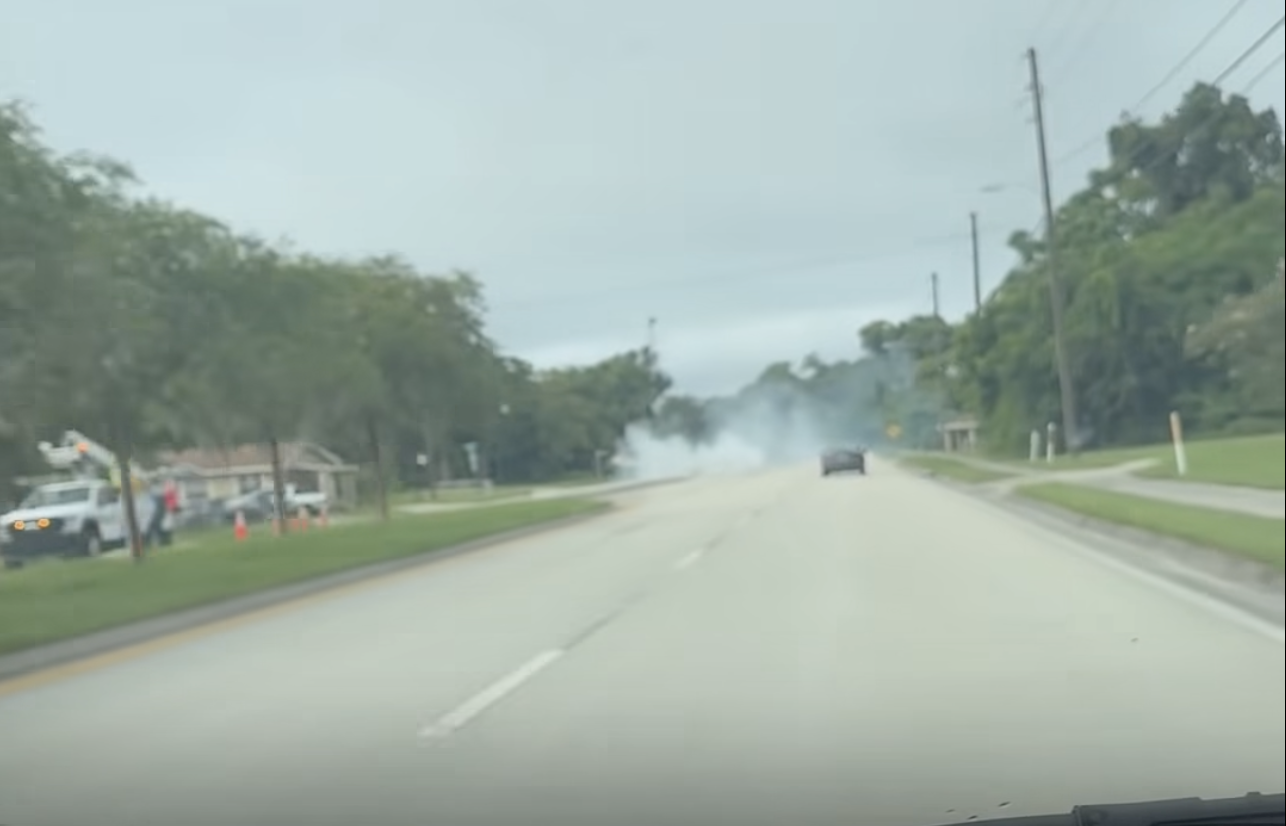
Nobody in that Longwood, Florida intersection actually saw the crash coming. That’s the part everyone keeps skipping past.
A witness who filmed the moment described it like weather rolling in. “It was like a cloud had dropped down from the sky in the road,” Krista Bridges told FOX 35 Orlando. She wasn’t talking about fog. She was describing burnt rubber, boiled off two spinning tires until it filled an entire four-way intersection.
That’s the detail buried under the headline everyone already knows. On September 7, Florida Highway Patrol says a 20-year-old driver named Malakih Battle was spinning his Chevrolet Corvette in donuts at a Longwood intersection when a Honda Civic entered the smoke, collided with him, then veered off the road and through the front pillar of a house. A 6-year-old boy was sitting on a couch a few feet from the impact. He wasn’t hurt. Troopers cited Battle for reckless driving and moved on to the next call.
Treat this as a story about one reckless driver and the real story slips right past. A stunt that doesn’t require much real speed just generated real, six-figure consequences, and Florida’s insurance rules were never built to handle it.
Start with what a donut actually does to a driver’s eyes, including the one doing it. Holding a car in a sustained spin means feeding in enough throttle to keep the rear tires overpowering the front’s grip, so those rear tires are spinning far faster than the car is actually traveling. That mismatch is what turns rubber into smoke. It’s the same basic principle behind the deliberate suspension tricks some drivers use to break rear grip on purpose. A donut isn’t really a loss of control. It’s a controlled maneuver that manufactures a whiteout as a side effect, inside whatever intersection the driver happens to be occupying.
That whiteout is the actual mechanism of this crash. The Corvette never hit the house. A car that couldn’t see through a self-made smoke cloud, driven by someone who couldn’t see through it either, collided with a car that had every reason to expect a clear intersection. The donut didn’t just risk the driver spinning it. It blinded everyone unlucky enough to share the road with him at that exact moment.
Here’s the part that should bother car owners more than the video. Florida’s minimum insurance requirements were never built for this kind of damage, and most drivers have no idea how thin that coverage really is. Every vehicle registered in the state needs just $10,000 in Personal Injury Protection and $10,000 in Property Damage Liability coverage, full stop, according to the Florida Department of Highway Safety and Motor Vehicles. There’s no mandatory bodily injury liability for an ordinary passenger car. That $10,000 property damage figure is supposed to cover whatever you wreck that belongs to someone else. It was a reasonable number when lawmakers set it, back when the typical claim was a crumpled bumper, not a hole in a wall.
It is not a reasonable number for replacing a structural porch pillar, a section of brick facade, and the framing behind it, and that’s before anyone even tallies the Civic. The homeowner’s own insurer will likely front that repair under her dwelling coverage, then chase Battle’s policy to recover it. If he’s carrying only the state floor, that $10,000 has to stretch across a house and a car, and whatever it doesn’t cover becomes personal debt owed by a 20-year-old who now also has a reckless driving charge on his record. His own Corvette isn’t touched by that mandatory coverage at all. Property damage liability only pays for other people’s property. Fixing his own car is a separate, optional coverage, and insurers routinely dig into whether a crash tied to an intentional stunt even qualifies for a payout.
Widen the lens and this stops looking like an isolated Florida story. The Auto Wire recently covered a Corvette driver who ran from Arkansas troopers at 156 mph before crashing, and just three days before Longwood, a stolen Corvette spun donuts for a crowd of roughly a hundred people in Pennsylvania before its driver abandoned it on I-80. None of those stories are really about horsepower. They’re about a pattern: low-cost, camera-ready stunts that create financial exposure wildly disproportionate to how “fast” they look on video. A donut in an intersection reads as harmless compared to a three-digit highway chase. The insurance math, and increasingly the state-by-state driving laws that govern reckless driving charges, don’t see it that way.
There’s also a tracking gap worth knowing about. Groups like the Storefront Safety Council obsessively count vehicle-into-building crashes involving retail stores and other commercial structures, logging more than 100 a day nationwide by that group’s estimate. Nobody tracks residential strikes with anything close to that rigor. The Longwood homeowner said this was the third vehicle to end up on her property this year, and the first to actually hit her house. That’s not a statistic anyone compiles. It just becomes a headline the next time a witness happens to be filming.
The Corvette’s speedometer never mattered here. The smoke did. And the bill for that smoke is about to land on people who were never anywhere near a steering wheel.